Quiet Beaches, Traffic, Canceled Flights: How Hawaiʻi Prepared For Tsunami
Traffic was gridlocked and sirens blared every hour after a tsunami was generated by a massive earthquake off Russia.
This story has been updated with the tsunami warning downgraded to an advisory.
Sirens blared across coastal areas of Hawaiʻi, cars jammed island roads and businesses closed early Tuesday as the state issued a tsunami warning following a magnitude-8.8 earthquake off the eastern coast of Russia.
And all across the Hawaiian Islands, people kicked into gear to get ready.
The Pacific Tsunami Warning Center warned that a tsunami had been generated and the first waves could hit Hawaiian shores Tuesday evening, with the potential to cause damage along the coastlines of all islands. Coastal residents were urged to move inland and to higher ground.
Waves of about 3 to 10 feet above tide level were possible along some coastal areas of Hawaiʻi, Chile, Japan and the Solomon Islands, it said, advising that “urgent action should be taken to protect lives and property.”
Some flights to and from Hawaiʻi were canceled or delayed as sirens in Honolulu sounded every hour with cellphone alerts acting as a countdown to the expected 7:15 p.m. hit. As that time came and went, flooding was reported on parking lots and some other coastal areas. No major damage was immediately reported, but officials noted the situation would be clearer in the morning.
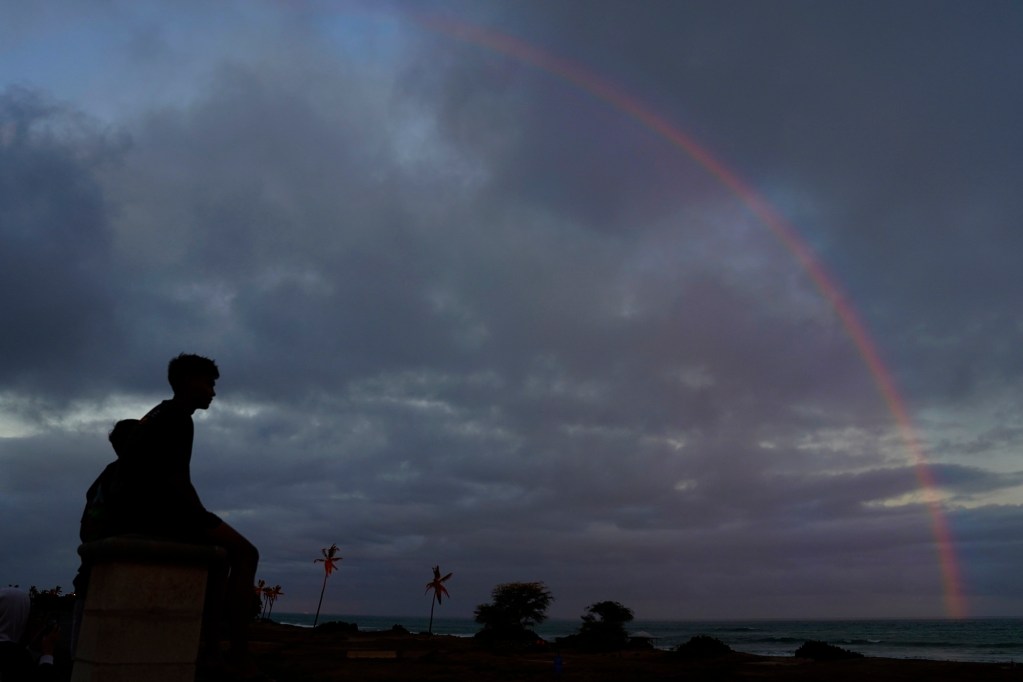
“So far, at the moment, so good,” Gov. Josh Green said at a press conference shortly after 8 p.m., but he and other authorities stressed that the all-clear had not yet been sounded and urged people to stay out of evacuation areas until scientists are confident the danger has passed.
Chip McCreery, the director of the Pacific Tsunami Warning Center, told reporters after 10 p.m. that the worst threat appeared to have passed. The tsunami warning was downgraded to an advisory just before 11 p.m.
Effects of the tsunami on Hawaiʻi
The largest waves were recorded at Kahului on Maui, which reached about 11 feet from crest to trough, Hilo on the Big Island, Hanalei on Kauaʻi and Haleʻiwa on Oʻahu’s North Shore.
“Based on that data I feel confident that at least we’re past the worst part of it,” McCreery said.
The highest wave “amplitude” figures — the increase in height above normal sea level — were 5.7 feet in Kahului, 4.9 feet in Hilo on the Big Island, 4.0 feet in Haleʻiwa on Oʻahu and 3.0 in Hanalei on Kauaʻi, according to the center.
Green earlier had said the state was coordinating with all levels of government and Hawaiʻi’s congressional delegation. Hospitals had activated extra shifts in case of mass casualties, he said, adding that he expected traffic to abate in time for everyone to evacuate.
“You need to expect that there will be flooding on all the islands, and it will be imminent after the wave hits,” Green said. “If you stay on beaches, you could risk death.”
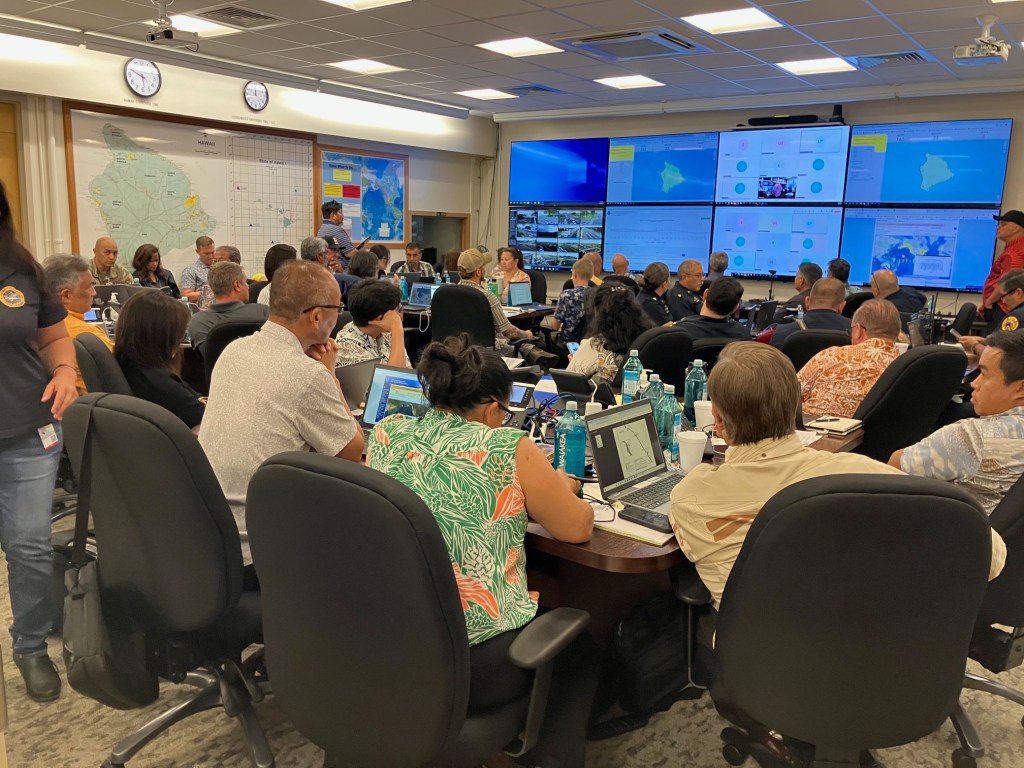
Each county’s Emergency Operations Center had members of the Hawaiʻi National Guard positioned to anticipate county needs in real time, the adjutant general Maj. Gen. Stephen Logan said at a joint press conference.
Two medevac helicopters were activated with search and rescue capability that included infrared sensors to look for heat signatures, he said. Ground vehicles that can travel through high water were also standing by in each county.
Large transport aircraft were ready to be deployed between the islands as necessary, though some would require approval from U.S. Indo-Pacific Command Admiral Samuel Paparo.
Green warned that there could be loss of power and low or no water pressure.
Evacuation centers were quickly established across the islands, too, in high schools, colleges, libraries and community centers. Later in the day, The Queen’s Medical Center in downtown Honolulu limited access to visitors, although the emergency department remained open, an operator said.
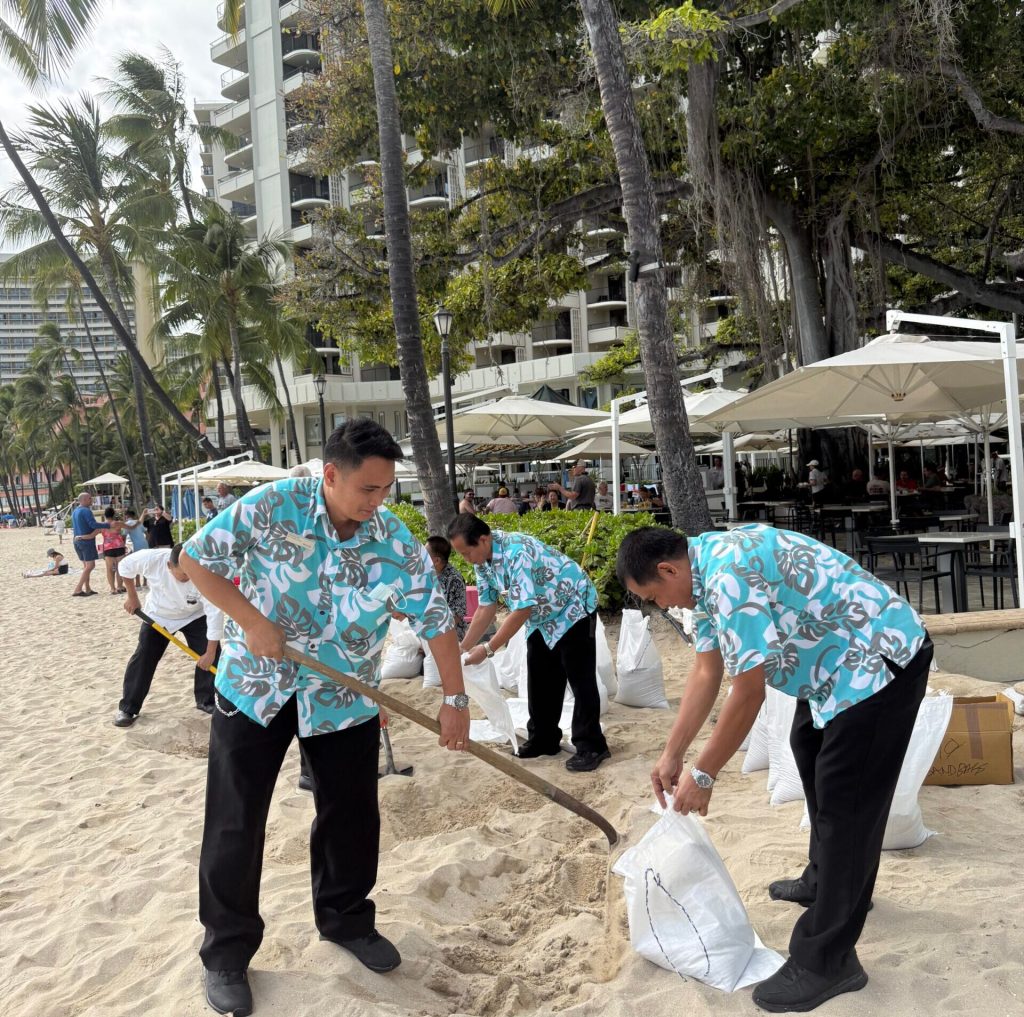
In Waikīkī, the beaches were empty, with normally coveted beach chairs vacant, usually open umbrellas furled. There, too, preparations were underway: At the Moana Surfrider, Executive Chef Jason Watanabe joined other workers to fill sandbags in case of flooding.
Traffic hit Hawaiʻi hard
The warnings and evacuations led to one predictable but unfortunate side effect: Gridlock.
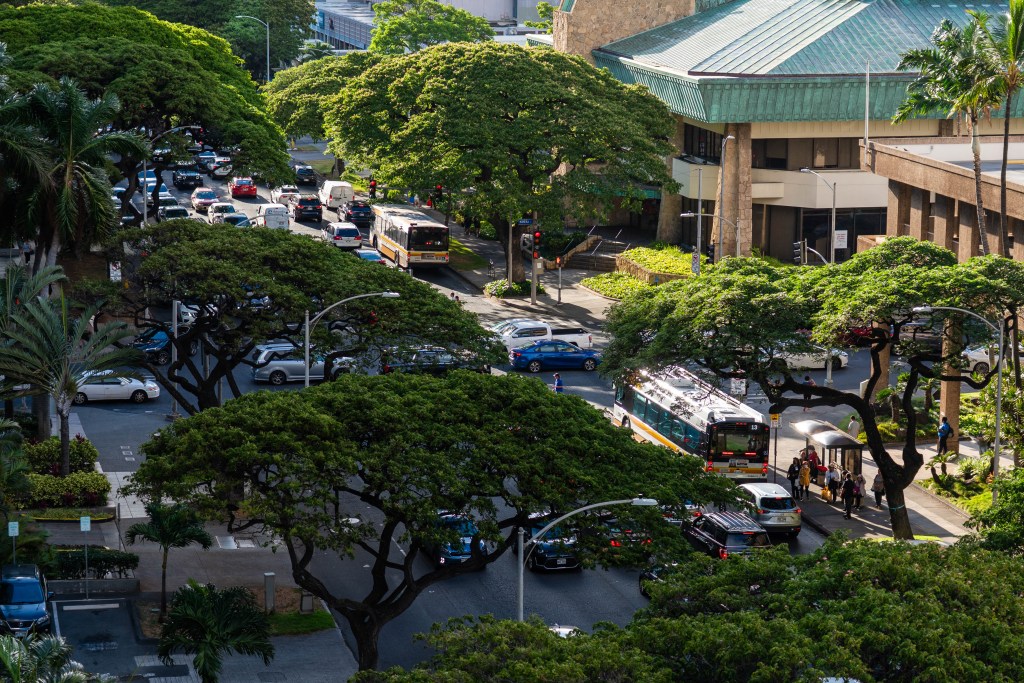
Traffic was already bumper to bumper as early as 3:30 p.m. around Ala Moana Shopping Center as people tried to move out of the evacuation zone, many converging on the mall’s parking garage, despite the fact that it’s in the evacuation zone, too.
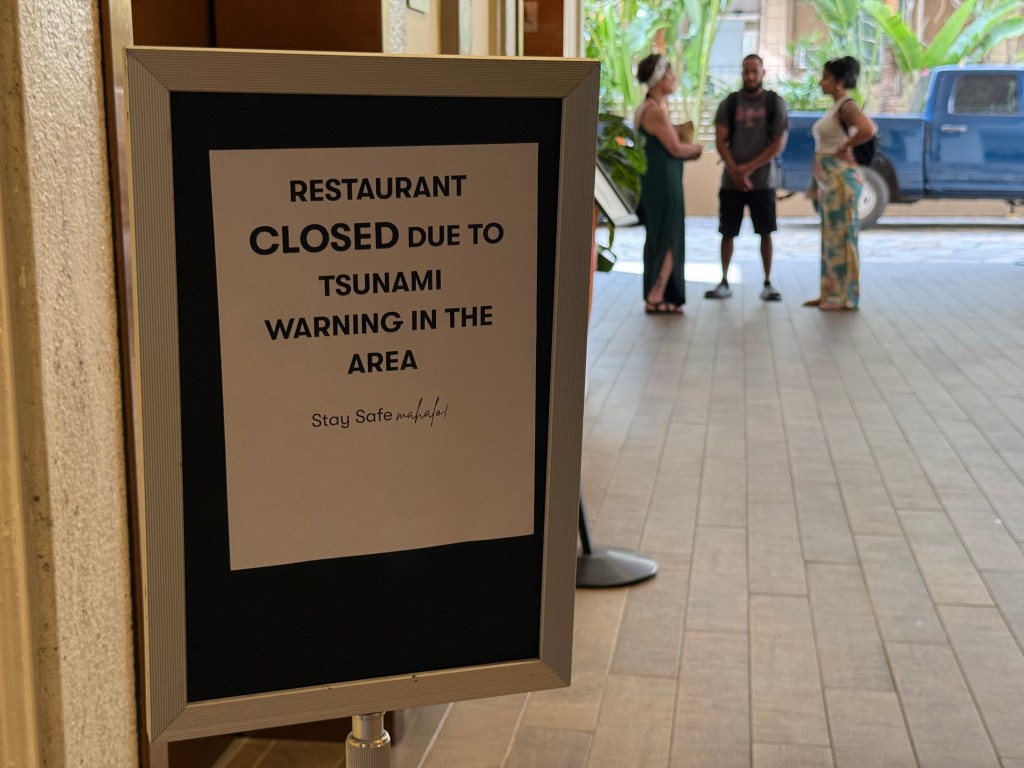
Along Oʻahu’s North Shore, roads were full of residents fleeing the coast in their vehicles, making it tough for people to reach an evacuation center set up at the Asian Pacific International School, on a high hillside in the middle of Hauʻula. The story was the same on main arteries on every island as people headed home. Bus service was stopped at 6 p.m.
“The roads are jam packed,” said Dotty Kelly-Paddock, a member of the Koʻolauloa Neighborhood Board who has campaigned for improved disaster preparedness for seniors for a decade.
“People are pretty frantic,” she said, speaking from an emergency operations center she set up on her Hauʻula property. “This hasn’t happened in a long time.”
She and a team of neighborhood residents trained in community emergency response had been sending out text message alerts to about 150 area residents all afternoon urging them to evacuate.
There was room for 600 to 700 vehicles at the Asian Pacific International School, Kelly-Paddock said, and a team of well-trained volunteers was on hand there to greet people, but things were going slowly because of the backed-up traffic.
Evelyn Lane, a Kahuku resident who also has been advocating for better disaster preparedness for kūpuna, said the drive from her home to the school normally takes about 10 to 15 minutes. It took her about 40 minutes to get there after the first tsunami warning alert, shortly before 3 p.m.
She said she expected many of her neighbors to instead head for the Kahuku Medical Center, mauka of the two-lane King Kamehameha Highway.
“Some people don’t feel safe getting on the road and trying to get here,” Lane said, “so they’ll just run up behind the hospital.”
Kelly-Paddock said she had exchanged text messages with Honolulu Mayor Rick Blangiardi, who told her, “Just stay on high ground.”
Meanwhile, officials opened evacuation bypass routes. On the west side of Oʻahu, the U.S. Army and U.S. Navy said they had temporarily opened Kolekole Pass from Lualualei Naval Road to Lyman Road. The route was accessible for emergency use in case residents needed as an alternate evacuation path.
Motorists were advised to use extreme caution and follow all posted signs and instructions from military and emergency personnel. “The pass will remain open until the all-clear is given by emergency management authorities,” according to a press release. It closed once night fell.
Honolulu-based hotel consultant Keith Vieira said hotels usually have established policies and procedures for tsunami warnings and work with state civil defense officials to decide when to implement those plans.
Larger hotels generally do not have to completely evacuate, said Vieira, former executive vice president of operations for Starwood Hotels & Resorts Pacific region.
“We just put people on higher floors,” he said.
On Maui, however, the Maui Beach Hotel in Kahului was among many facilities being evacuated, with managers going door-to-door and placing a small red circle sticker on the doors to indicate they had let the guests in that room know. They were also checking that guests had cars to leave, and they provided a map to tell them where to go — a high school.
Maui Police warned late in the day that Veterans Highway was congested and recommended that drivers use the Cane Haul Road to get to Kula. Maui halted its bus service starting at 6:30 p.m.
Maui County also took measures to protect its water system from potential damage. The county’s Department of Water Supply said it was closing valves in several areas, including Wailuku, Kahului and Lahaina, which could mean low-to-no water pressure in those areas until the all-clear was signaled. Several wastewater pump stations and facilities also were shut down proactively, according to a statement from the county.
Big Island police, meanwhile, blocked off entrances to downtown Hilo, where some older sections are in the inundation zone.
Hawaiʻi island Mayor Kimo Alameda said helicopters were deployed to hover over beaches in isolated areas around the island to issue warnings via loudspeakers to beachgoers, and a crew hiked into Waipiʻo Valley to warn anyone lingering there.
The county provided emergency shelter to guests in the largest Hilo hotels, and to two busloads of tourists who were on excursions in and around Hilo when the Pride of Hawaiʻi cruise ship stranded them by abruptly leaving Hilo Harbor to seek safety on the open ocean.
The Hilo airport was closed to allow Keaukaha residents to evacuate across the runway, but the Kona airport remained open to flights, Alameda said.
“This is one of those instances where you just err on the side of caution, and we’ve been through this before,” Alameda said. “The possibility it could reach our shores is pretty strong. How high, we’re not sure.”
As on Oʻahu and Maui, the main hitch in the evacuation by late afternoon was traffic congestion, he said. “You know, everybody wants to get out, but we do have police at the congested areas trying to direct traffic as best they can.”
“I try to remind the public, be patient,” Alameda said. “That’s why it’s a warning, and we’ve got time, so that’s key right now.”
He said Hawaiʻi National Guard troops and the Red Cross were standing by.
On Kauaʻi, residents were also fleeing in droves on the lone road out of the island’s North Shore. Evacuees faced traffic jams, aggressive driving, long lines at gas stations and grocery stores closing down early.
The Kauaʻi Police Department also blocked vehicles from entering Hanalei, the low-lying coastal town at highest risk for tsunami flooding on the Garden Island and where early predictions for this tsunami had suggested it might hit first and hardest.
Experts agree it’s only a matter of time until Oʻahu gets hit by a tsunami or hurricane. In this series, we examined the island’s vulnerabilities and what steps are being taken to make it more resilient.
>> Read our reporting on tsunami dangers to Hawaiʻi