

Protecting Coral Habitat May Prove Vital As Ocean Becomes More Acidic
Protections for critical coral habitat could bolster climate resilience for Hawaiʻi’s reefs.
Concerning news for coral reefs came out this week in University of Hawaiʻi research, while on the same day long-awaited protections for critical habitats offered some hope.
A paper published Monday in the Journal of Geophysical Research found the oceans around Hawai’i will become significantly more acidic throughout the 21st century, based on climate modeling.
That could do enormous harm to ocean organisms that form hard shells and skeletons, such as shellfish and coral, adding another layer of stress for already struggling species. And the scenarios UH researchers used for their models show to what extent carbon emission-driven climate change will make matters worse.
“Until about 2050, it doesn’t matter which scenario we’re on; we are on a path that has been built up over the last 100-plus years,” said Brian Powell, one of the four UH physicists who worked on the paper.
After 2050, however, he said the global carbon output will determine which scenario becomes reality.
“We don’t have to be on the business-as-usual track,” Powell said. “We can try to do better.”
On Monday, the National Marine Fisheries Service also announced protections for habitats around the world critical to endangered coral species, including in the Northwest Hawaiian Islands. The announcement came over a decade after the islands’ initial endangered designation.
David Derrick, one of the lawyers with the Center for Biological Diversity who sued to provide those protections, said that the Endangered Species Act played a vital role in their work. According to him, the law “gives groups leverage to hold the (government’s) … feet to the fire.”
Carbon Strikes Back
Ocean acidification occurs when carbon dioxide molecules in the air dissolve into the ocean, becoming carbonic acid, and higher concentrations of these molecules can create major issues for shellfish and coral.
Reef-building coral construct their skeletons by pulling in carbonate molecules from their environment to make calcium carbonate, which they incorporate into the hard structure of their bodies. When carbon dioxide dissolves in seawater, it competes with the corals for that carbonate.
Ultimately this leaves fewer building blocks to build a skeleton strong enough to withstand physical threats — it’s like building a cabin without support beams to keep it standing in a storm.
Because carbon dioxide dissolves more easily into colder water, ocean acidification has not historically been a major problem in Hawaiʻi.
In the Pacific Northwest the situation is different: Higher levels of ocean acidification have made it harder for juvenile oysters to build their shells and survive. Some Washington State oyster farmers actually raise their seedlings in Hawaiʻi’s waters before sending them home to mature.
More acidic waters would make it difficult not just for these oyster seedlings, but for local reef-building coral to perform their basic functions.
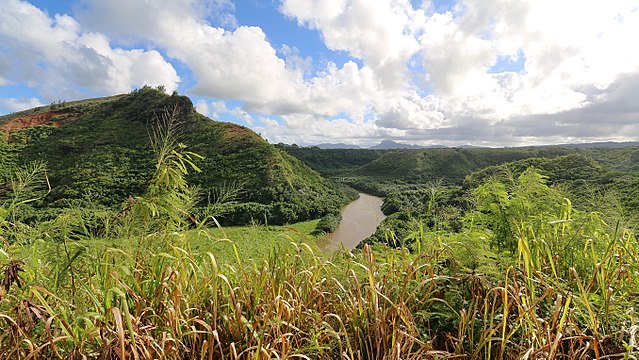
The researchers found that ocean acidification will not affect all areas of the state equally. Hawaiʻi’s microclimates mean that even different sides of the same island will likely see drastic differences in ocean pH levels, or how acidic those waters are.
“In terms of the ocean, the Hawaiian Islands are minuscule … they’re so tiny to you and I,” Powell said. “But yet, we can see differences between windward coasts and leeward coasts.”
Those variations demonstrate the importance of this new research, he said. Prior climate models looking at ocean acidification on a global scale did not take into account the unique local conditions of Hawaiʻi. Many, he said, only accounted for the presence of the Big Island, in part because it has such an outsized influence.
Hawaiʻi island “changes the climate of the North Pacific,” Powell said. “Because of those two massive mountains, they completely disrupt the trade winds and the flow of the atmosphere, and that wake extends 1,000s of kilometers behind the islands.”
That means that reefs in the Papahānaumokuākea Marine National Monument, to the northwest of the main Hawaiian island chain, will not be as subject to the higher acidification levels as the reefs around Maui.
Having more localized data may better inform protections for reefs around the state, Powell said. While he and his fellow authors are physicists, they are trying to “provide useful information to people who are ecologists and can look at trying to mitigate and manage the response of the corals.”
A New Hope
In 2023, the Center for Biological Diversity sued the National Marine Fisheries Service for failing to provide critical habitat protections for coral species that had been added to the Endangered Species List almost a decade earlier. That lawsuit led to the habitat protections announced this week.
Ocean acidification is only one of many threats to reefs, which also are stressed by such things as disease and heat. Powell described the Hawaiian Islands as sandwiched between two distinct threats.
“We essentially have an increasing zone of acidification coming from the north and an increasing zone of high temperatures coming from the south,” he said.
As these zones expand, they will likely reach a point where they overlap. This highlights a need for creating better habitat protections for threatened coral to bolster their resilience to those environmental pressures.
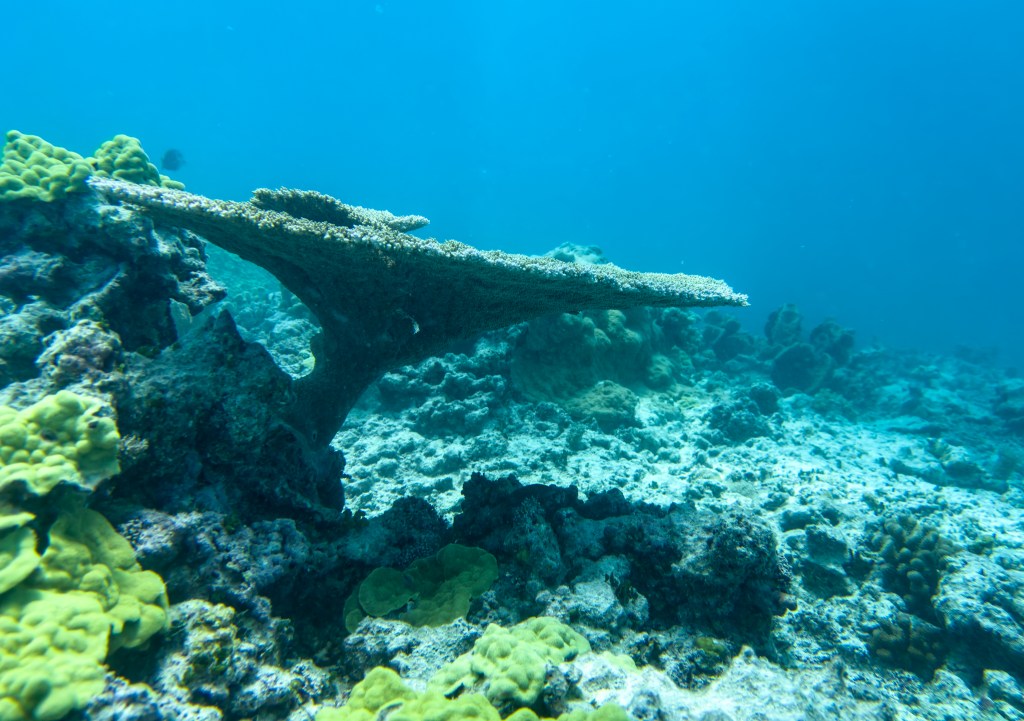
All living things need safe and stable habitats, but it’s particularly important for those that can’t move when their homes start to degrade, according to Derrick. Animals that can’t easily migrate, like coral, must adapt to changes in their environment or die.
“These corals have nowhere to go, because … they live where they start growing, and that’s that,” he said. “So to protect where they are is crucial.”
Minimizing human interaction, removing pollution and maintaining healthy fish populations are among the changes that can help coral become more resilient to climate change-related threats such as warming waters and ocean acidification.
Powell, the UH study author, said he is optimistic about the world’s ability to make better choices for the future, that the worst case scenarios shown by their models are not yet unavoidable.
“We don’t have to be nihilistic,” he said. “We can still push forward and make a difference.”
Civil Beat’s coverage of climate change and the environment is supported by The Healy Foundation, the Marisla Fund of the Hawai‘i Community Foundation and the Frost Family Foundation and its coverage of environmental issues on Hawaiʻi island is supported in part by a grant from the Dorrance Family Foundation.

