

It’s Slow Going In UH Quest To Reach 2035 Renewable Energy Deadline
The University of Hawaiʻi will need to get creative with renewable energy for the Mānoa campus, where the challenge is greatest.
Halfway to its 2035 net-zero energy deadline, the University of Hawaiʻi has only reached about 12% of its goal and the recent deprioritizing of renewable energy by the federal government is yet another setback.
A new bill signed into law last week might help. The bill prioritizes expanding renewable energy in Hawaiʻi through new rooftop solar and access to a process called wheeling, which allows for a more direct connection to renewable electric power sources.
But the road ahead is long, complex and expensive.
In 2015, the Legislature decided that the university’s energy usage had become too large of a burden on state taxpayers and set the 2035 deadline for UH facilities to produce as much renewable energy as their buildings use from the power grid.
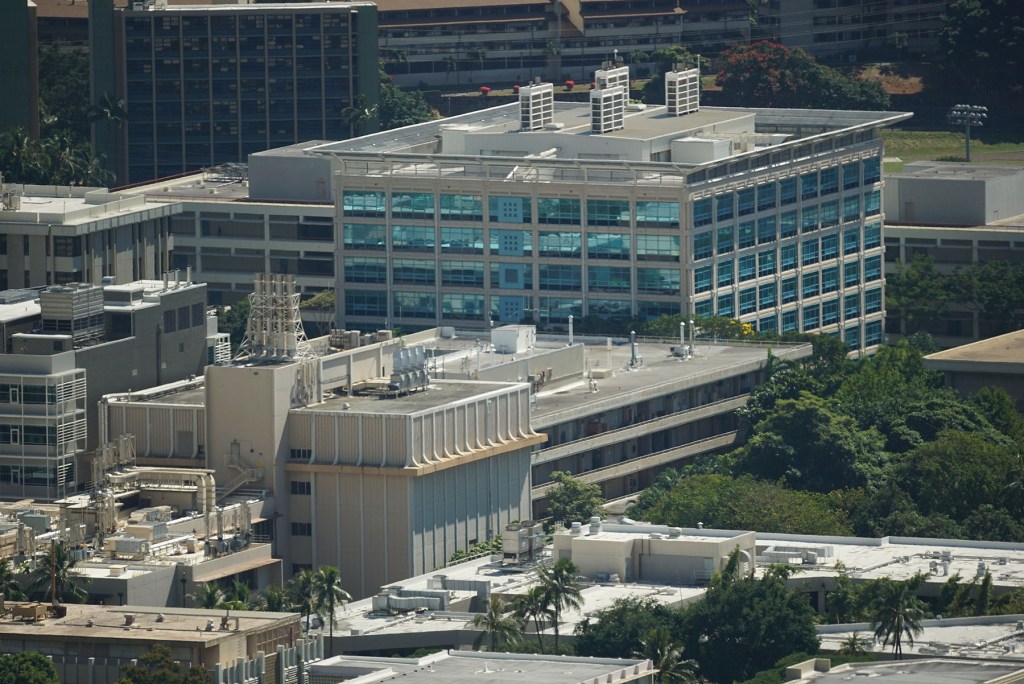
Since that time UH has been able to reach that balance on smaller campuses relatively easily, but the University of Hawaiʻi’s Mānoa campus continues to pose the greatest challenge for the net-zero goals
While the technology exists to address this issue, the university is struggling to get the funding it needs to make it happen.
“I think it’s going to be difficult with the absence of federal subsidies for renewables,” said Henry Curtis, executive director of Life of the Land, an environmental nonprofit. “Without tax support the projects will come at a higher price.”
Knowledge Is Power
Mānoa is the school’s largest campus, with scientific research facilities, sports stadiums and on-campus housing. It uses 60% of the electricity consumed by the entire UH system.
Miles Topping, the director of energy management at the university’s Office of Sustainability, said that the complexity of that campus has a big effect on its energy efficiency.
“We have multi-story, fully air-conditioned buildings that don’t turn off because they’re research buildings,” Topping said. “That makes Mānoa a little bit more of a challenge.”
The university is focused on installing as much rooftop solar as it can fit on the campus, Topping said. It installed a solar parking canopy and solar panel picnic umbrellas outside of the Life Sciences building in 2022.
“As it stands right now, with a very aggressive solar plan, we will get to about 40 or 50% (of net-zero) with solar alone,” Topping said.

Now the school is held back while it seeks funding to continue the project.
According to Topping, UH hired the firm G70 to create a comprehensive plan for implementing solar. The project overall will cost between $200 million and $400 million, in part because roofs must be replaced before the solar panels are installed.
Topping said university officials are trying to raise money in increments of $20 million. But requests for funding from the Legislature have been denied for the last two years.
Isaac Moriwake, managing attorney of the mid-Pacific office of Earthjustice — an environmental law nonprofit — said that he was optimistic about the university’s ability to secure the funding through nongovernmental sources.
“We have the technology, we have the plan,” Moriwake said. “We just have to get out of our own way.”
Wheeling And Dealing
Even if UH finds the funding, there is not enough space to get to 100% with campus-based solar alone.
Improving the efficiency of energy use in campus buildings is also part of the plan. A majority of the energy used is spent on heating, ventilation, and air conditioning systems. Changes anticipated in the annual UH Energy Report include installing and tracking energy-efficient lighting as well as HVAC, office and lab equipment.
To reach the goal, however, the university will have to find more ways to generate power, too.
One possibility is to build more off-site solar farms, like the one on UH land on the west side of Oʻahu. According to Topping, that land was initially intended to be used for agriculture. But due to a lack of access to water, UH took a deal offered by Hawaiian Electric Co. to have solar installed.

“We weren’t really utilizing it,” Topping said. The electricity produced at the farm is counted into the overall energy efficiency of the UH system but cannot currently be used by its facilities.
The wheeling option offered by the new state law may give UH the final energy push it needs to meet its 2035 goals by allowing it to bring power to the Mānoa campus from offsite generation, like the west Oʻahu solar farm.
“Every year we drag our feet,” Moriwake said, “we’re losing money and killing the environment.”
Civil Beat’s coverage of climate change and the environment is supported by The Healy Foundation, the Marisla Fund of the Hawai‘i Community Foundation and the Frost Family Foundation.
Civil Beat’s reporting on the Hawaiʻi State Legislature is supported in part by the Donald and Astrid Monson Education Fund.

