Tracking Coral Disease Attacking Hawaiʻi’s Reefs Is All-Hands-On-Deck Job
Creating a way for tourists and casual oceangoers to flag diseased coral is underway as white syndrome threatens reefs around Hawaiʻi.
The dive boat Maka Koa headed out of Kewalo Basin Harbor, threading its way between a line of surfers waiting on their boards for a wave and body surfers taking whatever the ocean offered.
Five of the divers taking up valuable space on the Waikīkī Dive Center trip were not focused on enjoying the beauty of Hawaiʻi’s famous reefs. Instead, they were there to study the diseases that threaten the reefs’ very existence.
It’s part of an effort to monitor potential threats to local reefs, which soon will also include a way for recreational scuba divers and snorkelers to get more involved.
Hawaiian reefs account for 85% of coral reefs in the United States, stretching over 1,200 miles around the state’s shoreline — a vast territory for any individual group to monitor. Adding to the urgency of staying on top of things, large gaps remain in knowledge about coral disease and how it spreads.
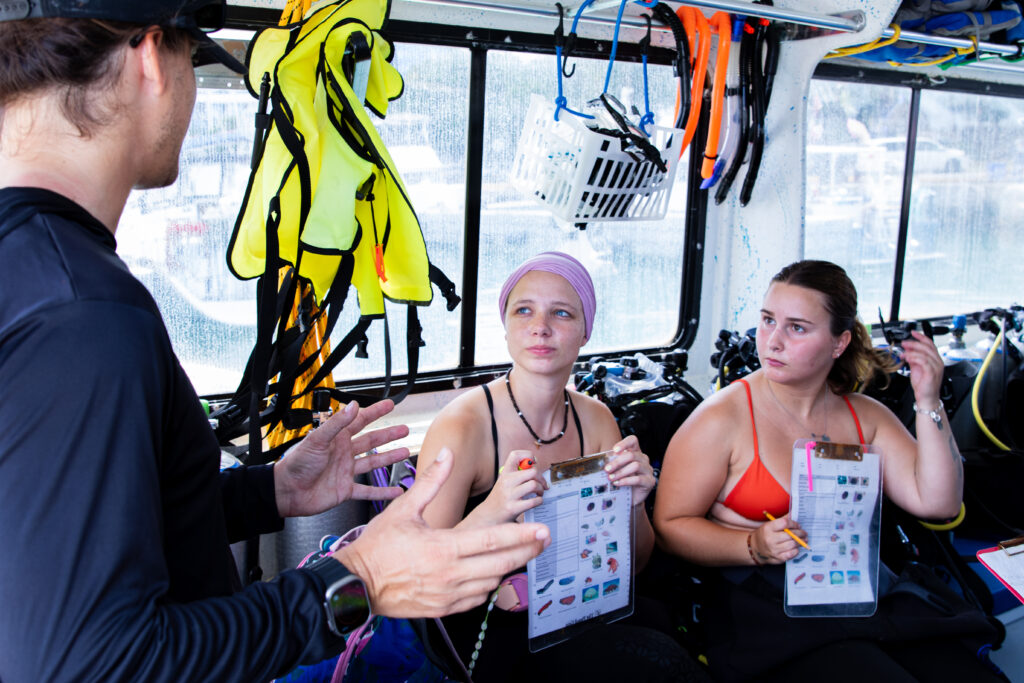
Dylan Brown, executive director of the Ocean Alliance Project, was aboard the Maka Koa this day, standing close to the bow of the boat with a mix of undergraduate interns and scientific divemaster candidates. Brown has established relationships with local dive shops to get boat seats at discounted rates that offer regular access to the reefs they study.
Adding detailed reports from recreational divers and snorkelers into the mix could act as a tip service for trained rapid response teams to manage incidents. A centralized reporting portal could streamline the process for everyone.
“I see all these collaborations just as critical for the ecosystem,” Brown said.
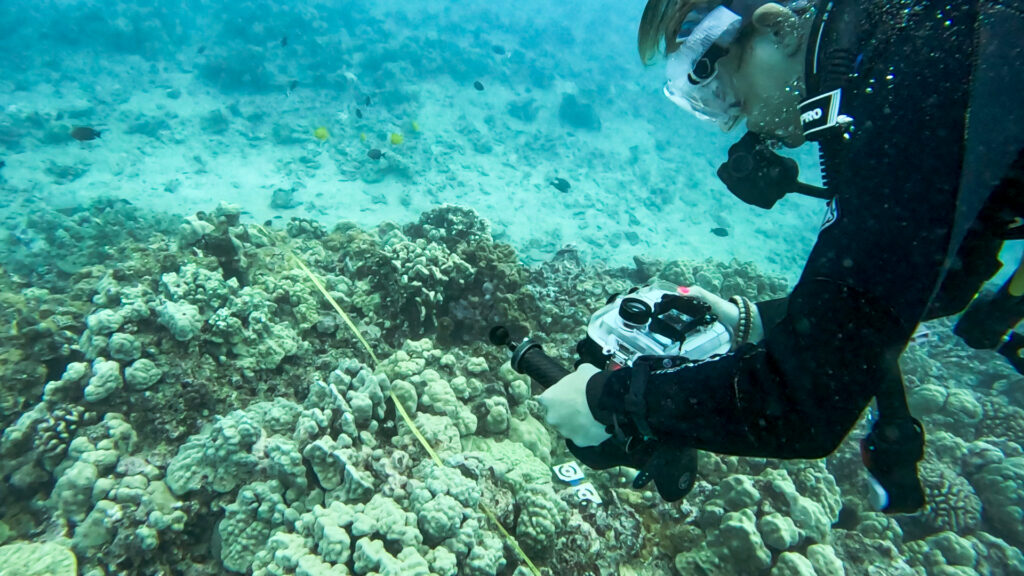
Brown’s team was set to survey a section of Horseshoe Reef, a popular Oʻahu dive site. Their goal was to help collect data for one of the interns, Isabella Nikazy, a senior at the University of Tennessee, who is researching a particular type of disease known as a white syndrome to determine how common it is and how quickly it spreads.
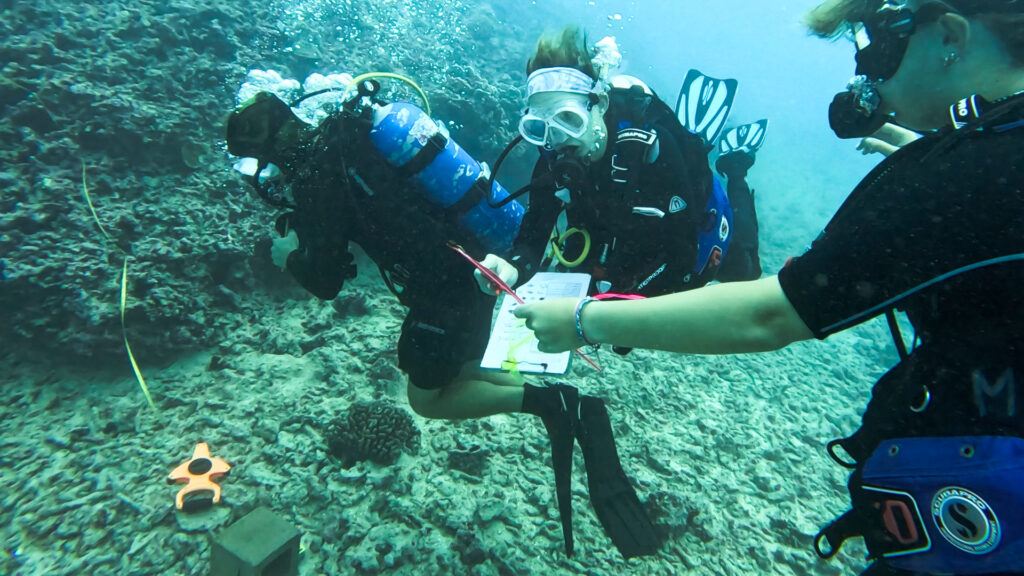
As the boat approached the reef, members of the team reviewed their dive plans and prepared clipboards holding water-resistant paper that allow them to communicate with each other underwater. To their gear, Brown added a high quality camera in a water tight housing and two concrete cinderblocks.
Then, each stepped off of the back of the boat and disappeared below the ocean surface.
Once they reached the site, Brown set down the cinder block and pulled out a spooling tape measure, which he used to mark a 100-foot line across the reef. He added markers to guide their imaging process, known as photogrammetry, to map the reef and spot changes in coral colonies over time.
“There’s just not a good baseline data set of, what do these reefs look like? What are coral coverages? What does our fish diversity look like?” Brown said. “That’s just a lot of information that’s not there. And so we seek to kind of step in and answer those questions.”
Unmasking The Culprit
The first known outbreak of white syndrome in the main Hawaiian Islands occurred in 2009, according to Greta Aeby, one of the world’s foremost experts on coral disease. It has since become the most common cause of disease outbreaks in Hawaiian coral.
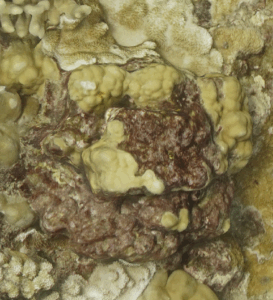
The term is a general name for a disease from an unknown source that breaks down coral tissue. If the coral’s immune system can’t fight it off, the colony dies. Nikazy’s project is looking at Montipura patula white syndrome, which refers to a specific type of coral prone to the disease, commonly known as sandpaper or ringed-rice coral.
This cause is a matter of some debate. Blake Ushijima, a microbiologist who specializes in coral pathogens at the University of North Carolina, traces it to a family of bacteria. Wildlife disease specialist Thierry Work with the U.S. Geological Survey says that his lab has been “unable to incriminate bacteria in coral disease.”
Following the initial outbreak, incidents began to happen with more regularity. Three of the five recorded outbreaks were in Oʻahu’s Kāneʻohe Bay in 2010, 2012 and 2015.
Bays can be particularly susceptible because of their geographical characteristics. Water moves in and out more slowly so pollutants — such as road runoff and sewage from septic systems — linger longer than in other bodies of water.
These pollutants combine with other stressors such as warming waters and algal growth to make the reef less resilient to infection. Aeby compared it to the way people are more likely to get sick when under stress.
Aeby found the growing trend concerning after her experience with another type of coral disease that has decimated Florida’s coral reefs in recent years: stony coral tissue loss disease.
“If the general public could see the changes to reefs in Florida, they would not want that for Hawaiʻi’s reef,” she said.
Stony coral disease was identified in reefs off of Miami in 2014. Now, only 11 years later, she said, it has spread along the entire coast of Florida and on down to the Caribbean.
Unlike coral bleaching caused by high water temperatures, coral disease could actually be combated, Aeby said, not just by finding cures but by taking care of Hawaiian reefs to give them a fighting chance.
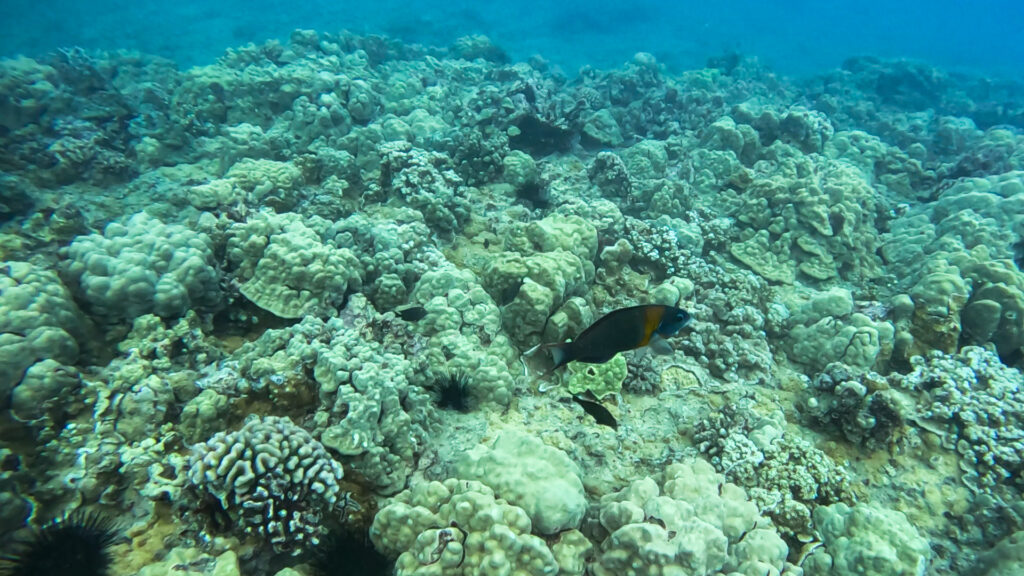
The good news for Hawaiʻi is that white syndrome appears to be a far less aggressive pathogen than stony coral tissue loss disease. It is much slower moving than its Florida counterpart, according to Eric Dilley, who this year became the rapid response coordinator for Hawaiʻi’s Department of Land and Natural Resources’ Division of Aquatic Resources.
Dilley’s new role was created to build response plans for an array of threats to local reefs, including damage by boats, coral bleaching and disease.
One of his primary responsibilities is to find ways to keep the stony coral disease from reaching Hawaiian waters. Another is to build relationships with other groups, from federal government organizations to nonprofits and citizen scientists, to bolster disease monitoring and response.
It Takes a Village
Rather than spreading themselves thin, groups such as the Ocean Alliance Project usually focus on a specific geographic area, where their intimate familiarity with certain reefs makes them better suited to notice changes. But they cannot monitor every inch of the reefs on their own.
Approximately 2.4 million people participated in guided ocean activities in Hawaiʻi during 2024 alone, according to the Division of Aquatic Resources. That offers an invaluable resource to collect data on reef health.
“You know, a couple of grad students, they can’t do disease surveys in an entire bay, or across the entire island every week or every month, but everybody’s in the water,” Ushijima said. “To just report an outbreak, that’s huge, because they’re your eyes.”
Dilley wants to merge the monitoring skills of nonprofit groups with the reporting capacity of beachgoers to build a better response network. To do so, the division is revamping a coral citizen science group called Eyes of the Reef, originally started by Aeby for the same purpose.
Eyes of the Reef currently has a reporting system, where filed reports are compiled into a private database for volunteers to follow up on individually. The rapid response team plans to update the website to make it the primary reporting hub for coral reef monitoring throughout Hawaiʻi.
“You know, a couple of grad students, they can’t do disease surveys… across the entire island every week or every month, but everybody’s in the water.”
Microbiologist Blake Ushijima, University of North Carolina
The new reporting system will populate an interactive map with the reports, including photos and location information, making them immediately available to the public. This will allow the public to see what other people are reporting and where.
Once a report is received, the goal is for the rapid response team to assess the evidence, then reach out to a trusted nonprofit working in the area of the reported issue. Once verified, the aquatic resources division could coordinate a response, whether that is additional monitoring or mitigation.
While the plan is still being developed — and is subject to change following review and feedback from stakeholders — Dilley said that he hopes to have the reporting portal up and fully functional by this time next year. In the meantime, he advised people to use the existing site.
“If you see something that doesn’t look right,” Ushijima said, “… take a picture of it and send it to somebody who might know what it is.”
Civil Beat’s coverage of climate change and the environment is supported by The Healy Foundation, the Marisla Fund of the Hawai‘i Community Foundation and the Frost Family Foundation.