

Auditor: Plan To Cool Hawaiʻi Classrooms A ‘$120 Million Disaster’
A decision to use solar air conditioning created costly maintenance issues and was an inefficient way to cool down sweltering classrooms, state auditors found.
A multimillion-dollar effort to cool the state’s school classrooms has fallen well short of its goals due to rushed planning and poor decision-making, the state Office of the Auditor found in a damning report released Tuesday.
The one-off Cool Classrooms Initiative, launched by then-Gov. David Ige in 2016 and meant to air-condition over 1,000 classrooms by that year’s end, ran over budget and reached only 838 classrooms in 53 schools that the auditors, after significant sleuthing, were able to verify.
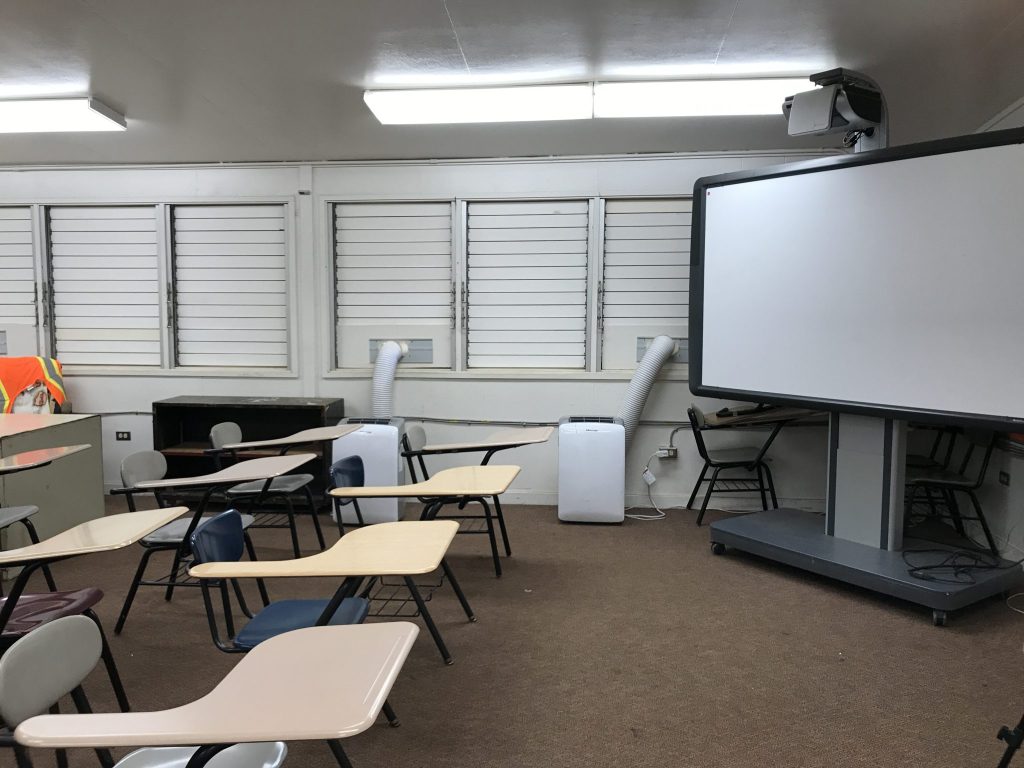
And despite spending an average of $125,000 per classroom, some school principals told auditors the units did little to alleviate the heat in rooms where temperatures can reach 100 degrees.
But the schools that ended up with air conditioning were not necessarily even the hottest, according to the Department of Education’s own heat rankings. The department never developed criteria for choosing which classrooms to cool under the program, the audit found.
In the end, the majority of the units were installed in Central and West Oʻahu, while only one school on the North Shore benefited. Only one school on the Big Island was included.

Portable classrooms, including those already cooled by trade winds, ended up being prioritized for installation, the report found, because they were “the most straightforward and quickest to complete.”
The plan also ignored or overlooked passive and less-costly cooling strategies the department had already paid another consultant to provide.
The report pulls few punches in its criticism of the heat abatement program and the Department of Education’s record-keeping, saying the DOE “was unable to provide us with a complete and accurate accounting of the $100 million that the Legislature appropriated.”
The auditors’ work was hampered by a lack of documentation due to high turnover in the staff of the Cool Classrooms Initiative, and the departure of its chief architect, DOE’s former public works administrator, who retired in 2017.
“Paradoxically, the more information that we were able to gather from DOE and its contractors, the less clarity there was about how much was spent, where it was spent, and what it was spent on,” the report said.
The final price tag came closer to $105 million, the audit found.
The lack of detailed information was compounded by the DOE’s reliance on external design consultants and firms that consumed over $25 million, a quarter of the sum allocated by the Legislature.
Solar AC Was Major Misstep
The Department of Education’s decision to install “complex and unfamiliar” solar-powered air conditioning systems under the program was a major folly made under “public and political pressure,” the auditors said.
The tight timeframe for the installation was partly driven by the department’s net-zero energy usage goal of 2035, the report found.
However the units have never worked very well and the reliance on solar limited their functionality to only five hours a day, leaving classrooms to swelter the rest of the day, DOE staff told the auditors.
Problems with the solar AC systems were compounded by a department decision to use plexiglass to seal jalousie windows in classrooms — ostensibly to improve AC efficiency — but also blocking trade winds when the units were turned off.
The relatively new technology also required costly installation and maintenance and turned the program into a “multi-million-dollar salvage effort,” according to the report, that added another $6 million to the costs. The lack of standardized equipment and a reliance on multiple vendors and contractors further complicated efforts to maintain and fix the systems.
Many of those solar-powered systems now are already at the end of their lifespan and will need to be retired soon, according to an unidentified DOE official cited in the report who called the heat abatement program a “$120 million disaster.”
Audit Critical Of DOE Response
The auditors also said the DOE had provided minimal structure and oversight of an additional plan launched in 2019 enabling schools to air condition classrooms themselves.
While the department provided broad guidance on electrical capacity and recommended models to install, the purchase or donation, installation and maintenance of the equipment was left to the schools.
The report said the DOE’s knowledge of and involvement in the School Directed AC Program was “limited to non-existent.” A requirement that schools submit an inventory of their air conditioning inventory so their load capacity could be assessed has never been enforced.
An unnamed interim assistant superintendent at the DOE’s Office of Facilities and Operations told auditors that the office only finds out a school hasn’t followed the guidelines “if something blows up”.
The auditors were unusually critical of the response provided by DOE Superintendent Keith Hayashi, which they said ignores the serious problems presented in the report and shows a disregard for policies and procedures and a lack of transparency.
Hayashi’s letter said the DOE appreciated that the report acknowledged the high turnover of staff associated with the Cool Classrooms Initiative, as well as the challenges of implementing the legislation on a tight timeline.
But, Hayashi’s comments “highlight the department’s serious misunderstanding about its responsibility and the importance of being accountable for its operations and use of public funds,” the report said. “Turnover does not relieve the department’s responsibility to be accountable for its performance.”
CORRECTION: This story has been updated to correct information related to DOE’s former public works director.
Civil Beat’s education reporting is supported by a grant from Chamberlin Family Philanthropy.
Read the full audit below.

