Hawaiʻi County Council Wants ‘Desecration’ To End At Military Training Area
Its resolution also asks the state to reject any land lease renewal unless there is a “comprehensive cleanup” of the site.
A Hawaiʻi County Council committee has plunged into the controversy over military use of state lands in the islands, voting 8-0 for a resolution calling for a halt to all “desecration activities” at the Pōhakuloa Training Area.
That includes artillery fire, the author of the resolution said.
Nearly 400 people submitted written testimony supporting the council resolution, which also urges the state to require the military to commit to a “comprehensive cleanup” of the training area before agreeing to any land swap or lease renewal. A lot more verbal testimony was presented during a two-hour-plus hearing Tuesday.
The vote by the Environmental and Natural Resources Management Committee included all but one of the council’s nine members, indicating the non-binding resolution will pass easily when the full council takes it up Sept. 3.
The U.S. Army is seeking to retain thousands of acres of state-owned lands after its state leases expire in 2029.

The military says it needs those lands for training, but the state Board of Land and Natural Resources rejected an environmental assessment for retaining nearly 23,000 acres the military leases at Pōhakuloa last spring. The land board also rejected another environmental report in June that covers 6,322 acres on three other training areas on Oʻahu.
The Hawaiʻi County Council resolution urges the state to reject any lease extensions or land swaps at Pōhakuloa unless the military agrees to a comprehensive cleanup and restoration. Those lands have been used for artillery practice and other live-fire training for decades.
It also calls for an analysis to identify cultural, historical and natural resources on the Pōhakuloa lands, and assess what impact military activities are having on those features. The analysis would also gauge whether the state is meeting its responsibility to protect Native Hawaiian rights.
Marine Corps veteran Leomana Turalde, a Waiākea High School graduate who served in Iraq, told council members he trained at Pōhakuloa before he deployed. But, he said, “I’m done with that. I’m done with allowing Hawaiʻi to be the practice range to do stuff like that.”
“It’s hard as a Hawaiian growing up on the Big Island having this experience that I have to look at my own home as a place where we practice to kill people,” he said.
Hilo resident Cristina Holt described the military presence in Hawaiʻi as an “illegal occupation,” and urged council members to “at least take a moral stand, and pass Resolution 234-25.”
“And if you are unable to even do that,” she said, “if you are unwilling to side with the hundreds of constituents who have stood up, and you side with the military-industrial complex, please know we are coming for your seats, and we are coming for your jobs.”
The resolution was introduced by council member Rebecca Villegas, who represents Kona. She said in an interview that “our people have spoken very clearly that they want an end to these practices in the piko (center) of our island at the base of our most sacred mauna.”
The only written testimonies opposing the resolution came from the Kona-Kohala Chamber of Commerce and the Hawaiʻi island Chamber of Commerce, which both stressed benefits that flow from the training area, such as support for emergency services.
Pōhakuloa police and fire crews have responded to hundreds of calls for service off the base, according to written testimony submitted by Carla Kuo, the Hawaiʻi island chamber’s executive officer. That includes help with brush fires, search-and-rescue operations and auto accidents, she wrote.
The training area also employs about 200 Big Island residents, “and supports local contractors and businesses through visiting military personnel and training operations,” Kuo wrote.
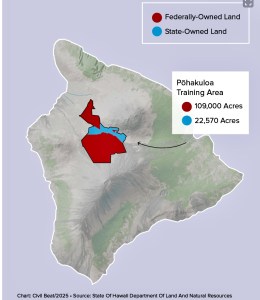
The 23,000 acres of land leased from the state at Pōhakuloa hold some key facilities, including water storage tanks, training equipment and maneuver areas. The chamber argued that renewing the state lease is “essential.”
Big Island Mayor Kimo Alameda said in a written statement that “this issue inspires passionate views from many perspectives, and it is essential that we listen to one another with respect.”
“The Pōhakuloa Training Area has long played a critical role in supporting national security and military readiness, while also contributing to our island’s economy and workforce,” Alameda said in his statement. “At the same time, we must acknowledge and address the lasting impacts that military training has on our ʻāina, our natural and cultural resources, and our communities.”
Here’s the County Council resolution: