Maui County Reaches Grim Milestone In Fire Victim Identification
The police forensic team has determined that nothing more can be done to separate and identify the last partial remains.
Long after officials had identified all 102 Lahaina fire victims, the Maui Police Department was left with a conundrum: What to do with remains so fragmented they could not be separated out with even the most advanced science.
The remains belonged to previously identified people who had died huddled closely together. Using DNA, fingerprints and anthropological markers, the medical examiner’s office had matched bones and put a name to each person who had died. But fragments and fine dust remained.
For more than a year after the last victim was named, the coroner’s office in Maui County continued its work to try to make sure families received as much of their loved ones as possible.
Then, as the second anniversary of the fire loomed, forensic experts determined that science had reached its limit. In June, Maui County went to court to seek what’s known as a burial transit permit, which would allow the department to cremate the remains.
The mortuary that does the cremation typically holds onto the ashes, although it’s unclear what will happen to these. In a written response, police spokesperson Alana Pico said only that the permit would allow the department to honor victims “with the care and respect they deserve.”
All The Experts Can Do
Officials identified the first victim just four days after the 2023 fire that destroyed much of Lahaina.
Forensic experts started with the most complete sets of remains, relying on fingerprints, X-rays and dental records and even studying bones for anthropological clues like age or sex. DNA became a valuable tool, especially when victims had been badly burned.
County officials quickly put out a call for family members of the missing to submit DNA samples for comparison. Rapid DNA testing devices brought in for the disaster response churned out results for four or five samples every two hours. The turnaround time was so astounding that Maui County purchased its own rapid DNA machine last October, making it the first county in Hawai‘i with the technology.
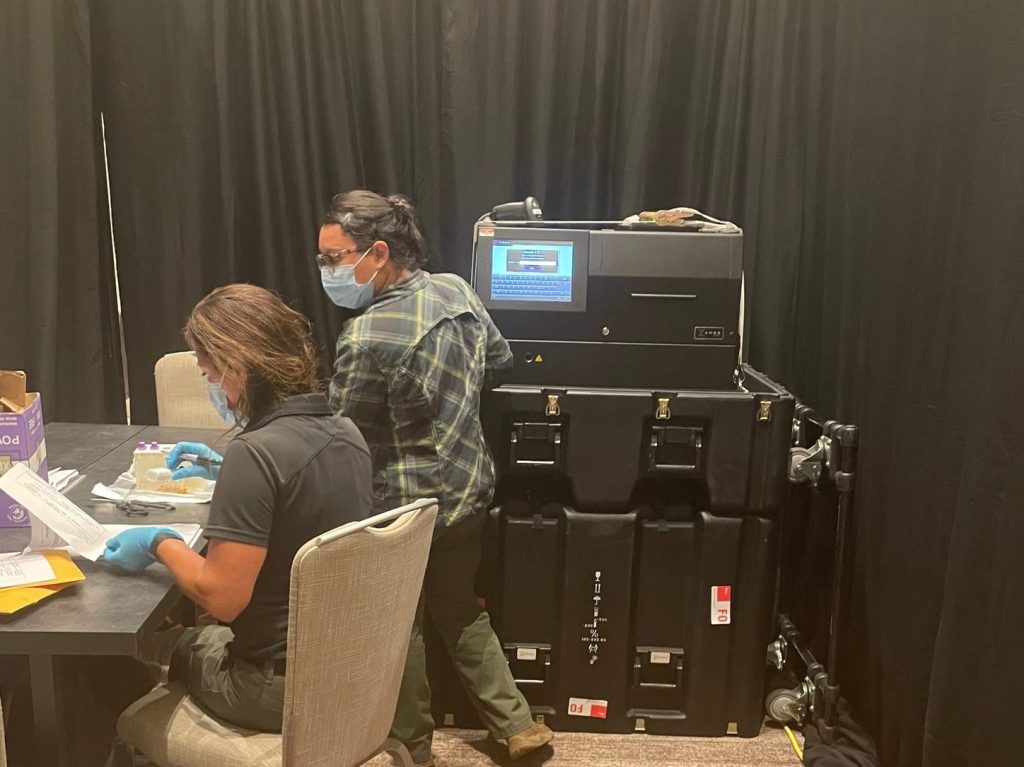
But even the most advanced tools only go so far. “Many of the fragments were too far burned for DNA detection. Some remains were also too small or too damaged to be refit,” the county’s June court petition said.
It’s those partial remains that officials now want to put to rest. In particular, there are two sites where people who weren’t related to each other had died together and fragments of bones had overlapped. In one circumstance, 10 people had perished gathered in and around two cars on Kuhua Street. In another, six people had died in a Quonset hut nearby.
Experts, the petition said, have done all they can.
“While it is possible to run DNA sampling on very small or degraded fragments, the testing process can entirely consume the fragments in question,” according to the county’s court petition. “Furthermore, there is generally a very low probability of highly degraded fragments containing identifiable DNA.”
Like law enforcement agencies across the country, police departments in Hawaiʻi are used to dealing with unidentified or unclaimed remains. First, the county coroner seeks a permit from the state Department of Health, which is required to bury or cremate someone regardless of whether they’ve been identified. When a loved one can’t be located, the state Department of Human Services will pay for the cremation at a mortuary that then holds onto the remains.
But there was no precedent for how to deal with cases where everyone had been identified and what was left could belong to multiple people. Before issuing the permit, the health department asked police to obtain a court order. That’s where the court petition came in. A judge granted one on July 25, exactly two weeks before the second anniversary of the fire.
The county petition also included an individual whose family had asked not to be notified if more remains were found. The family had already laid their loved one to rest, the petition said, and done what they could to get closure.
“Our hearts go out to the families and loved ones affected by this unimaginable loss,” Pico said. “This permit will enable the remains to be laid to rest with as much dignity and reverence as possible.”
Civil Beat’s coverage of Maui County is supported in part by a grant from the Nuestro Futuro Foundation.