

Student Scientists Are Tracking Heat Risk For Their Peers
Students are helping with summer research to measure temperatures at Hawaiʻi’s K-12 schools and set guidelines to prevent heat-related illness.
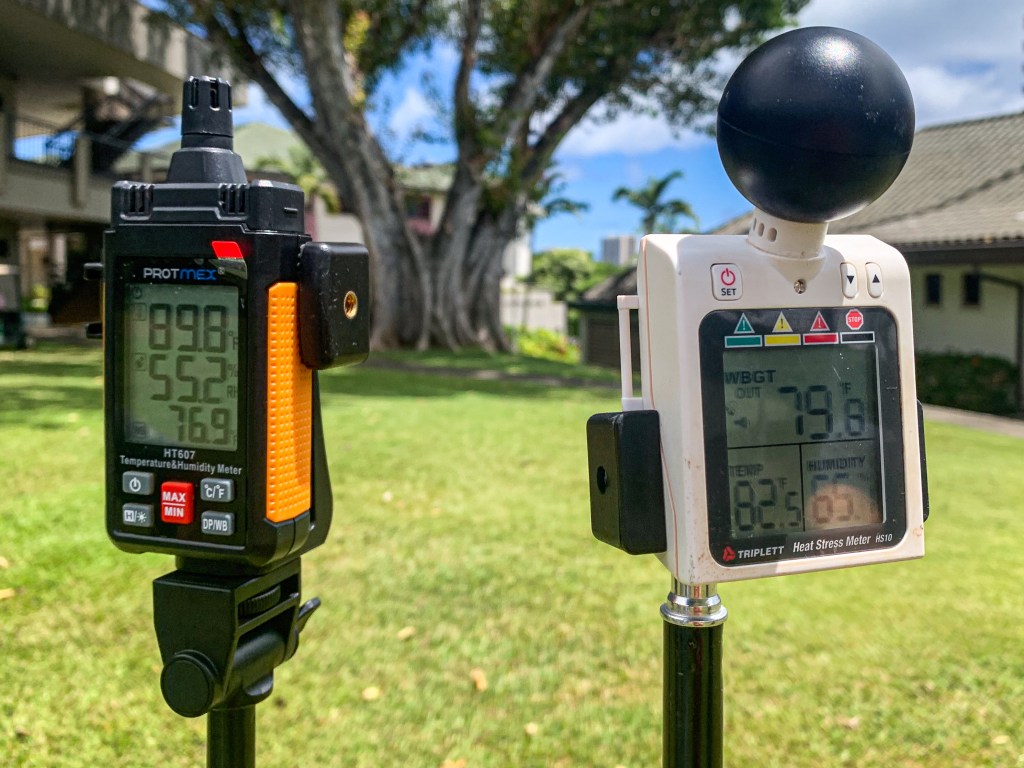
A few weeks ago, Abner Chun and Nicholas Chi, both 16, braved the afternoon sun to install two distinct instruments on long black stands on the grassy grounds of Punahou School — one short and squat with a big round bulb at the top, the other sleek and black with a top like a short wand.
The sun warmed the two curious-looking objects, known as wet-bulb thermometers, and numbers started to blink across Chi and Chun’s digital screens.
As global temperatures rise, a local coalition of health professionals is working with Chun, Chi and a host of other high school students across Hawaiʻi to gather data that could lead the way to protecting the islands’ keiki from heat-related illness.

That coalition, the Climate Change and Health Working Group, pushed earlier this year for state lawmakers to pass a bill that would install the special thermometers at every Hawaiʻi school, along with clear guidelines of how to use them and help keep kids cool and safe.
The bulbs more accurately account for how temperature and humidity translate to heat stress on the human body than a basic thermometer or the heat index, providing an early warning system for when it’s too hot to play or stay outside.
House lawmakers killed the bill, in part due to the thermometer cost. Now, the high-schoolers are trying to see if cheaper options might work as part of the Sustainability Fellowship Program hosted at Punahou. For their research project, they chose to test different low-cost web bulb thermometers across multiple campuses.
Chun, a rising senior, is helping evaluate the effectiveness of the bulbs’ readings. He said that more accurate information could help schools develop better strategies to prevent heat illness and injury. Speaking like a scientist, he said that with “the reading that you get from this, you can set… evidence-based guidelines.”
Hawaiʻi schools and public parks programs currently follow a variety of guidelines, but they focus primarily on being aware of the signs of heat illness and ways to treat them. New policies could prevent them.
Can’t Take The Heat
Wet bulb globe temperature is a measurement developed by the U.S. military to account for the effects of heat on the human body. The temperature reading combines three measurements now streamlined into a single thermometer: air temperature, black globe temperature and natural wet bulb temperature.
Air temperature is a traditional thermometer and “black globe” is a thermometer within a black orb that measures the feeling of direct sun exposure. Natural wet bulb temperature is more complicated, essentially the value taken using a wet towel wrapped around a traditional thermometer.
As the water from the towel evaporates in the heat, it has a cooling effect, just as sweat helps cool the human body. However, the more humid the air around the thermometer, the harder it is for the towel’s water to evaporate. That leads to a higher temperature reading. It’s the same for the human body. As humidity rises along with temperatures, it gets harder for the body to cool itself. As the humidity increases, so does, the risk of heat illness.
“Wet bulb is really an indication of heat stress on the body in direct sunlight,” said Liz Kiefer, a board-certified physician and co-founder of the working group. “It’s basically meant to be a guide for whether it’s safe for kids to play outside.”
Children are more susceptible to heat injury because their smaller bodies absorb heat faster, they sweat less efficiently and lose fluid more quickly than adults, according to the Environmental Protection Agency.
This increased risk, the working group says, calls for a more tailored approach to assess when it is safe for children to play outside and for how long. As climate change pushes Hawaiʻi from a subtropical to a tropical environment, children in public schools will have ever-increasing exposure to heat both inside and outside the classroom.
“We were really influenced by states that had high heat and high humidity and multiple deaths among mostly high school students,” said Kiefer. Just last week another high school football player died in Memphis due to severe heat stroke during practice.
“These kids were exercising outside without standard regulations,” Kiefer said, “and died of their heat illness.”

When it comes to high school sports, local schools use the Hawaiʻi High School Athletic Association Heat Acclimatization and Practice Policy. It details specific heat ranges for activities based on both the heat index and wet bulb globe temperatures.
The problem, said James McCallen — director of Community Preparedness and Resilience with the Hawaiʻi Public Health Institute — is that those guidelines aren’t meant for younger students.
McCallen, who cofounded the working group, said that although the sports association’s guidelines are in-depth, they’re not legally required, so it’s not clear how they are enforced. And even if they are enforced, he said, they do not take into account the physiology of smaller children in relation to heat.
Finally, for those who are using the guidelines, it is unclear if they are using wet bulb thermometers and, if they are, where they are sourcing them. If all of the thermometers do not give the same readings it would make the use of wet bulb guidelines virtually useless.
The Department of Education provided a statement via email that assured that the department follows heat guidelines developed in collaboration with the Department of Health. It also stated that all high school sports follow policies of the Hawaiʻi High School Athletic Association, which governs school sports.
However, McCallen said that the non-sport heat guidelines they are referencing have not been updated since 2010. He also said there is a growing body of research showing that those who experience a heat illness are more likely to have adverse reactions to heat in the future.
McCallen said he hopes to work with both the Department of Education and the Department of Health to utilize new technologies to prevent these injuries in the first place.
Keiki Are The Future
As a part of their study, Chi, Chun and their partner, 17-year-old Yinan Wang, tested the lower-cost thermometers at several sites across Oʻahu. They also interviewed coaches and athletes from some of the schools they surveyed.
Their research aimed to satisfy the Sustainability Challenge Project component of their two summer-long fellowships. The program, open to high school students across the state, focuses on engaging kids with science and Hawaiian values of connecting with the environment.
“We need to recognize how we’re raising children in Hawaiʻi, to be island-conscious, grounded in Hawaiian culture,” said Debbie Millikan, a former marine scientist and current Punahou teacher who runs the program. “We can’t forget that. We can’t lose that, and we need to amplify it.”
For the project component, groups of kids were paired with companies and nonprofits that had sustainable practices. The students would learn through those partnerships how to design scientifically rigorous research that aligned with their interests.
McCallen said that when he heard about the program, he thought their goals aligned: “It was just a perfect fit to host three interns in that program.”
One of the main takeaways for the students was the difficulty of collecting precise data.
Transportation limitations made it hard for the trio to access their sites at other schools, such as Waiʻanae High School. That limited their data to being taken at different times or mostly on the Punahou campus.
During the site visit at Punahou a few weeks ago, as Chi and Chun stood in direct sunlight for the 20 minutes needed for an accurate reading. The two thermometers made by different companies never showed the same values.
Just before the timer was up, a separate blinking alarm came from the thermometer with the black orb on top warning that the heat threshold had been crossed, posing a potential threat to anyone playing outside. The other thermometer remained silent, indicating it was safe to stay outdoors.
The students said they learned what many scientists learn from their work — that it will take more research to find a definitive answer to their question. But they said they are confident that there is a reliable low-cost solution to monitoring temperatures on school campuses and would like to see the study continued by other students.
Wang said people often assume the more expensive option is the better one.
“I feel like I’m just kind of wanting to highlight (that) it might not be,” she said, “We don’t know which one is, like, actually closer to the ambient temperature.”
How do you beat the heat? Take our survey:
Civil Beat’s education reporting is supported by a grant from Chamberlin Family Philanthropy and its coverage of climate change and the environment is supported by The Healy Foundation, the Marisla Fund of the Hawai‘i Community Foundation and the Frost Family Foundation.

