

Students Are Missing Out On The Right To Hawaiian Immersion, Lawsuits Say
Two lawsuits filed against the Department of Education this summer allege the state has fallen short of its constitutional duty to provide families with access to Hawaiian language immersion schools.
In February, Harley Miner showed up to Waiau Elementary on the first day of kindergarten registration, only to find out the Pearl City school near her home had no space left for her son.
Miner planned to enroll her son in the elementary school’s Hawaiian language immersion program since the family speaks Hawaiian at home and he attended an immersion preschool. But Oʻahu has few public schools that offer Hawaiian immersion programs starting in kindergarten, and Miner later learned that families had lined up at 4 a.m. on registration day to enroll their kids at Waiau.
“I didn’t do all of this just to put my kid in English school because DOE doesn’t have space for him,” Miner said.
She put her son on Waiau’s waitlist but ultimately sent him to Ke Kula Kaiapuni ʻo Ānuenue, a Hawaiian immersion school in Pālolo Valley, where he takes the bus every day.

Unlike other neighborhood schools, where families are zoned for specific campuses, students can enroll in any Hawaiian immersion program run by the education department.
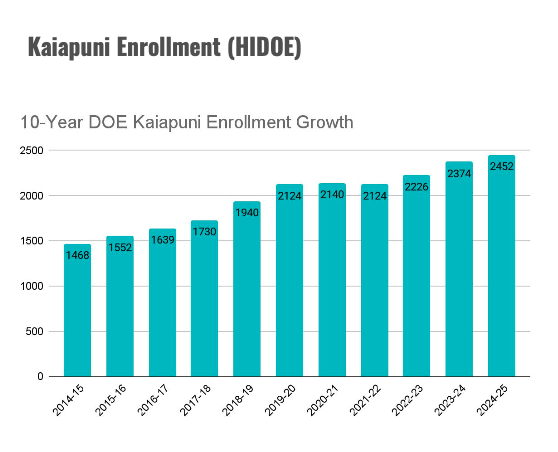
Over the past decade, demand for the education department’s Hawaiian immersion programs — collectively known as Kaiapuni — has grown by nearly 70%, even as overall public school enrollment has fallen. But families and advocates say the number of Kaiapuni classroom spaces and teacher positions hasn’t kept up with the demand, with some schools like Waiau Elementary creating a waitlist for their immersion programs.
Two lawsuits filed against the Department of Education and Waiau Elementary’s principal this summer claim these waitlists are unconstitutional and the state has fallen short of its responsibility to reasonably provide families with access to Hawaiian immersion education. Families who want to register their children in immersion classes at Waiau Elementary face enrollment barriers that other public school parents don’t face, the lawsuits say.
DOE spokesperson Nanea Ching declined to comment on the active litigation but said the department is working on a four-year strategic plan to expand and strengthen opportunities for Kaiapuni students.
The Hawaiʻi Supreme Court ruled six years ago that the department has a constitutional responsibility to make “all reasonable efforts” to provide immersion education to students. The courts have yet to decide what reasonable efforts entail, said Sharla Manley, an attorney at the Native Hawaiian Legal Corp. who helped file the case against the education department.
“At the end of the day, DOE is not providing reasonable access,” said Manley, who also filed the two lawsuits against Waiau Elementary and the education department this summer.
Limited Options
Families attempting to enroll their kids in Waiau Elementary’s immersion program faced a range of challenges: no communication about when registration opened, little information about how they could get off the school’s waitlist and, in some cases, no other Kaiapuni options near their homes, according to the lawsuits Manley filed this summer.
The school advised one of the two families involved in the lawsuits to simply enroll their child in an English-speaking program instead, even though the student spoke Hawaiian at home and went to an immersion preschool. Waiau’s administration didn’t provide families with information about alternative Kaiapuni programs they could pursue, according to the lawsuit.
As of Friday, the family who filed the first lawsuit was able to enroll their child in Waiau’s immersion program, Manley said, and plans on dropping their case. A second case, involving another family unable to enroll their child in Waiau’s immersion program, is still active.
Limited access to Kaiapuni programs creates challenges that families don’t face when enrolling their kids in English language schools, Manley said. Not all immersion schools offer transportation, and parents face long commutes if they need to enroll their children in a program outside of their neighborhood school zone.
Central Oʻahu has no immersion programs. Kauaʻi also has no Kaiapuni programs run by the DOE, although the island has two Hawaiian immersion charter schools.
Between 2014 and 2024, the number of DOE immersion schools grew from 14 to 21. But it’s difficult to find the space and resources needed to start a school from scratch or establish a program on an existing DOE campus, said Kalae Akioka, a Kaiapuni teacher at Pūʻōhala Elementary in Kāneʻohe.
Superintendents can provide school facilities for a Kaiapuni program if 15 or more families in a district express interest, according to state law, but it’s not mandatory for DOE to do so.
The department is working on a strategic plan for Hawaiian immersion that focuses on growing capacity and providing more access to families, said Board of Education member Kahele Dukelow in a meeting on Thursday. A draft of the plan sets goals like monitoring the percentage of families who can enroll in Kaiapuni programs after expressing interest and creating a new complex area superintendent role dedicated to overseeing immersion schools.
Some families believe that establishing K-12 campuses offering classes solely in Hawaiian could be the solution for expanding access and creating environments where students are encouraged to speak Hawaiian all day.
But even existing Kaiapuni programs are struggling to find campuses that can accommodate their growth.
At Pūʻōhala Elementary, families protested this summer when DOE said it would reduce classroom space for the Hawaiian immersion preschool on campus, citing the need to make more room for older Kaiapuni students. The preschool is run by the educational organization ‘Aha Pūnana Leo and rents classroom space from the department.
Last month, the department decided the preschool could keep its two classrooms on Pūʻōhala’s campus for the new school year. But the school, which hosts English and Hawaiian language students on its campus, is still struggling to find enough space to accommodate all kids in the Kaiapuni program, said parent Brandi Cutler.
Ideally, Cutler said, families would like a K-12 campus fully dedicated to Kaiapuni students, but it’s difficult to find the resources to get started.

“The goal is definitely for all of us to be together so the kids can actually be immersed in the language,” Cutler said.
But immersion schools have also struggled to fill educator positions, something the department will have to address if more growth is going to be possible. According to the DOE, 1 in 5 Kaiapuni teacher positions are vacant, even with the $8,000 salary bonus the state introduced in 2020.
It’s difficult to find educators who can speak Hawaiian fluently and also have the expertise and training needed to work in schools, Akioka said. There’s limited curriculum available in Hawaiian, she said, and it can be daunting for educators and administrators to create immersion programs from scratch.
“The reality of that is so hard for people to understand until they’re doing it themselves,” Akioka said.
Civil Beat’s education reporting is supported by a grant from Chamberlin Family Philanthropy.

