Why The Hanapēpē Massacre Was Largely Forgotten For Decades
A team of amateur sleuths found the mass grave from the 1924 conflict. Kauaʻi then spent $1.4M to buy the battle site and plans to transform it into a public memorial park.

What happens when the remnants of a painful page in history fade from public memory?
It took a small band of amateur historians and community members years to find the mass grave and stitch together the missing details of the deadly labor dispute known as the Hanapēpē Massacre.
Those grassroots efforts have come center stage in a government project to preserve the historical landmarks that includes over $1 million in county funds.
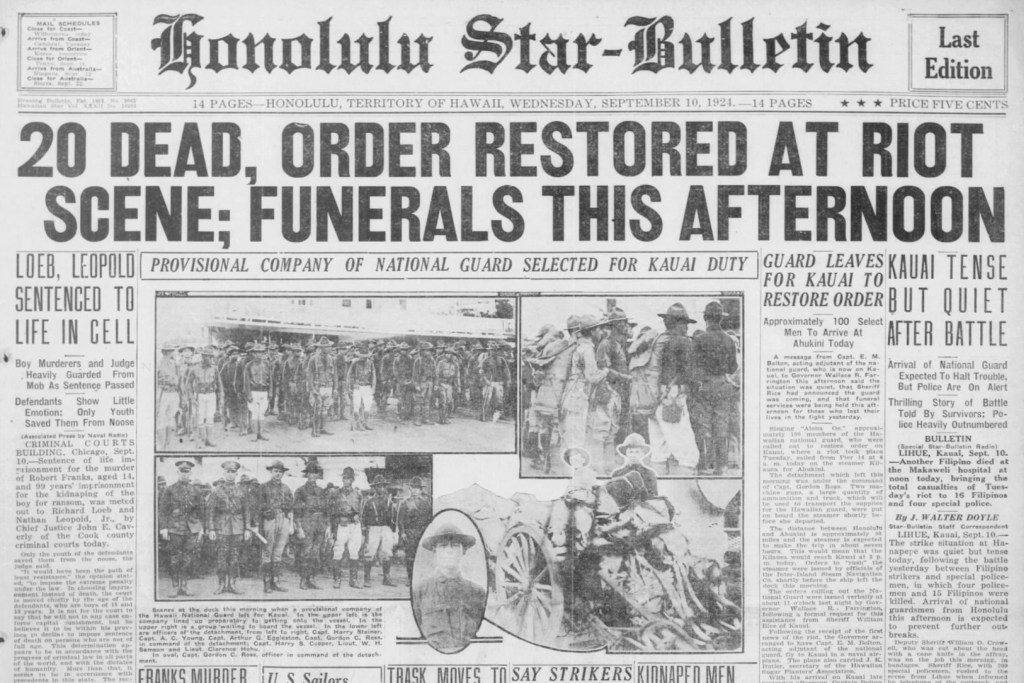
The story begins in the West Kauaʻi town of Hanapēpē more than a century ago when Filipino sugar plantation workers on strike for fewer hours and fair pay, from $1 to $2 a day, seized two strikebreakers on bicycles. Kauaʻi Sheriff William Crowell tried to free the captives, but the strikers refused to let them go.
The standoff escalated into a fierce battle on Sept. 9, 1924, between dozens of armed law enforcement officers — many of them deputized on that day — and about 150 Filipino strikers. All told, 16 Filipino strikers were shot to death while four sheriffs died from stab wounds.
It was one of the deadliest conflicts in Hawaiʻi’s history and set the plantation-era immigrant labor movement back for decades.
Public outrage was muted in the immediate aftermath of the killings. Higher wages and improved working conditions for immigrant laborers wouldn’t be achieved for many years.
But the labor conflict reflected growing tensions between the Western plantation owners and the foreign laborers who were beginning to agitate for better working conditions. It also highlighted the lack of immigrant justice in the then-U.S. territory.
The Filipinos themselves were divided with men from the region of Visayas leading the strike. The two kidnapped strikebreakers, who survived, were Ilocanos. As a result, many sugar plantation owners stopped hiring Visayan Filipinos, instead centering their recruitment efforts on illiterate Filipinos from other regions.
With the march of time, many details of the Hanapēpē Massacre dissipated from public memory and the site was eventually occupied by a gas station and later a vacant lot where people sometimes dumped wrecked vehicles.
‘We Should Always Remember’
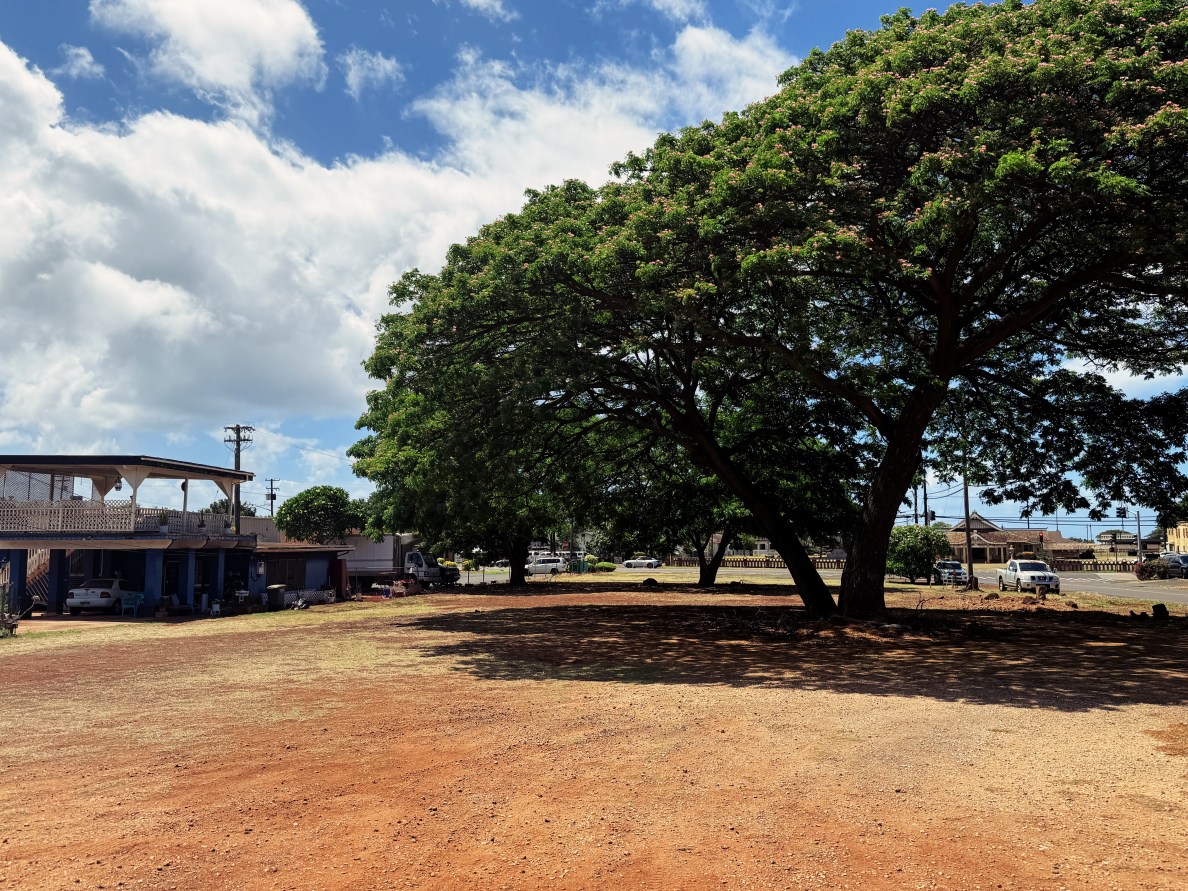
Today, the spartan quarter-acre lot off Kaumualiʻi Highway in the red-dirt-dusted town of Hanapēpē is on the verge of a transformation into a historical park anchored by a monument to recognize those who died.
“It’s important to know the horrific acts of the past so we don’t make the same mistakes again,” Mayor Derek Kawakami told Civil Beat. “I think it has a resonant message for the people of today and the people of tomorrow and we should always remember parts of our history that we never want to return to.”
In May, Kauaʻi County finalized a $1.4 million deal with the Texas-based oil, gas and renewable energy company Par Pacific Holdings to buy the pair of side-by-side parcels that constitute the future park. The money came from a fund endowed by a half-percent of the county’s annual real property tax haul that’s designed to help preserve open space, shoreline access and other important natural and cultural resources.
The fund is typically used to acquire land for ecological or recreational conservation. In recent years it has funded land acquisitions that have expanded the size of Black Pot Beach Park in Hanalei and preserved access to the dirt trail down to Hideaways Beach on Kenomene Bay in Princeville. The battle site purchase marks the first time the fund has been used to preserve a site for its cultural value.
The county is also considering an additional $215,000 investment to anchor the park with a historical monument. It’s soliciting monument design ideas from artists.
A mile away, an unmarked earthen depression where the slain strikers are buried at the Hanapēpē Public Cemetery will finally get a memorial marker.

The amateur historians who rediscovered the mass grave also spurred a change in the cemetery’s stewardship. The county, believing it owned the property, had long maintained the cemetery. But new interest in the site led county workers to discover that the state is in fact its rightful owner. The state has since taken over maintenance duties and plans to properly mark the mass grave and erect a separate monument to honor the slain police officers and the Filipino plantation workers buried there.
When it’s installed next year the memorial will feature two concrete columns separated by a gap that symbolizes the two sides of the conflict.
“The way they’re oriented is that no matter the time of day, there’s always a shadow cast,” said Eric Agena, the Kauaʻi program manager for the Hawaiʻi Department of Accounting and General Services. “The shadow represents that dark chapter of labor history.”
The Search Begins
Mike Miranda, a leading member of the band of amateur sleuths that solved these decades-old mysteries, said the new knowledge about the massacre offers a timely teaching moment.
Growing up on Kauaʻi, Miranda, 45, of Līhuʻe had never heard about the Hanapēpē Massacre until he learned about it in an ethnic studies class as an undergraduate sociology student at the University of Hawaiʻi in 2003.
Several of his Oʻahu-born classmates had learned in school about the violent labor strike. But Miranda didn’t have a clue, and that embarrassed him. He couldn’t find any books on the subject at the UH library, but his curiosity was piqued. It also felt personal: His great-grandmother was among the first wave of Visayan Filipinos who migrated to Kauaʻi to work on plantations.

Back on Kauaʻi, Miranda attended a celebration at Hanapēpē Town Park in 2006 marking 100 years since the first Filipino laborers arrived in Hawaiʻi to work on the sugar and pineapple plantations. The event included the dedication of a plaque to honor the people who died in the Hanapēpē Massacre.
“The lapse of time and the loss of records have obscured the identities of several of those who died,” the plaque read. “Out of respect for those whose names are not known, none shall be listed here. They shall remain nameless, known only to themselves, to their families, and to God.”
Miranda found it curious that the park selected to host the plaque had no historical significance to the event.
After the ceremony, a publicized list of the names of the victims of the Hanapēpē Massacre was found to contain errors. Some of the people on the list had outlived the labor strike, presenting another puzzle.
More than a decade later Miranda received a phone call from the Filipino American National Historical Society asking if he would be willing to explore the forgotten history of the Hanapēpē Massacre and present his research at the group’s 2020 biannual convention in Waikīkī.
Miranda wasn’t sure why the historical society had chosen him for the task, but he agreed to poke around in exchange for a trip to the convention.
Miranda rounded up a couple of friends and fellow history buffs and started searching public libraries for clues about who exactly perished in the Hanapēpē Massacre and where they were buried.
Forgotten Victims
On a trip to the Hawaiʻi State Archives on Oʻahu, Miranda met Chad Taniguchi, a fellow UH alumnus, who had in 1975 collected interviews of surviving participants and witnesses of the clash for an oral history project.
The last surviving witnesses — sisters who ran for cover in a crack seed store when the fighting broke out — had died in 1998. But many of the known victims still had descendants in Hanapēpē. Inspired by Taniguchi’s work, Miranda set out to talk to the town’s elders and try to track down the victims’ living relatives.
New awareness about the event is inspiring a new generation of Kauaʻi residents who trace their roots to the event to confront a lost chapter of their lineage. Others with a familial connection to the law enforcement officers who shot and killed the strikers are making amends for an uncomfortable chapter in their family history.
But Miranda had a rocky start to his investigation. Some people shut their door in his face when he came around looking for answers. Others demanded he drop his little history project. The pushback, Miranda said, came from fear that digging into the past could stir up bad blood between the offspring of the strikers who died and the sheriffs who shot them.
Miranda kept probing. Word quickly spread that he was trying to uncover forgotten truths about the Hanapēpē Massacre, leading a local geneology buff to join the effort and the rediscovery of a list of the names of the victims in church and funeral records.
“What kept me working on it was wanting to not let this go forgotten and also to let the kids who grew up here learn about it,” Miranda said. “That and we had a lot of lucky breaks.”
The interviews Miranda conducted helped him and his team narrow down the location of the mass grave to three possibilities. After analyzing the ironwood trees in archival images of the 1924 funeral, they zeroed in on one: A coastal public burial ground known to locals as the Hanapēpē Filipino Cemetery.

Miranda then found an engineer on the island who had ground-penetrating radar capable of discovering buried bodies without digging them up. When Miranda told him about his project, the engineer volunteered his time and equipment to scan the cemetery grounds.
The team got a tip to scan the ground around a gnarled tree, where the radar revealed a series of foot-long burials, likely the bodies of children from an era when it was not uncommon for babies to die before their first birthday.
The eerie discovery left them no closer to finding the plantation workers’ graves.
In the cemetery one day in October 2019 Miranda noticed a line of trees that resembled the landscaping in the 1924 funeral photos.
On a bare stretch of scrubby earth between disorderly rows of headstones, the radar turned up one casket-shaped burial after another — 16 in total. Choking dust billowed around the team as the searchers stood awestruck before breaking into a celebratory round of high-fives.
“‘Holy crap!’” Miranda recalled thinking later that night. “This is kind of a big, big thing to do.”
It took several days to map the unmarked mass grave. On one of those days, a descendant of one of the sheriffs who died in the Hanapēpē Massacre went out to the cemetery to watch. Later, she called Miranda and his team over to her great-grandfather’s grave.
Behind the trench where the Filipino strikers are buried, there’s a small, triangular rock hand-etched with the date of the Hanapēpē Massacre. The headstone bears no name. But Miranda said the woman told him it marks the burial of one of the sheriffs.

After the coronavirus broke out, the Filipino National Historical Society canceled its Waikīkī convention. But the pandemic provided Miranda free time to probe deeper. Instead of sourdough baking or jigsaw puzzles, he knocked on the doors of Hanapēpē residents with roots dating back to the battle.
This work helped the county substantiate the cultural and historical value of the battleground as it began two years of negotiations to acquire the site.
The rediscovery of a violent episode in Kauaʻi history in this arid, tight-knit town of nearly 1,400 residents has been controversial at times.
Early efforts to fill seats on a community advisory board formed to guide the county’s historical preservation efforts easily attracted offspring of the slain strikers but failed to draw in the sheriffs’ descendants. Uneasy with the history, they feared a memorial to the labor strike victims would portray their ancestors in a negative light.

Over the years, efforts to build bridges between relatives of the strikers and sheriffs have been successful, and descendants of the sheriffs have since joined the advisory group. Some of them have recommended that the county refrain from etching the word “massacre,” on any memorial marker and instead refer to the event as the Battle of Hanapēpē. No decision on the wording has been made.
“It’s sensitive,” said Kauaʻi Deputy Planning Director Jodi Higuchi Sayegusa. “It was a tragic event and lessons were learned on both ends and we’re trying to focus on peace and bringing people together.”
“To say that it was a massacre infers that it was one-sided,” she explained. “What descendants from the sheriff’s side are saying is many of those folks were only just deputized the day of (the battle) to help back up the sheriff. So they weren’t necessarily on the wrong side. They were just trying to do their job that day.”