Big Island Housing Scandal Stalls Plans For Apartments
The affordable rentals in Kailua-Kona were supposed to be ready in 2024 and cost $50 million. The developer now hopes to finish in 2027 at a cost of $81 million.
Developer Honua’ula LLC began pushing ahead with plans for an apartment complex in Kealakehe — a North Kona community that is desperate for affordable housing — in the early days of the pandemic.
It was an uncertain time for almost all businesses, but for Honua’ula it was the beginning of a years-long legal and financial ordeal.
The project hit a wall when a Big Island housing corruption scandal erupted into public view in 2022. While the Honua’ula management was not accused of any wrongdoing, its consultant Alan Rudo was indicted and pleaded guilty to a federal corruption charge.
Then the federal government seized the land where the apartments were supposed to be built, and Honua’ula had to navigate a path through a federal forfeiture case.
It recovered from that mess only to become mired in a new, ongoing court battle between Honua’ula and a neighboring landowner that a Honua’ula executive says could again threaten the entire project.

“It’s been a very, very long journey,” said Carlo Mireles, chief operating officer of Honua’ula, during a presentation to the Hawaiʻi Housing Finance and Development Corp. earlier this month. And construction hasn’t even started yet.
During those years of delays, the shortage of affordable housing in Kailua-Kona has worsened, and the cost of the project grew from $50 million to more than $81 million, collateral damage from the housing scandal that is still dragging on in federal court.
An Urgent Need For Affordable Units
The Hawaiʻi Housing Finance and Development Corp. calculates the Big Island needs almost 19,000 additional housing units from now to 2027 to meet demand, and the need is particularly acute in the island’s tourism hub in North Kona and South Kohala.
Hawaiʻi County Mayor Kimo Alameda said in an interview Thursday the problem is “super frustrating,” with the affordable housing shortage weighing heavily on working families.
Rents are sky-high, which County Council member Holeka Goro Inaba said makes it incredibly hard for residents to find rentals they can afford.
Alameda said he understands most of the residents have to drive more than 45 miles from Hawaiian Ocean View Estates in Kaʻū to work the jobs in Kailua-Kona. Some commute from Puna, which is even farther away.
For those who do have access to housing in Kailua-Kona, “I know of local families just like mine, the kids are adult kids living with them,” Alameda said. “We’re becoming more multi-generational as we speak.”
Against that backdrop, the years of delays in the Honua’ula project at Kealakehe are exasperating. Mireles estimates the 105 apartments planned for the Honua’ula Living Community project will eventually house more than 600 lower-income Kona residents, if he can just get them built.
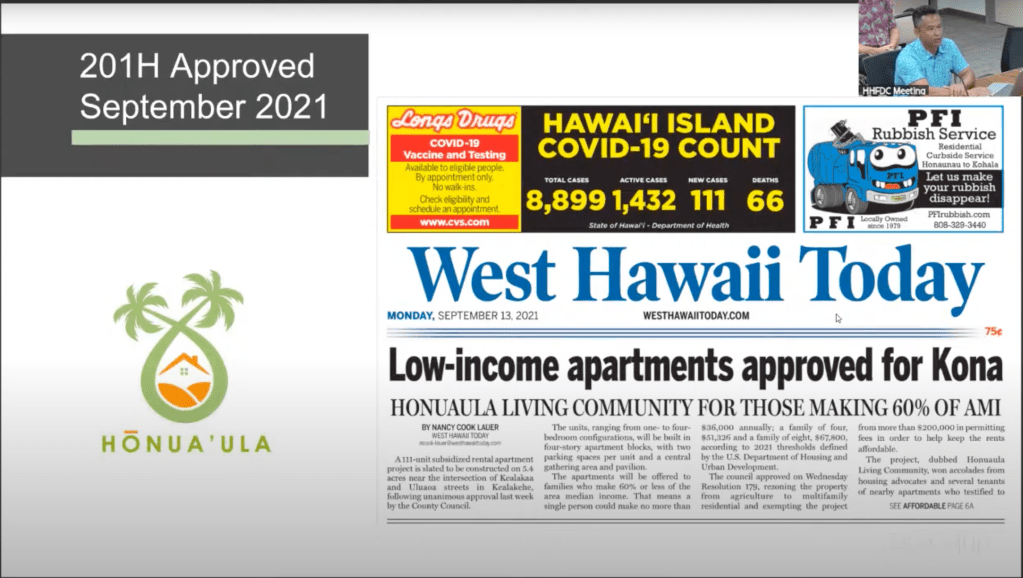
For a while, things went well. The county struck a deal with Honua’ula in 2021 to allow the developer to bypass some normal county requirements to help reduce costs for the affordable housing project. In mid-2022, the Hawaiʻi Housing Finance and Development Corp. earmarked tax-exempt bonds and tax credits to help finance the deal.
Then everything blew up. Rudo, a former county housing specialist, pleaded guilty on July 18, 2022, to conspiracy to commit honest services wire fraud, a felony punishable by up to 20 years in federal prison. He admitted to seeking or accepting $1.8 million in bribes and kickbacks during his time with the county.
His partners — Hilo lawyers Gary Zamber and Paul Sulla Jr. and businessman Rajesh Budhabhatti — were indicted a week later, and Rudo testified at their trial earlier this year.
A federal court jury on June 4 found Sulla, Zamber and Budhabhatti guilty of conspiracy to commit honest services wire fraud and nine counts of honest services wire fraud. Sulla was also convicted of money laundering, according to the U.S. Attorney’s Office for the District of Hawaiʻi.
A Corrupt Transaction
The component of the federal case that affected Honua’ula was a scheme to use affordable housing credits issued by the county to buy land.
When developers build more affordable units than are required for a project, they can receive excess credits that can then be sold to other companies. Developers buy those excess credits from one another for thousands of dollars because they can later surrender the credits to the county to fulfill affordable housing requirements for other projects.
Rudo helped arrange a deal when he worked for the county to award 104 affordable housing credits to West View Developments LLC, an entity in which he was secretly part owner with Zamber and Budhabhatti, according to court records.
West View was supposed to earn those credits by developing 52 affordable units initially and 62 more in a later increment, but those units were never built.
Instead, West View traded 46 of the credits along with about $14,000 for 13 acres of land in Kailua-Kona, according to federal court records.
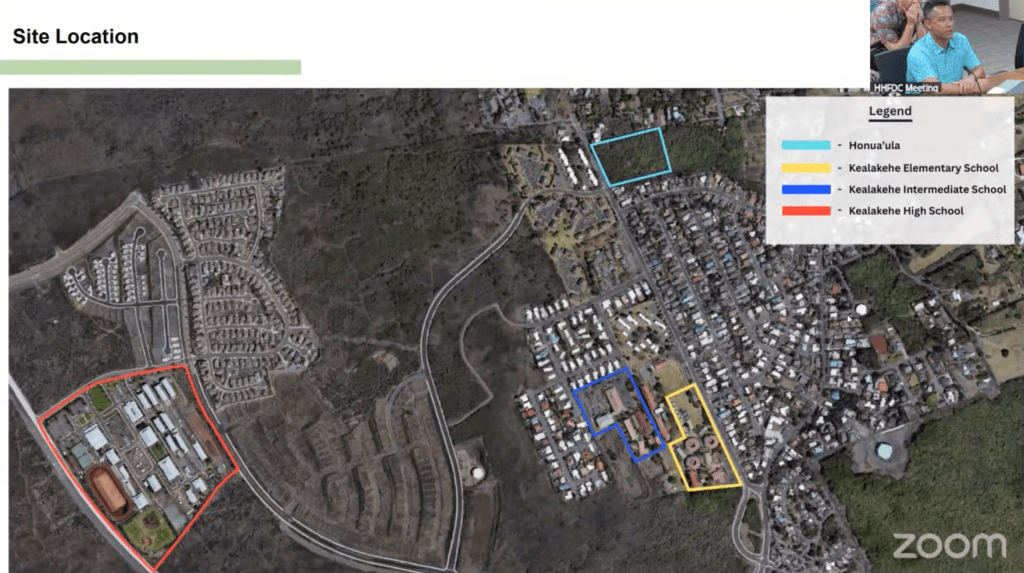
West View then sold 7 acres of that land and some credits for cash, and in 2020 leased the remaining 6 acres near Kealakehe Elementary School to Honua’ula for 55 years for the apartment project.
By then Rudo had left his job with the county Office of Housing and Community Development, and worked as a consultant for Honua’ula. However, Honua’ula did not know Rudo was also a secret partner in West View, according to court records.
After the federal indictments, authorities seized money and assets involved in several of the deals engineered by Rudo and his partners, including the 6 acres that Honua’ula leased for its project.
Federal authorities honored Honua’ula’s leasehold interest in the property, and finally sold the fee interest for the 6 acres to new owners that include Mireles’ company Mirein Development Holdings LLC last fall. Honua’ula then arranged for a new lease that extends until 2099.
The HHFDC board this month earmarked additional bonds, tax credits and a new loan from the state Rental Housing Revolving Fund for Honua’ula, but the project is still not in the clear.
When Rudo and his West View partners sold the 7 acres mauka of the Honua’ula site to a new owner for cash in 2021, they agreed to a request from buyer PMJ Kona LLC to record a restrictive covenant imposing a height limit on the 6-acre Honua’ula property, according to court records.
That height limit of 835 feet above sea level preserves the views from the mauka property owned by PMJ Kona, but makes it impossible for Honua’ula to develop four-story apartment buildings on the land it leases makai of the PMJ property, according to court records.
Honua’ula filed a lawsuit in Big Island Circuit Court last year in an effort to have the height restriction struck down, describing it as “a scheme to strip Honua‘ula of its right to develop a critical affordable housing project in the County of Hawai‘i.”
The lawsuit wants a court ruling that Honua’ula’s right to build the apartments takes priority over the height limit, making the limit “invalid and unenforceable.”
PMJ filed a reply to the Honua’ula lawsuit arguing that since Honua‘ula hired Rudo as consultant and project manager, “Honua‘ula must suffer the burdens, and consequences and benefits of his wrongful and proper actions, not PMJ Kona. Thus the Restrictive Covenant is valid and enforceable.”
Gary Grimmer, PMJ’s lawyer, said in an interview PMJ is a partnership of three women who are longtime Kailua-Kona residents who build and sell custom single-family homes. They are planning a six-lot subdivision of the mauka parcel to build more custom homes, he said.
Grimmer suggested Honua‘ula can excavate earth at the apartment site to lower the project or change its design to comply with the height restriction, but Mireles said in a written statement that simply won’t work.
The cost of excavation would make the project unfeasible, and Honua‘ula has committed to providing a specific number of affordable units, he wrote. Building fewer units “would impact the overall financial viability of the project.”
“If the affordable housing project remains subject to the height restriction, the entire project is in jeopardy,” Mireles wrote. Honua‘ula is scheduled to begin construction by the middle of next year, but that schedule is contingent on the court ruling the height limit cannot be enforced, according to Mireles.
The county has been named in the Honua‘ula lawsuit, and county Public Information Officer Tom Callis said in a statement “the County of Hawai’i will pursue all of its legal remedies in this case with the goal of supporting affordable housing development.”
The case is set to go to trial on Dec. 1, 2026.
Civil Beat’s reporting on economic inequality is supported by the Hawaiʻi Community Foundation as part of its work to build equity for all through the CHANGE Framework; and by the Cooke Foundation.