E-Bikes In Schools: Hawaiʻi Politicians Call For Restrictions
Efforts to implement stricter rules and more consistent standards have taken on urgency amid a sharp increase in traffic fatalities this year.
Hawaiʻi could ban some electric bikes from public school campuses in response to rising traffic fatalities statewide, some of which involved e-bikes, as government officials take aim at reckless behavior on the roads.
This top-down thinking departs from the Department of Education’s current policy, which puts the onus on individual schools and area complexes to ban e-bikes. So far, that’s led to a piecemeal approach to the problem.
“This is a big problem within DOE itself,” ʻEwa neighborhood board chair John Clark III said. “DOE takes a decentralized approach to almost everything it does.”
The issue is complicated by the popularity of e-bikes among youth both for recreation and as a convenient form of transportation in an era of bus driver shortages and high fuel costs. But efforts to implement stricter rules and more consistent standards have gained urgency as the death toll from traffic accidents in the islands so far this year nears 100.
Most were on Oʻahu, which has recorded 65 traffic fatalities so far this year, compared to 32 last year, according to Hawaiʻi News Now.
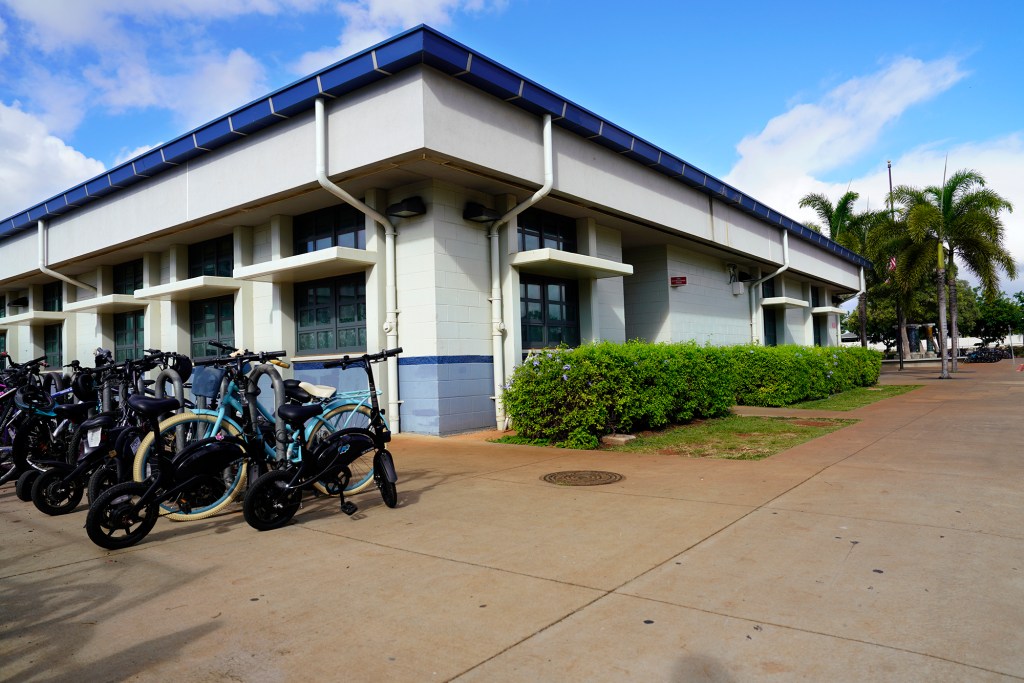
Gov. Josh Green singled out e-bikes in his executive order issued last week aimed at curbing the high traffic fatality rate. The order calls for uniform regulations for e-bikes across the state and encourages the Department of Education to set and enforce policy banning non-conforming e-bikes from school property.
The governor’s office didn’t elaborate on what it meant by non-conforming e-bikes, but the term usually refers to devices that go much faster than regular bicycles and don’t fit the national legal definition of “low-speed electric bicycles,” which are limited to 20 mph when carrying someone who weighs 170 pounds.
The age limit to operate e-bikes is 15, and the devices are supposed to be registered with the counties. However, they don’t require a driver’s license to operate.
Clark said he would like a blanket ban on e-bikes at elementary and middle schools since kids that young have less experience with the rules of the road and the physics of maneuvering around on a bike, much less one that speeds up just by twisting the throttle.
“These incidents seem to be happening at school or as the kids transit to and from school,” Clark told Civil Beat.
Some schools have instituted their own bans on e-bikes, but Westside Rep. Darius Kila said principals have told him that they would prefer to get guidance from the department or area complex leadership rather than having to go out on a limb themselves.
Piecemeal Approach
More than 21,000 e-bikes have been registered on Oʻahu during the past five years, according to the Honolulu Department of Customer Services — about one-third the number of registered pedal-powered bicycles.
Many are ridden within the confines of the law. But some riders are younger than the legal age limit and ride faster-than-allowed e-bikes recklessly through the streets, popping wheelies and weaving in and out of traffic. It’s a dynamic that can end in injury and even death.
“We’re seeing our young students and our young people be the very ones that are hurt the most,” Kila said.
Kila, who chairs the House Transportation Committee, and Rep. Justin Woodson, who chairs the House Education Committee, sent a letter Tuesday in support of the governor’s executive order to DOE Superintendent Keith Hayashi. Kila also sent a letter to Disa Hauge, the Leeward Oʻahu Complex Area superintendent. They urged the department to ban e-bikes that don’t fit the state’s legal definition — often because they move too fast — and other devices from campuses and to support safe transportation alternatives.
DOE spokesperson Nanea Ching said in a written statement that the department doesn’t have a statewide policy regarding e-bikes, but she noted that some individual schools and complexes have already banned all e-bikes from their campuses.
‘Ewa Makai Middle School, for example, banned e-bikes in April shortly after a 12-year-old was hit by a car while riding one, leaving the student in critical condition.
“E-bikes can reach higher speeds than traditional bicycles,” ‘Ewa Makai Middle School’s then-principal Kim Sanders said in a letter announcing the ban to parents and guardians, “increasing the risk of accidents and injuries in the community.”

The ban has been extended to all middle schools and elementary schools in the Campbell-Kapolei Complex Area, which includes ‘Ewa Makai Middle School, and it also covers all e-bikes — not just the ones that go faster than the law allows. Ching said enforcement is more difficult at high schools because students can legally operate e-bikes when they turn 15.
Transportation also can be difficult for students, and e-bikes provide an easy solution. Many school bus routes over the years have been canceled due to driver shortages, although the DOE has made progress on that issue in part by expanding its free county bus pass program to middle and intermediate school students.
In her letter, Sanders encouraged parents and guardians to explore other transportation options, like traditional bicycles, scooters, walking and carpooling.
‘They’re Just So Poorly Defined’
Kila said he understands that many families have challenges with transportation, but he believes the dangers outweigh that benefit.
Schoolchildren in ʻEwa Beach have been severely injured while riding fast e-bikes through the streets. One morning in August, 15-year-old Maddex Fiesta was riding an e-bike without a helmet against a do not walk signal when he was hit by a car and later died of his injuries.
“Imagine if, from the beginning, the Department of Education instituted rules around what is allowed on their properties,” Kila told Civil Beat, “if we could have potentially saved some of these students’ lives.”
Hawaiʻi Bicycling League advocacy director Eduardo Hernandez said his group doesn’t support non-conforming e-bikes, which he said are more akin to electric dirt bikes since they can not only move faster, but lack pedals. He isn’t sure the campus ban is necessary, however, since children shouldn’t be legally operating them anyway.

“They’re just so poorly defined that nobody really knows what to do with them,” he said of the non-conforming e-bikes. He would like to see more kids getting to school on bicycles, including e-bikes – but only if they’re following the law.
“It would create less traffic, less congestion, less greenhouse gas emissions,” he said. “Every school during start and close of school is just a kind of traffic jam as people go to drop off their kids or pick them up.”
E-bikes emerged quickly as a new technology to be regulated, and government has been slow to catch up. The Legislature passed a bill this year to update Hawaiʻi’s e-bike definition to national standards by creating three tiers of regulation, essentially based on speed, and the bill was backed by organizations like the Hawaiʻi Department of Transportation.
Green, however, vetoed the bill, saying its language unintentionally encompassed electric cars. Kila hopes a new version will pass during next year’s legislative session, and that it will help the state and counties with enforcement.
CORRECTION: The name of the ʻEwa Neighborhood Board Chair was misstated in an earlier version of this story. The name has been corrected to John Clark III.
Civil Beat’s education reporting is supported by a grant from Chamberlin Family Philanthropy.