

Future Hawaiian Leaders To Benefit From Revamped OHA Civics Program
The intensive weeklong program will introduce high school students to the legislative process and give them the skills to participate in civic life at a “crucial moment” for Hawaiʻi.
The Office of Hawaiian Affairs plans to restart a mock legislative program next summer for high school students that was once credited with launching political careers and a wave of Hawaiian activism before it fizzled out in the early 2000s.
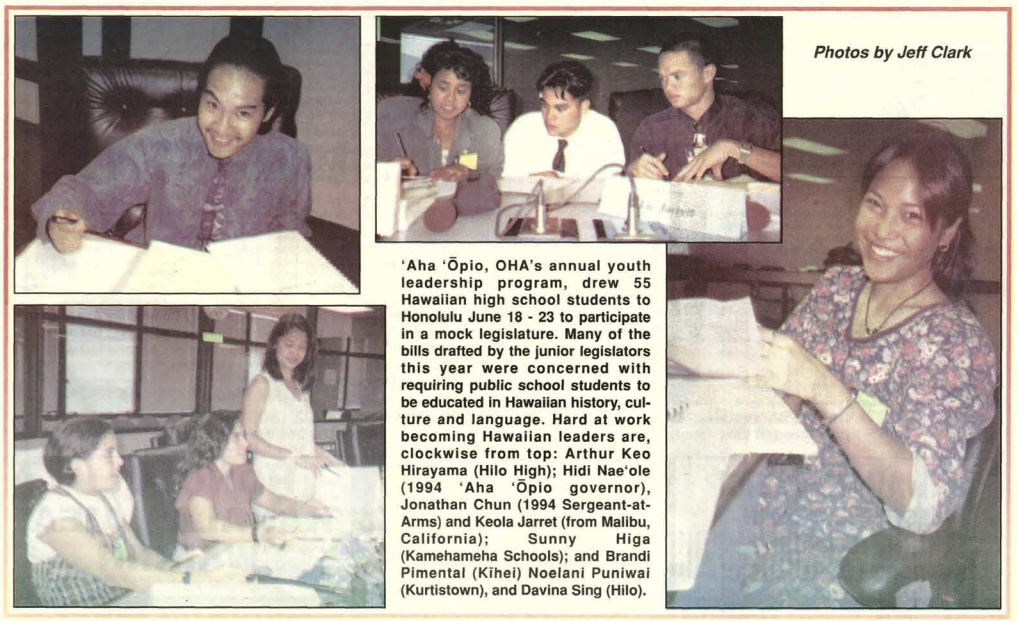
In the 16 years it existed, the ʻAha ʻŌpio program drew more than 800 students from across the state and mainland to Oʻahu for an intense crash course in lawmaking and civics that brought guests like then-Gov. Linda Lingle and key legislators. The program generated real policy change; measures that eventually passed the Legislature on college financial aid and geothermal development originated at the ʻAha ʻŌpio.
The revamped program, which is set to launch next June with 50 rising high school seniors, comes amid a push from educators to improve civic education in the islands. Advocates say Hawaiʻi’s low voter turnout is a symptom of a lack of engagement in civic life and local communities.
It also comes at a key time for Hawaiian issues. Kahuku High School Teacher Kaylene Sheldon, who isn’t part of the program but supports efforts to bring it back, says now is the right time to restart the program with renewals of military leases coming up and the impact of the Trump administration on Hawaiʻi.
“It’s good for students to learn the facts and the law at this crucial moment,” Sheldon said.
Sheldon wants students to tackle big questions: What is the federal government’s role here? What should it be? Who owns and controls land in the state? Who controls our water?
And, one question posed to her by Haunani Kay-Trask, Sheldon’s college professor: “Who benefits from our misery?”
‘We Want To Prepare Them’
The ʻAha ʻŌpio program ran from 1988 until 2004. After that, the office outsourced planning for it to the University of Hawaiʻi Hilo with the goal of turning it into a multi-year initiative with programs on each island. OHA was still funding the program through UH in 2010, but by then it had shrunk to a program only for Big Island students.
In the last year, OHA Trustee Kalei Akaka, granddaughter of the late-U.S. Sen. Daniel Akaka, and OHA Board Chair Kai Kahele, a former congressman who participated as a teenager in the 1991 ʻAha ʻŌpio, pushed heavily to restart the program. Trustees allocated funding to resume the effort in OHA’s most recent budget.
Kahele credits the program with jumpstarting his career — he first served in the military before being appointed to the state Senate and then winning election to the U.S. House in 2020 — and said the program “lays the groundwork for Native Hawaiian leaders.”
During the simulated legislative session, students would introduce bills and argue for support through committees and then the entire assembly. Spending a week immersed in history and the democratic process will give students “a better idea of what civic engagement really is,” Kahele said in an interview.
“We think that is something lacking, not just in the Native Hawaiian community but in the broader community,” he said. “We want to prepare them, so when they are 18 years of age and have the opportunity to vote they know why that is so important.”
In between sessions debating policy ideas, students will hear from guest speakers and can expect field trips to courthouses, ʻIolani Palace, the Mauna ‘Ala burial grounds and sites where government decision-making takes place, including the Capitol.
“If we get them in the spaces that they’re going to need to be in to be leaders and advocates, then those places won’t be as scary or unfamiliar when they need to go and actually do the work,” OHA education director Kuʻuleianuhea Awo-Chun said.
OHA has budgeted $200,000 to cover travel for students from neighbor islands, along with room and board and compensation for 20 staffers running the program next year.
Kahele said during a recent board meeting that House Speaker Nadine Nakamura supports the program and will make the House chambers and committee rooms available for OHA’s use in June. The office is exploring housing options at the East-West Center as well as at the University of Hawaiʻi and Kamehameha Schools.
OHA plans to reach out to schools directly to start recruiting students and will also take applications at the Native Hawaiian Convention next month in Seattle and the Association of Hawaiian Civic Clubs’ annual convention.
Summer Program Was ‘A Spark’
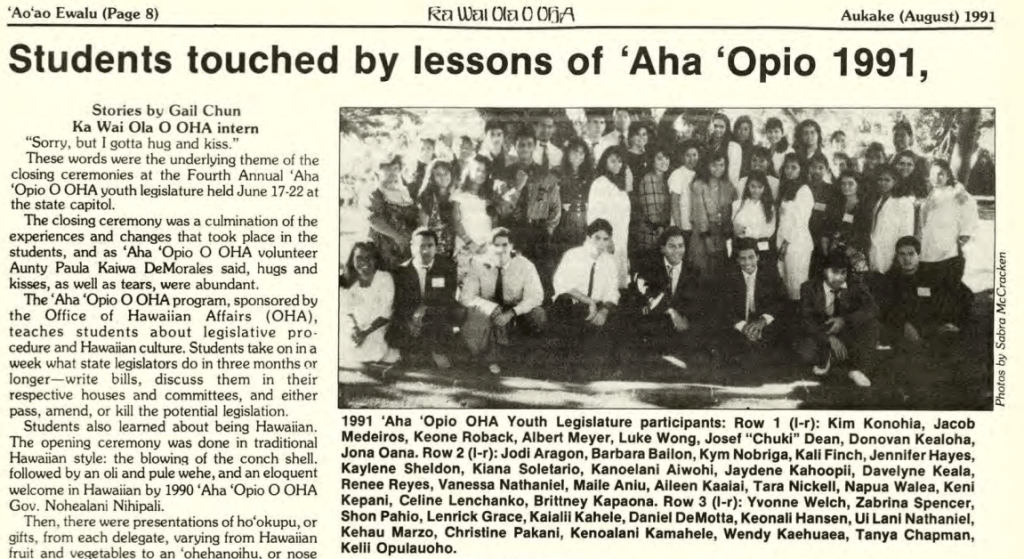
Sheldon said there were almost no Hawaiian language classes when she was in high school in the late 80s and early 90s. But her teachers were members of the Hawaiian civics clubs and encouraged her to apply for the 1991 ʻAha ʻŌpio program.
It was a crash course in government operations in Hawaiʻi. Newspaper accounts say Sheldon’s class, which included Kahele, had one day to research and write bills.
“It was kind of overwhelming,” Sheldon said.
An account of the 1991 ʻAha ʻŌpio program from Ka Wai Ola said the students proposed bills on job training programs for homeless people, funding for Hawaiian education programs, abortion rights and access to childcare for teen parents and geothermal development.

Sheldon recalled field trips to places like the Royal Mausoleum and Queen Emma’s Summer Palace.
She was surprised by the talent of her classmates. Everyone seemed adept at hula or singing and chanting. Neighbor island students were particularly attuned to issues like water diversions and land ownership.
“That was a spark in my life,” Sheldon said. “It was like ‘Oh, I’ve got to get more active in learning about these things.’”
She came back as an advisor a year later before heading to college, where she initially majored in business but then switched to Hawaiian language.
“It was just an indescribable feeling, like an ancestral connection, a pilina, or calling,” said Sheldon, who now teaches Hawaiian language at Kahuku High School.
OHA staff couldn’t find data on how effective the program was at increasing civic engagement, Awo Chun said. OHA plans to send surveys to alumni and participants to measure the program’s effectiveness this time around.
Anecdotally, it spurred change. A proposal from the original 1989 ʻAha ʻŌpio eventually formed the basis for a bill proposing a limited number of tuition waivers at the University of Hawaiʻi for Native Hawaiian students. That program is still in place today.
OHA trustees said they want to incorporate bills from the students into the office’s legislative package ahead of the 2027 session.
Civil Beat’s education reporting is supported by a grant from Chamberlin Family Philanthropy.

