Maui Weighs Kinder Approach To Homelessness Amid Encampment Crackdowns
Some council members want to set a clear legal policy for the administration to follow.
Some people had been living in the Ukumehame homeless encampment for years when county officials removed roughly a dozen from the grassy area just off Honoapi‘ilani Highway during a sweep in August, according to Native Hawaiian housing advocate Mōʻī Kawaʻakoa.
“A lot of them didn’t know where to even begin. They were confused, overwhelmed,” said Kawaʻakoa, who was there to provide assistance to those who were being displaced. “Over 25 years, you accumulate things — you have animals, you have plants, you have this and you have that.”
The Ukumehame enforcement action was among the most recent homeless encampment sweeps by local and state authorities on Maui, including one on Amala Place near Kanahā Beach Park in July and another near Kahului Harbor last year. The people displaced by these sweeps could soon have stronger protections under a measure the Maui County Council is weighing, bucking a nationwide trend toward more conservative policies to crack down on homeless encampments.
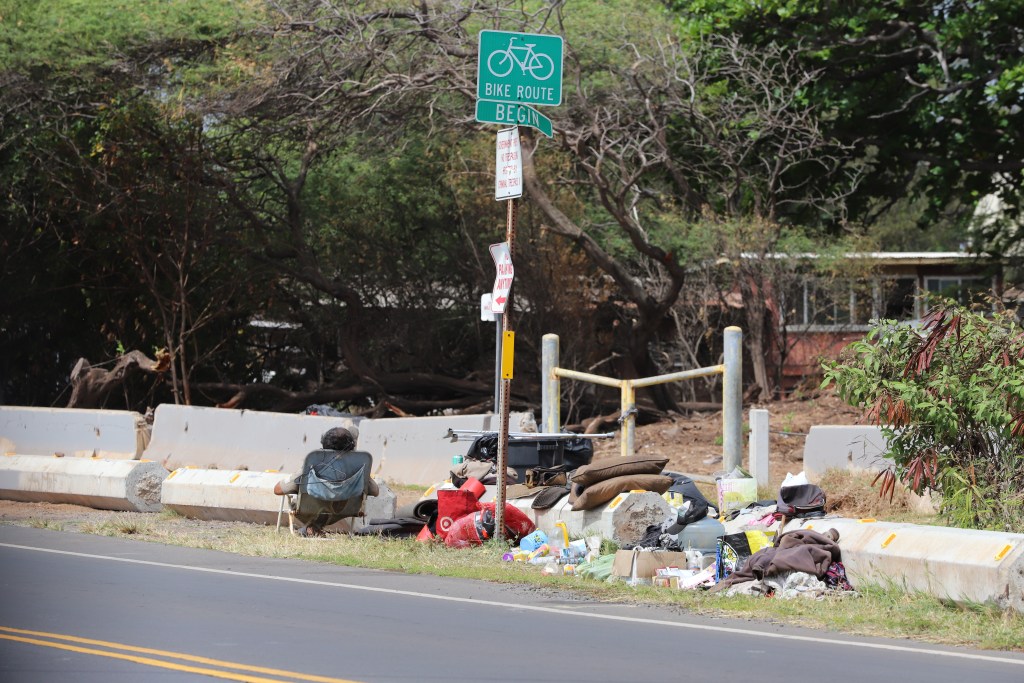
As the state and Honolulu also shift toward stronger methods to remove homeless people from the streets, council member Gabe Johnson of Lānaʻi is championing legislation to mandate a softer touch.
Last week, the council’s Water Authority, Social Services, and Parks Committee took up a bill that would provide clear instructions for how the county should conduct sweeps. Bill 111 would require the county give more notice to homeless individuals before clearing encampments, store their personal belongings and inform them about shelters and safe places.
Johnson said he wrote the bill because he believed local government officials should be required to treat all Maui residents with compassion and respect, and he said he was not swayed by changing political tides in other parts of the state or country.
“We should behave differently,” he said.
Council members on Thursday agreed to table the matter to give the council more time to review amendments and discuss them with the county attorney.
‘Much More Complicated’
In recent years, the U.S. Supreme Court ruled that local governments could enforce laws against homeless individuals that criminalize sleeping or camping in public spaces, and President Donald Trump signed an executive order that prioritizes federal funding for communities that adopt tougher policies aimed at reducing homelessness.
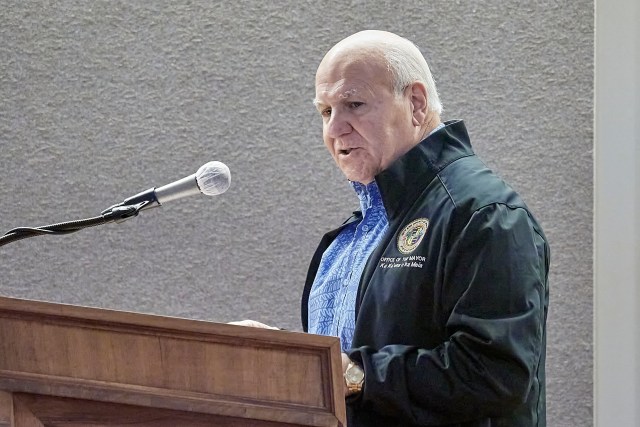
Closer to home, Honolulu Mayor Rick Blangiardi has openly embraced a strong-arm approach to homelessness and has overseen high-profile sweeps of encampments.
Kawaʻakoa, who leads the nonprofit Holomua Outreach, didn’t think any of that should matter on Maui. She was one of seven advocates arrested during the Ukumehame sweep after trying to help residents of the encampment move to another outdoor area instead of one of the county’s shelters.
“I don’t care what the federal government does, they’re going to do it anyway. It’s out of our hands,” she said. “What we can control is what happens here on Maui. So if we can handle something on our level locally and set an example, then maybe we can inspire the state of Hawaiʻi to follow suit.”
Maui County Council Chair Alice Lee said homelessness should be dealt with compassionately, but it is “much more complicated than meets the eye” and requires more than just ensuring adequate access to shelter before sweeps.
“I take a more holistic view of the problem,” Lee said, “because not every houseless person has the same problems.”
The council should coordinate with the state to address issues like homelessness, mental illness and drug abuse, she said, before trying to relocate people to shelters where they may or may not be interested in staying.
Homeless Encampments On Maui
Johnson first proposed Bill 111 about a year after the Aug. 8, 2023, wildfires displaced thousands of Maui residents. It was also just a few months after a Hawaiʻi Supreme Court ruling determined that homeless people’s rights were violated in 2021 when the county forcibly cleared a Kahului encampment. Officials failed to ensure there was adequate shelter space available before conducting the sweep and disposed of personal property, including cars, according to court documents.
“The fact that we got sued and the fact that the previous administration was throwing away citizens’ belongings … That’s why I wrote the bill,” Johnson said.
On Thursday, almost two dozen people from Maui, Molokaʻi and Lānaʻi testified largely in favor of the legislation and the proposed changes. Several amendments, crafted by Johnson in coordination with local housing advocates, aimed to more clearly outline a sweep protocol, including by establishing that the county must provide encampment residents 45 days notice before a forced relocation, ensure adequate shelter accommodations are available for varying types of households and store displaced people’s personal property for at least 90 days.

Julie Checknita said it was long past time for the county to drastically change its approach to homelessness and the forced removal of encampments.
“Families want to be together. People want to be with their community. These camps are communities,” she said. “They’re people who support each other, and tearing them apart and sending them scrambling is such a waste of resources. Where are they going to go? They’re not going to disappear. They’re human. They’re here. They need somewhere to go.”
Kelsey Mapa told council members that her “heart breaks every few months” when the county clears encampments and she sees her unhoused neighbors “get dehumanized and swept away like trash.”
County officials have said the homeless encampments along Amala Place, Ukumehame and elsewhere were done in the name of public safety and fire prevention.
Noah Jackson, a representative from Mayor Richard Bissen’s administration, told the council that the most recent sweeps in Kahului and Ukumehame reflected the government’s efforts to improve its protocol for removing encampments.
In recent months, officials had arranged for surge bedding at shelters before conducting sweeps, moved forward with its safe parking program, updated its contract with the shelter organization Ka Hale A Ke Ola, offered trauma-informed care through the Department of Human Concerns and taken other actions intended to make their approach to homelessness more compassionate, he said.
Codifying the requirements outlined in the proposed amendments to Bill 111 could also put the county at risk of being unable to adapt in certain unforeseen situations, said First Deputy Corporation Counsel Mimi DesJardins.
“Nobody’s going to be 100% happy,” she said. “We’re trying to comply with the law, but be compassionate at the same time. That’s where the flexibility is required.”
Johnson isn’t convinced.
“The administration might be considering themselves doing a good job,” he said. “I disagree, so I’m trying to put it in code to make them do it a particular way.”

Some housing advocates and homeless individuals who testified at Thursday’s meeting offered suggestions for how the county could improve its approach.
A man going by the name Stitch said he was homeless but lucky to have a landowner’s permission to camp on their private property. He encouraged the county to consider setting aside land where others without a home could camp legally.
“Just give them a piece of land,” he said. “Throw a couple porta-potties out there. Police it like you would police any other public area and encourage them and work with them to get back on their feet again.”
Only one person — Melvin Johnson Jr. — testified against Bill 111 in its entirety. He agreed steps need to be taken to help more of Maui’s homeless population get connected with the resources they need, but said the county would be at risk of losing federal funding if the legislation were to pass.
The last point-in-time count, which measures the level of homelessness on a single night, was conducted in January 2024. It estimated there were 654 homeless people on Maui, with 369 of them sheltered and 285 unsheltered.
According to a December report commissioned by the council, homelessness on Maui was primarily caused by income inequality, housing availability and the cost of living.
Civil Beat’s coverage of Maui County is supported in part by a grant from the Nuestro Futuro Foundation and its reporting on economic inequality is supported by the Hawaiʻi Community Foundation as part of its work to build equity for all through the CHANGE Framework; and by the Cooke Foundation.