On a media tour, Bryce Moore, left, and Star-Advertiser reporter Allison Schaefers photograph a grave in Papaloa Cemetery. (Kevin Fujii/Civil Beat/2025)
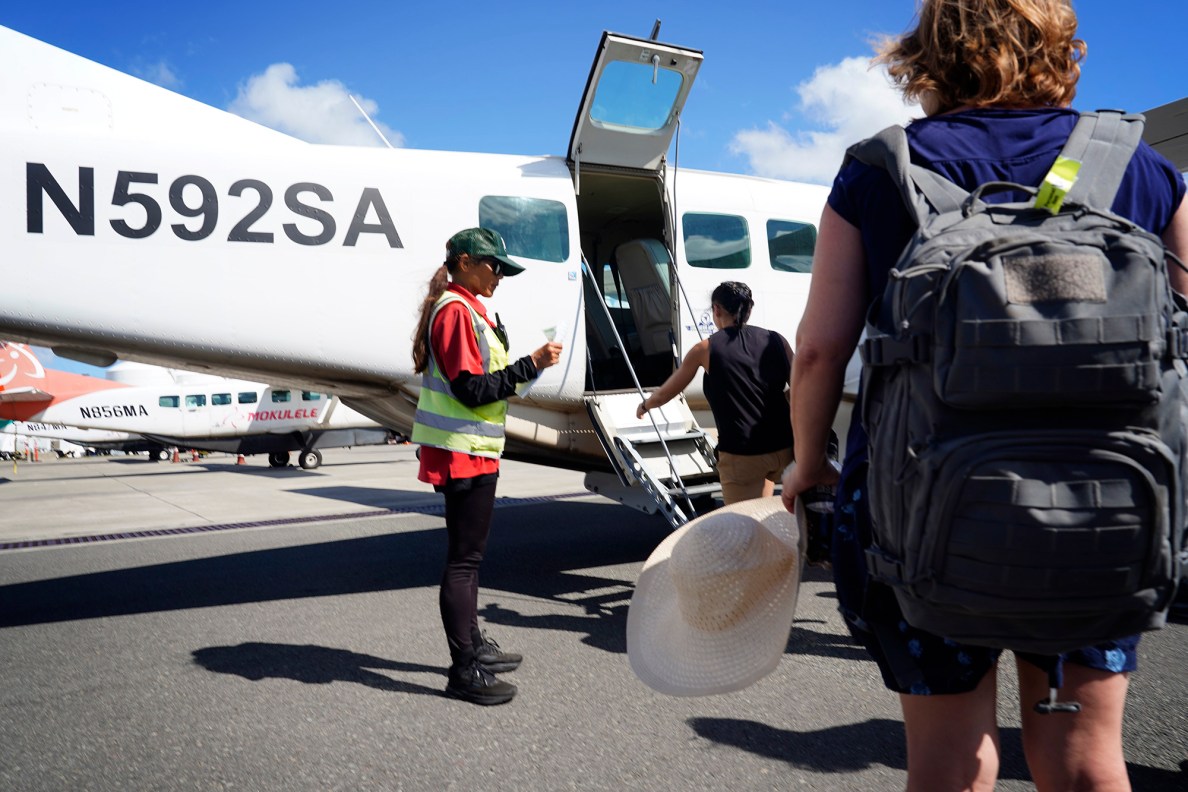
A Mokulele Airlines Cessna 208B Caravan loads up reporters and photographers for a media tour of Kalaupapa National Historical Park. (Kevin Fujii/Civil Beat/2025)
More than five years after the Covid-19 pandemic shuttered tours of Kalaupapa National Historical Park, Hawai‘i’s famed leprosy colony has reopened to the public.
Kalaupapa Saints Tours, operated by 90-year-old former Hansen’s disease patient Meli Watanuki, will offer limited access to the historical site starting later this month.
There are only 10 scheduled tours this year with an eight-person cap. All 80 slots for the remainder of 2025 sold out in about 75 minutes, said Randy King, Seawind Tours & Travel founder and CEO who advises Watanuki. Wait lists are quickly filling up.
Kalaupapa as seen from the air during the media tour flight’s approach to Kalaupapa Airport. The arrival of the first dozen patients to Molokaʻi’s remote peninsula on Jan. 6, 1866 was part of a drastic government measure to protect the rest of society from a then little-understood and incurable infectious disease. Hansen’s Disease, also known as leprosy, is now curable with an antibiotic regimen of six months to two years. (Kevin Fujii/Civil Beat/2025)KHON2’s Bryce Moore receives a lei from Sister Barbara Jean Wajda of the Sisters of St. Francis of the Neumann Communities. Mother Marianne was also a sister of the same order. She was canonized as St. Marianne Cope in 2012 for her mission work with the exiled patients of Kalaupapa. (Kevin Fujii/Civil Beat/2025)
Molokai’s top tourist destination closed in early March 2020 under pandemic-era public health restrictions far stricter than those enacted in the rest of the state. A blanket no-visitor policy meant that former Hansen’s disease patients, as well as National Park staff and scientists who live on the secluded Kalaupapa peninsula, could not receive visits from family and friends.
Gatherings were forbidden in groups larger than five, even outdoors. Participants in smaller gatherings had to wear masks and stay 6 feet apart.
Those rules endured for more than three years, leading some former patients to beg for hugs even as much of the rest of the world was growing to accept Covid-19 as a manageable part of everyday life.
Even after state health regulators lifted pandemic-era restrictions, the National Park Service continued to block public access while the agency developed a new tour permit approval process.
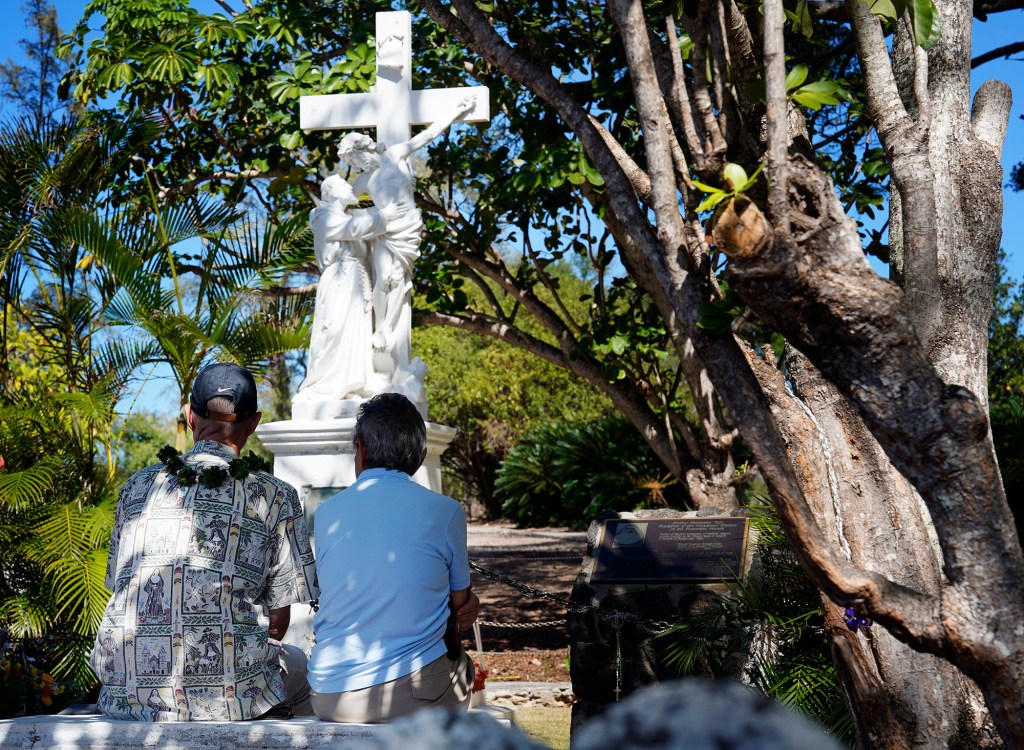
Papaloa Cemetery is one of the early stops on the Kalaupapa Saints Tour. Roughly 8,000 burials have amassed since the first exiles arrived on the peninsula in 1866. Most of the people forcibly removed from their families and banished to Kalaupapa were of Native Hawaiian heritage. (Kevin Fujii/Civil Beat/2025)
Hawaii News Now reporter Casey Lund, far left, Pacific Historic Parks Communications Director Jim McCoy and Star-Advertiser reporter Allison Schaefers tread the path where Father Damien once walked at Papaloa Cemetery during the Kalaupapa Saints Tour. (Kevin Fujii/Civil Beat/2025)
An axis deer stares down a group of journalists during the Kalaupapa Saints Tour at Papaloa Cemetery. (Kevin Fujii/Civil Beat/2025)
NPS does not facilitate its own tours of Kalaupapa. But the agency has the power to approve tour providers owned by Hansen’s disease patients who reside on the peninsula. The NPS is required to offer this business opportunity to patient-residents until no more are interested.
Whereas other national parks welcome millions of people annually, Kalaupapa has historically allowed a maximum of 100 daily visitors, including staff. The visitor cap has been reduced to 30 people a day, a decision that respects the privacy and lifestyle of former patients who still reside on the peninsula, Park Superintendent Nancy Holman said.
Before the pandemic, there were two approved patient-owned tour providers. One of those companies, Kekaula Tours, is defunct. Former patient Clarence “Boogie” Kahilihiwa owned the tour company until he died at age 79 in 2021.
The other tour provider was Saints Damien and Marianne Cope Molokai Tours, which is co-owned by Watanuki and a non-patient who served as the company’s tour guide and bus driver.
Watanuke was 18 when she was diagnosed with Hansen’s disease in her native American Samoa. She moved to Kalaupapa of her own volition after a second bout of illness in Honolulu in the 1960s left her abandoned by her husband and young son. Living in the settlement, she made friends and remarried.
Her tours are small to keep the peace among her fellow former patients and other residents, most of whom are employed by the National Park Service or the Hawaiʻi Department of Health.
It’s paramount that visitors respect the painful history of Kalaupapa and the people who continue to live there, Watanuke said.
Kalaupapa Saints Tour guide John Meadows, left, and Randy King, founder of Seawind Tours & Travel, approach a historic structure called the longhouse where exiles met with visitors, separated by a screen. (Kevin Fujii/Civil Beat/2025)Inside the longhouse, where exiled leprosy patients met with visitors, separated by a now-removed screen. (Kevin Fujii/Civil Beat/2025)Kalaupapa National Historical Park Superintendent Nancy Holman greets journalists on the first tour of Kalaupapa since Covid closed the peninsula to tourists more than five years ago. Multiple state and federal agencies worked together to allow a patient-owned tour company to bring visitors back, she said. (Kevin Fujii/Civil Beat/2025)Kalaupapa Saints Tour stops at a heiau, or ancient Hawaiian temple, on Damien Road. A new tour van brought to Molokaʻi’s secluded outpost on the annual barge shuttles visitors around the 12-square-mile peninsula’s historical sites. (Kevin Fujii/Civil Beat/2025)
Kalaupapa Saints Tour stops at Father Damien’s grave at St. Philomena Church. (Kevin Fujii/Civil Beat/2025)
Protruding from Hawaiʻi’s steepest sea cliffs, Kalaupapa Peninsula is a windswept outpost with a difficult history as the place where thousands of people afflicted with Hansen’s disease were exiled to live apart from the rest of society.
The first exiles arrived on the remote peninsula in 1866. Conditions were so deplorable at that time that being exiled to Kalaupapa was synonymous with certain death.
Three patients remain of the many former leprosy patients who chose to continue to live in Kalaupapa despite the 1969 repeal of the Hawai‘i law that exiled them there until death. One of them celebrated his 101st birthday in April. Another three former patients reside in Honolulu, where they can access more advanced medical care. Those still living on the peninsula receive support from the Hawaiʻi Department of Health.
For many of the former patients who chose to remain in Kalaupapa voluntarily as full-time residents, the peninsula was the only home they had ever known. Others had been abandoned by their family members outside the settlement.
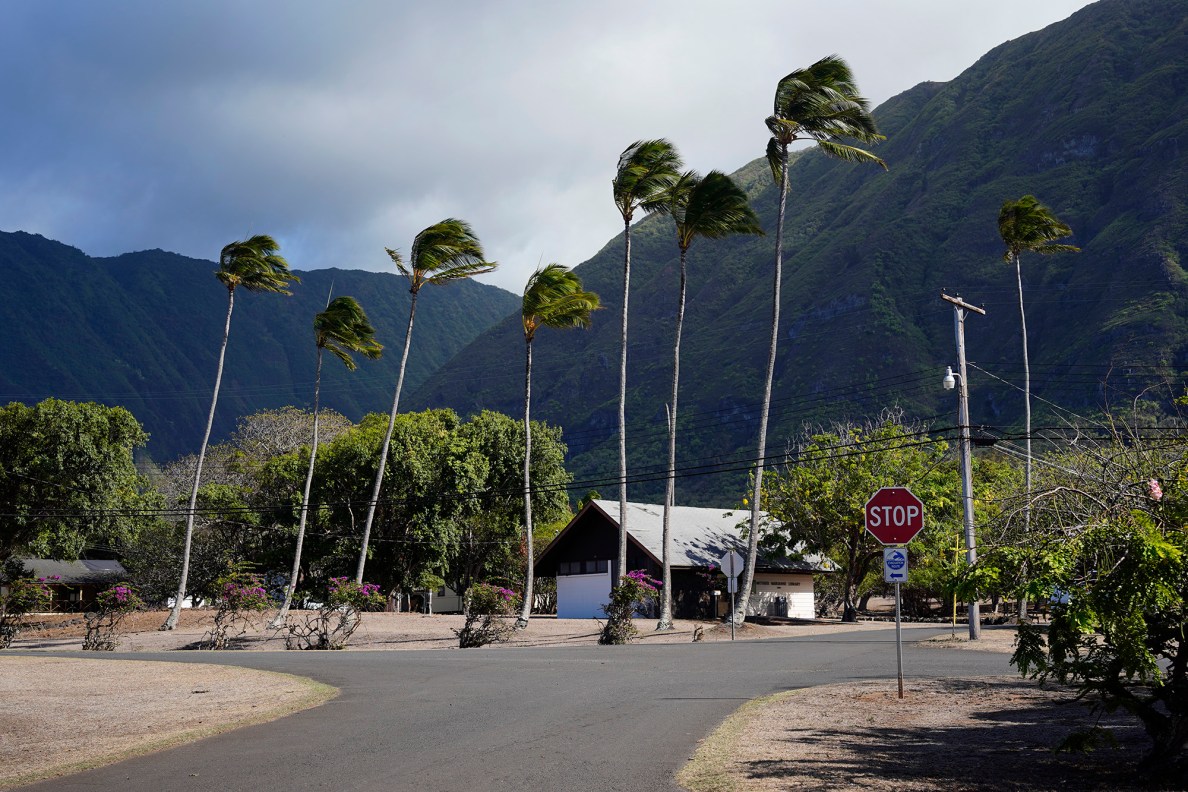
Hawaii News Now reporter Casey Lund photographs the entrance to St. Philomena Church during the inaugural tour of Kalaupapa operated by the former Hansen’s Disease patient-owned company Kalaupapa Saints Tour. (Kevin Fujii/Civil Beat/2025)Adorned with lei, a bust of Father Damien sits at the edge of the sanctuary at St. Philomena Church. (Kevin Fujii/Civil Beat/2025)John Meadows, a tour guide for the revamped Kalaupapa Saints Tour, points out the holes in the floor of St. Philomena Church. Father Damien cut the holes and fashioned long straws from leaves to help patients afflicted with hypersalivation attend mass. (Kevin Fujii/Civil Beat/2025)The Kalaupapa Saints Tour stops for lunch at Judd Park, which offers the quintessential view of Molokaʻi’s rugged north shore. (Kevin Fujii/Civil Beat/2025)Sister Barbara Jean Wajda steps out of Bishop Home as a group with Kalaupapa Saints Tour passes by. Mother Marianne Cope, now St. Marianne Cope, managed Bishop Home for young girls and older single women afflicted with Hansen’s Disease and banished to the peninsula. (Kevin Fujii/Civil Beat/2025)Kalaupapa Saints Tour stops at the home of Kenso Seki, affectionately known as the mayor of Kalaupapa. He was an inventor, craftsman, handyman and community figure who was respected for his faith and service to others. Kenso gifted his home on the peninsula to the National Park Service for use as a museum. (Kevin Fujii/Civil Beat/2025)Seawind Tour & Travel Founder and CEO Randy King, left, and Sister Alicia Damien Lau sit in front of the grave of Mother Marianne Cope. Patients were angered in 2005 when the Franciscan nun was exhumed from the settlement 87 years after her death and returned to Syracuse, New York, where she began her ministry. But because she had osteoporosis, only a small collection of bone fragments could be extracted from Kalaupapa’s volcanic dirt. This was a relief to some of the patients who revered the saint for her dedication to Hawai‘i’s outcast leprosy victims despite the risks to her own health. (Kevin Fujii/Civil Beat/2025)A mosaic of Father Damien by artist Karen Lucas greets visitors to the Church of St. Francis of Assisi. (Kevin Fujii/Civil Beat/2025)A grove of palm trees line a street intersection in Kalaupapa, where there are few vehicles and seat belts are optional. Visitors are likely to encounter more axis deer than peninsula residents. (Kevin Fujii/Civil Beat/2025)
A collage of Hansen’s Disease patients inside Father Damien Memorial Hall. (Kevin Fujii/Civil Beat/2025)
Before and after portraits of a Hansen’s Disease patient inside Father Damien Memorial Hall. (Kevin Fujii/Civil Beat/2025)
All told, 8,000 patients were exiled to the remote Molokaʻi peninsula. “Interestingly, there’s only 1,300 grave markers,” tour guide Meadows said.
The community bulletin board outside of Paschoal Hall offers Kalaupapa residents updated community information. (Kevin Fujii/Civil Beat/2025)Television news reporters Casey Lund and Bryce Moore attach microphones to Kalaupapa Saints Tour owner Meli Watanuki. Seawind Tours & Travel Founder and CEO Randy King and Watanuki’s grandniece Rosa Key look on. (Kevin Fujii/Civil Beat/2025)Kalaupapa Saints Tour owner Meli Watanuki relied on her deep faith and love of Kalaupapa during the pause before her company was awarded a permit to bring visitors back to the storied peninsula. (Kevin Fujii/Civil Beat/2025)
Kalaupapa is also the original resting place of saints, including Father Damien who devoted a third of his life to helping residents of the leprosy colony before he contracted the disfiguring disease and died in 1889.
When Damien’s remains were exhumed in 1936 and reburied in his native Belgium, Sister Alicia Damien Lau said the door to the trunk of the hearse inexplicably flung open on the roughly 4-mile drive from his burial site in Kalawao to the Kalaupapa airport.
“It was his soul jumping out because he wanted to stay in Kalaupapa,” Lau said.
Lau has been at Kalaupapa since 1965. She is one of two Catholic nuns who reside in Kalaupapa for the benefit of the last living resident patients.
“I’ll be here until the last patient is gone,” she said.
Soaring cliffs form a spectacular backdrop to the Kalaupapa National Historical Park sign in the afternoon golden light. (Kevin Fujii/Civil Beat/2025)
The Kalaupapa Airport parking lot. (Kevin Fujii/Civil Beat/2025)
Defunct pay phones at Kalaupapa Airport reflect the slow pace of change on the remote peninsula. The airport building is currently under renovation for the first time in 73 years. (Kevin Fujii/Civil Beat/2025)Pacific Historic Parks Communications Director Jim McCoy, left, shares a light moment with Sister Alicia Damien Lau and Park Superintendent Nancy Holman as the Kalaupapa Saints Tour media tour ends and participants prepare to fly back to Honolulu. Holman said she is excited and energized to have visitors return to the park. (Kevin Fujii/Civil Beat/2025)
As a local newsroom, Civil Beat has a unique public service role in times of need. Your support ensures that we can pivot when emergencies arise and get vital information out to everyone, from all communities.
Support timely and accurate breaking news stories as well as impactful coverage across the state. Donate today.