

Hawaiʻi Lawmakers Introduce A Lot Of Bills. See Whose Pass — And Fail
Committee chairs and legislative veterans have the best track record, a review of the data shows. But even they only get a fraction of what they introduce through.
Only about 10% of all bills introduced during a Hawaiʻi session will pass and become law. The 2025 session was no exception — 3,172 bills were introduced in the House and Senate and only 313 became law.
Still, lawmakers are lucky if 10% of their own bills make the cut. A Civil Beat analysis of the 2025 session shows that just one-third of lawmakers had at least 10% of their bills approved.
“The real question is why so many bills get introduced in the first place,” Colin Moore, a political scientist at the University of Hawaiʻi Mānoa, told Civil Beat in an email. “Legislators usually have a few core priorities, but most of the demand comes from constituents and organized interests that ask them to submit measures.”
The lawmaker who introduced the most bills and saw the most pass was Sen. Karl Rhoads, who saw just nine of his 173 measures succeed. That works out to 5%.
And some bills — notably, the budget bill that funds and operates state government — is must-pass legislation. The author of that measure was Rep. Kyle Yamashita, a Democrat, who scored highest in his chamber for number of bills passed, eight total.

Explore detailed legislator profiles, voting records and what happens in hearings on Digital Democracy.
Most of the lawmakers interviewed for this story said they are comfortable with the current system and would not want to further limit the number of bills they can introduce. Senators have no limit, while the House has several limits depending on whether it’s the first or second year of a biennial session and what committee a member chairs.
Supporters of limits argue they would make the process more efficient, said Moore, “but it’s unclear how much time would actually be saved since most bills never even get a hearing. The evidence for real efficiency gains is anecdotal, and caps could unintentionally disadvantage less organized or underfunded groups that might struggle to get their ideas heard.”
Lawmakers also argue that most legislation, even if it does not get heard, is worthy of consideration and note that a good many ideas for bills come from their own constituents.
Moore calls those “hero bills,” proposals “that have little chance of passing but allow lawmakers to show responsiveness — i.e., be a hero — to particular groups or constituents.”
Rather than capping the number of bills each year, Moore suggests limiting the number of bills that are introduced “by request,” since the “cost of doing that favor for a constituent or interest group would rise if legislators had fewer opportunities to introduce measures. That would be a positive outcome.”
The legislators who introduced the most “by request” bills in the 2025 session were Senate President Ron Kouchi and House Speaker Nadine Nakamura, both Democrats. Civil Beat excluded nearly all “by request” bills from this analysis because most measures were introduced on behalf of the governor, county councils, mayors and prosecutors, and dozens of state agencies.
Still, Moore said limiting those bills is low on his list of reform proposals.
“If there’s a rule worth changing, I’d rather see more transparency in the ‘by request’ system,” he said. “Letting the public and media see who a bill is being introduced for could reduce the number of BRs and make the process more open and accountable.”

Civil Beat is focusing on transparency, accountability and ethics in government and other institutions. Help us by sending ideas and anecdotes to sunshine@civilbeat.org.
What The Data Shows
The analysis of the 2025 session shows that the legislators who introduced and passed the most bills are veteran lawmakers and chairs of committees. Rhoads and Yamashita, for example, chaired the Senate Judiciary Committee and House Finance Committee, respectively. (Yamashita was replaced by Democratic Rep. Chris Todd at the end of session.)
As a party, Republicans introduce and pass far fewer bills than Democrats, who hold a 64-12 majority. Those in leadership positions like the Senate president and House speaker and their top lieutenants are also less likely to introduce and pass bills.
There are prominent exceptions to that last point, however. Dru Kanuha, the Senate majority leader, introduced the fourth-highest number of bills — 93 total. But 57 of those bills were what’s known as short-form bills, blank pages that can be filled in later should the need arise for major legislation.
In the House, each committee chair may introduce up to five short-form bills as long as they pertain to the committees’ subject matter.

What Lawmakers Say
Rhoads defends introducing the most bills. He says 173 in 2025 was higher than in past sessions.
“The reason I introduced them is because I thought there was a problem that needed to be solved, and we just happened to get a lot of issues that came up that looked like they needed legislation to fix,” he said. “Do I wish more of them had passed? Absolutely. Am I proud to be the one who got the most? Sure. I mean, I work hard and I try to get things done.”
Bills authored by Rhoads, a Democrat, that passed included one providing additional funding to the adult services probation branch of Oʻahu’s First Circuit Court and to increase the fees paid to witnesses in civil and criminal trials.
“Most of the ones that actually passed were ones that came from a constituent or something that came to light at the neighborhood board meeting,” he said.
Rhoads added that he doesn’t usually introduce “by request” bills, especially if he doesn’t like them.
“And if someone comes to me and with an idea that I think is a good one, I’ll just put it in as my own,” he said.
Rep. Darius Kila ranked seventh for the most bills passed — seven total, or 16%. Thirty-five bills died and another passed (it called for regulating e-bikes) but was vetoed by Gov. Josh Green.
Kila, a Democrat who is chair of the House Transportation Committee, attributed his relative success rate — second best in the House after Yamashita — to team work and residents in his district.
“I would like to think it’s a reflection of collaboration and the effort to really identify issues that people bring up to me,” he said. “And I think as a committee chair, there’s obviously sometimes a lot of issues in the subject matter. But then even in my community, there are some things that are super specific to the community.”
A bill to fund the University of Hawaiʻi Cancer Center to conduct a multiethnic cohort study focusing on the social determinants of health, lifestyles, environmental exposures and resilience factors of Native Hawaiians, Pacific Islanders and Filipinos, was one that passed. Kila represents a district that includes Nānākuli, which is in close proximity to landfills.
Another Kila bill requires the Department of Transportation or appropriate county department to scan dead cats and dogs for disposal for microchips so that pet owners can be notified. Busy Farrington Highway runs through Kila’s district.
Kila said he did not want to limit the number of bills introduced, saying it would amount to limiting the voices of lawmakers and the community they represent.
“Without the citizen initiative process, we have to introduce bills for our constituents, and that’s their opportunity to try to float the idea and actually get teeth behind it,” he said.
Sen. Brenton Awa, a Republican who was among the top 10 legislators who saw none of their bills pass, doesn’t want to limit bill introductions, either. He does not think it would make the Legislature operate more efficiently.
“The system is not broken,” he said. “The system would work if people would work together across the aisle, but because we’re in a one-party dominant Legislature, we don’t have that leverage right now.”
All 14 of Awa’s bills died. One of them — Senate Bill 1582 — unanimously passed the Senate but was quickly killed in the House. It called for recognizing the coconut palm as a “culturally significant plant and sustainable staple food source” in the islands.
Awa blamed partisan politics in the House for the bill’s demise, even though Hawaiʻi is in the midst of an environmental crisis with the invasive coconut rhinoceros beetles destroying trees.
“It wasn’t a lack of time or support for the bill (that killed it),” he said. “I could introduce the cure for cancer and they would pretend it doesn’t exist.”
Some legislators say the session’s short length constrains the ability to either hear more bills or allow more time for their consideration. The Hawaiʻi Constitution requires the annual session to begin on the third Wednesday every January but sets no adjournment date. It usually ends in early May.
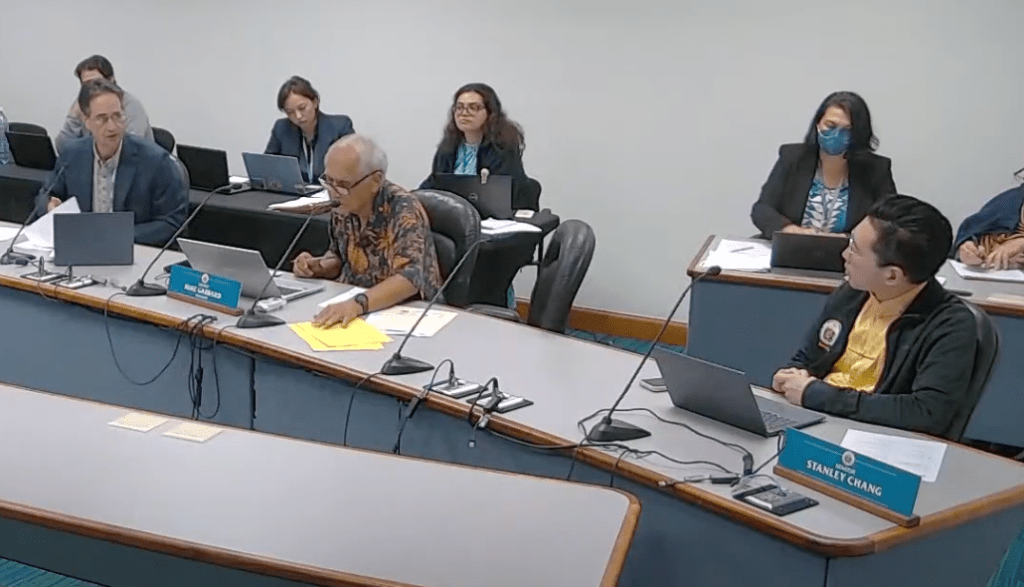
“I don’t necessarily think that there are too many bills, but I do think that the Legislature does not have time to consider all of the bills,” said Sen. Stanley Chang, chair of the Senate Housing Committee. “And I think there are a couple of structural reasons why.”
One of reasons, he said, is because there is a limited time period in which to introduce bills at the beginning of session.
“So the members are really incentivized to throw the kitchen sink in by a certain date, because they simply do not have the opportunity to raise a new issue come February or March,” he said, adding that sometimes bills are “half baked” so early in the process. “I think if that deadline were removed, then there would no longer be the incentive to dump in the kitchen sink by whatever the January deadline is for a bill introduction.”
Hawaiʻi Legislators
Learn more about the legislators interviewed for this story. Explore detailed legislator profiles, voting records, and hearing participation on Digital Democracy. Visit Digital Democracy
Chang also said that the legislative session that stretches from late January to early May simply does not give members enough time to consider all bills.
“I kill a lot of my own bills because I don’t have the time to hear them,” he said. “But if we had an unlimited legislative session, if we had a continuous legislative session where anyone could introduce a bill at any time, and anyone could hear a bill at any time, then I think that would address that issue.”
Chang, who still managed to be one of the top introducers of bills and among the most successful in seeing his own bills pass, expressed frustration at time limits.
“We could work on bills more thoughtfully,” he said if lawmakers had longer sessions. “Instead of taking multiple years to refine a bill, we could refine it over multiple months. We could revisit the issue month after month instead of having to meet a deadline in two weeks that, if you don’t meet, the bill is going to die.”
Foaad Khosmood, the research director for Digital Democracy, contributed to this report.
Check out the complete list of legislators and the bills they introduced as lead author, and the percentage of bills they had passed during the 2025 session. (Note: Rep. Joe Gedeon did not participate in the 2025 session.):
We need your help to improve Digital Democracy in time for the 2026 session. Please check it out and drop us a note at digitaldemocracy@civilbeat.org with anything we need to fix and interesting ideas for us to look into.


