

This School Wanted Officers On Campus. 3 Others Will Get Them First
Representatives of Nānākuli High and Intermediate School say they have been left out of Oʻahu’s upcoming school resource officer pilot program.
Updated: This story has been updated to include information from the Department of education provided after a publication.
Two years ago, Kaui Asinsin brought the idea of getting a police presence at Nānākuli High and Intermediate School to her neighborhood board.
Asinsin, who was then a security attendant on campus, was tired of seeing multiple fights per week break out between students.
Now, a pilot program with the police department is almost ready to be implemented at three Oʻahu schools, but Nānākuli High and Intermediate is not one of them.
“I’m happy that it got passed, but I’m disappointed that Nānākuli got overlooked,” said Asinsin, who now works as a community schools coordinator at the campus. “Nānākuli gets overlooked with resources. We just don’t seem to get what we should get.”

State Department of Education officials selected Kaimukī, Kapolei and Waiʻanae high schools as the campuses to get school resource officers — a term for specially trained police officers assigned to school campuses. Department spokeswoman Nanea Ching said in an email that the pilot schools were selected because they either have existing career pathway programs with the police department or are working to build one.
“This initiative builds on meaningful partnerships already in place,” she wrote.
State Sen. Samantha DeCorte, who represents West Oʻahu, including Nānākuli, has been helping lead the charge to get officers at the school since 2023, when she was chair of the Nānākuli-Māʻili Neighborhood Board. She doesn’t know why the school wasn’t chosen and is frustrated by the lack of communication from the education department.
“Never at any point were we under the impression that Nānākuli was not going to be the priority,” she said. “Somebody needs to be held accountable.”
The SROs, who are all retired police officers, are expected to start sometime in the coming weeks once the state police union contract gets approval from the county councils.
‘We’re Not Getting Any Answers’
Advocates for the program say they’re hopeful that once the pilot is over, the program will be able to expand to Nānākuli. But they’re frustrated that they have to wait.
“It just stings that we’re not getting it now when we could use it now, not next school year,” said state Rep. Darius Kila, who represents parts of West Oʻahu, including Nānākuli and Māʻili.
Kila was also part of the initial push for the school resource officer program, and in 2023 sent a letter to Department of Education officials asking for authorization to hire additional after-hours private security guards for the Nānākuli campus. The school had multiple high-profile incidents that year, including a student who was assaulted by eight other teens at lunch and a 15-year-old who was beaten and robbed on campus after school hours.
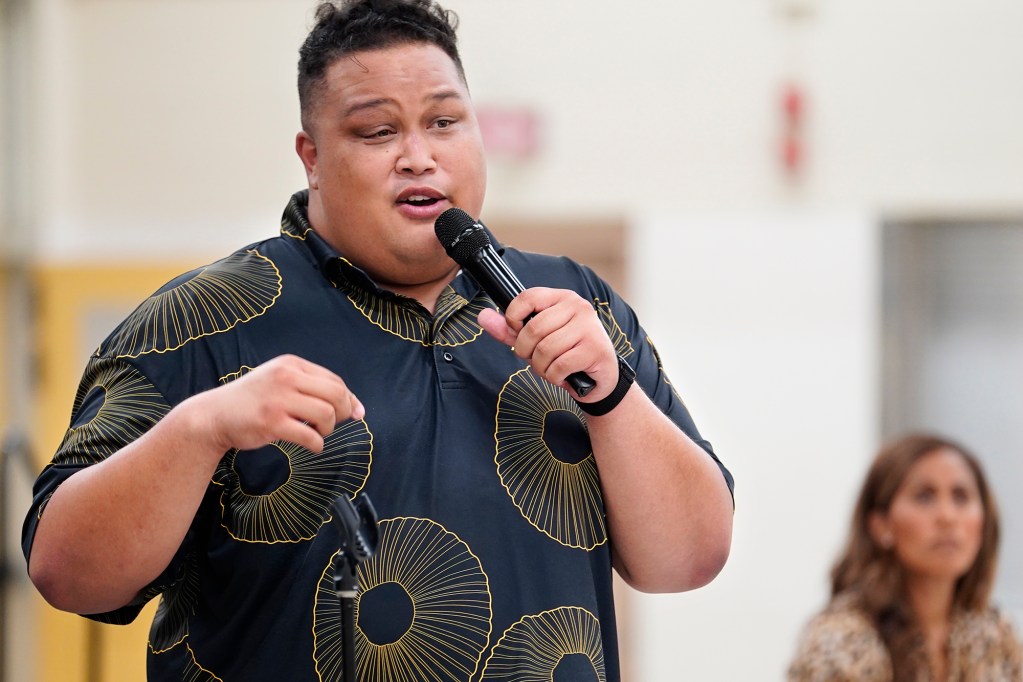
Last month, Kila wrote another letter asking that Nānākuli be reconsidered for the program. He cited rising concerns about youth violence on the Westside.
“Nānākuli High School has faced unique safety challenges over the years, and our students, faculty, and families deserve the same proactive protections afforded to other communities,” he wrote. “It was precisely these concerns that gave rise to the conversations about establishing a pilot program in the first place, which makes our exclusion all the more concerning.”
The letter was addressed to Honolulu police Interim Chief Rade Vanic, but police spokesperson Claudette Springer said it was the Department of Education that selected the schools.
High-profile incidents also have occurred at Waiʻanae and Kapolei high schools in recent years. A video of Waiʻanae High School students beating a fellow teen went viral in 2022, leading to the arrests of four 17-year-old boys. Two Kapolei High School students were arrested in 2023 after multiple brawls broke out on campus.

During the 2023-2024 school year, Nānākuli High had 125 out-of-school suspensions, compared to 186 at Waiʻanae High School, 219 at Kapolei High School and 39 at Kaimukī High School, according to data published by the Department of Education. Other schools not selected for the program had far more suspensions, such as Waipahu High School, which had 289, and Campbell High School with 272.
But it’s unclear what factors went into the education department’s decision, which is frustrating for DeCorte.
“We need to be able to communicate that to the teachers and the parents,” she said. “We’re not getting any answers.”
Asinsin said violence at Nānākuli High and Intermediate has improved thanks to private security guards patrolling the campus and the elimination of recess, when fights would often start. Honolulu police officers also visit the school monthly for events.
But just because the fighting has subsided doesn’t mean the school shouldn’t be working to prevent future issues, she said.
“Schools in general, we’re so reactive instead of proactive,” she said. “Sometimes we can let things go when we could have prevented it.”
Start Date To Be Determined
Under the program, three officers will be stationed at each of the selected schools. Their start date will be decided once the police union contract has been finalized statewide.
The officers all attended a National Association of School Resource Officers training in Arizona earlier this year. They are fully sworn officers and will carry guns on campus, according to Honolulu police spokesperson Alina Lee.
The department has proposed a salary of $96,000 per year, though that may change depending on the finalization of the union contract, Lee wrote in an email. They will be paid out of the Honolulu Police Department’s operating budget.

Jonathan Frye, vice president of the police union, said in a statement that HPD is too short-staffed to place officers in schools, but he called using retired officers “the next best thing.”
“Every student deserves to go to school on a safe campus,” the statement says. “We are hopeful the pilot program succeeds and becomes a model that can be expanded island wide.”
Kauaʻi, Maui and Hawaiʻi counties already have school resource officer programs in place.
Disciplinary statistics from the Hawaiʻi Department of Education show that three-quarters of school-related arrests last year took place at a school with an officer on campus.
But advocates of the program say they hope SROs will help foster positive relationships between police and youth in the community.
“I wanted to really use this as an opportunity for our students and for our families to see that HPD is here to help,” DeCorte said. “Officer so-and-so is actually uncle.”
Civil Beat’s education reporting is supported by a grant from Chamberlin Family Philanthropy.

