For investigations editor John Hill’s series When No One Is Watching, about dysfunction in Hawaiʻi’s child welfare system, the photographer used a method that exploits imperfections for unexpected results.

Why These Photos Were Made With A Toy Camera And The Wrong Size Film

For investigations editor John Hill’s series When No One Is Watching, about dysfunction in Hawaiʻi’s child welfare system, the photographer used a method that exploits imperfections for unexpected results.

Kevin Fujii/Civil Beat/2025

When Executive Editor-In-Chief Amy Pyle brought this project to my attention, she asked how I could contribute visually to these heart-wrenching stories.

The first thing that came to mind were the innocent children. Their childhood lost to abuse. Play time might have been a luxury. And, if they had toys or sporting equipment, did they just have to make do with what they could salvage for a bit of exploration and imagination in their youth? What put a smile on their faces? What caused them to wonder in awe or excitement about the world? Or was all this stolen from their lives?

I had experimented with my plastic, medium-format Holga 120 film camera over the decades and decided this method would illustrate the fact that these keiki had reached maturity in an uncommon way.
Scenes from outside of the Prince Jonah Kūhiō Kalaniana'ole Federal Building are  photographed with 35mm film inside a Holga 120 Thursday, Aug. 14, 2025, in Honolulu. (Kevin Fujii/Civil Beat/2025)
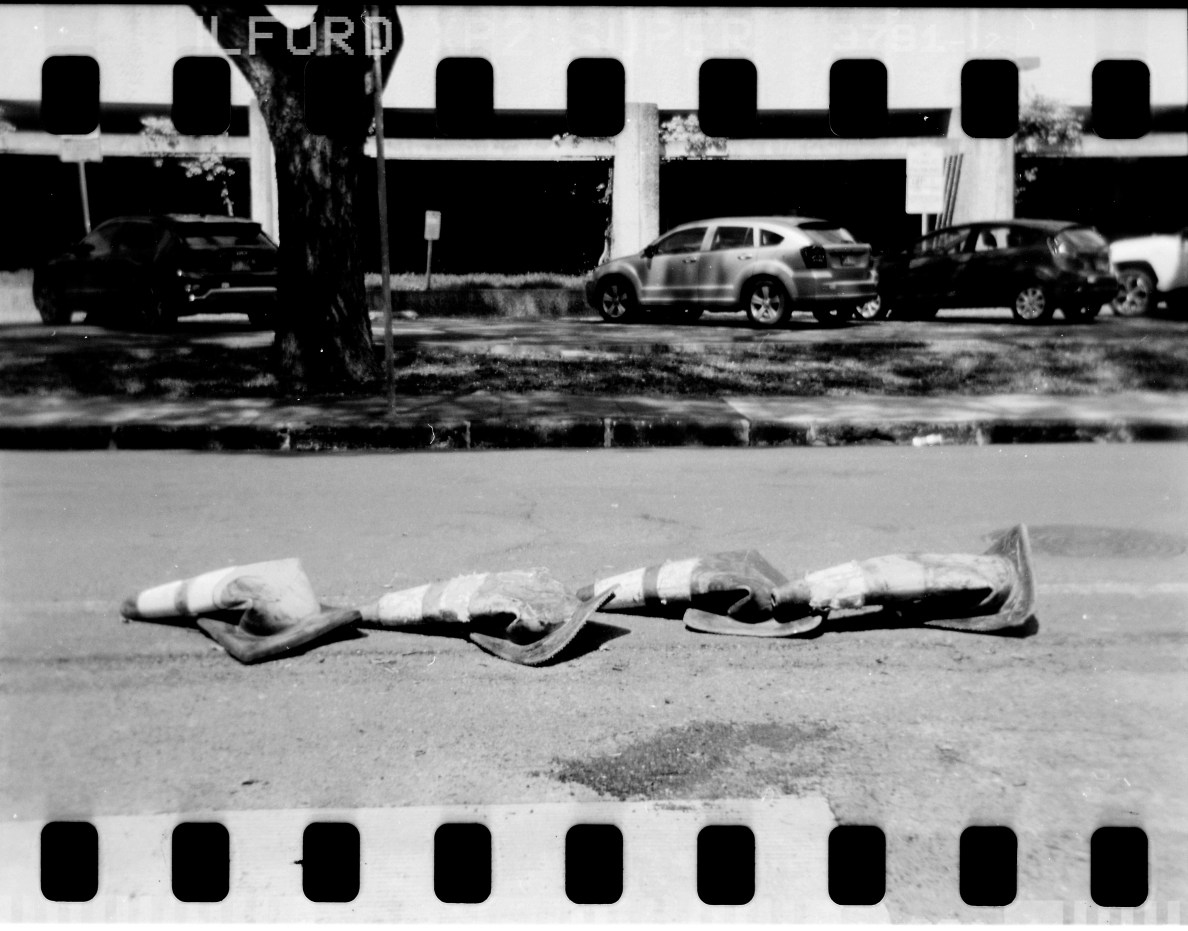
We all know what traffic cones should look like. We envision them standing upright, glowing bright orange, making a bold statement. But these four traffic cones in front of the Prince Jonah Kūhiō Kalaniana’ole Federal Building endured enough punishment by heavy machinery rolling over them, their lives deflated. These cones are the shells of what we know they should be, could be. Photographed with 35 mm film inside a Holga 120 on Aug. 14 in Honolulu. (Kevin Fujii/Civil Beat/2025)

This cheap, plastic toy camera is known for creating unexpected results. The imperfections of the Holga create light leaks, the plastic lens doesn’t focus very well and the shutter can be opened multiple times without advancing the film to a new, unexposed frame.

This is called Lomography — a lo-fi method to capture the unexpected with inexpensive analog equipment.

After I had been playing with the Holga for some time, a photo blog caught my attention using 35 mm film instead of the camera’s intended 120 film. I don’t remember who wrote it or shot the photos. But it was a picture of a red 1960s Ford Mustang contrasting against a bright blue sky and gray buildings framing the sides. The coolest thing to me was the exposure between the sprocket holes.
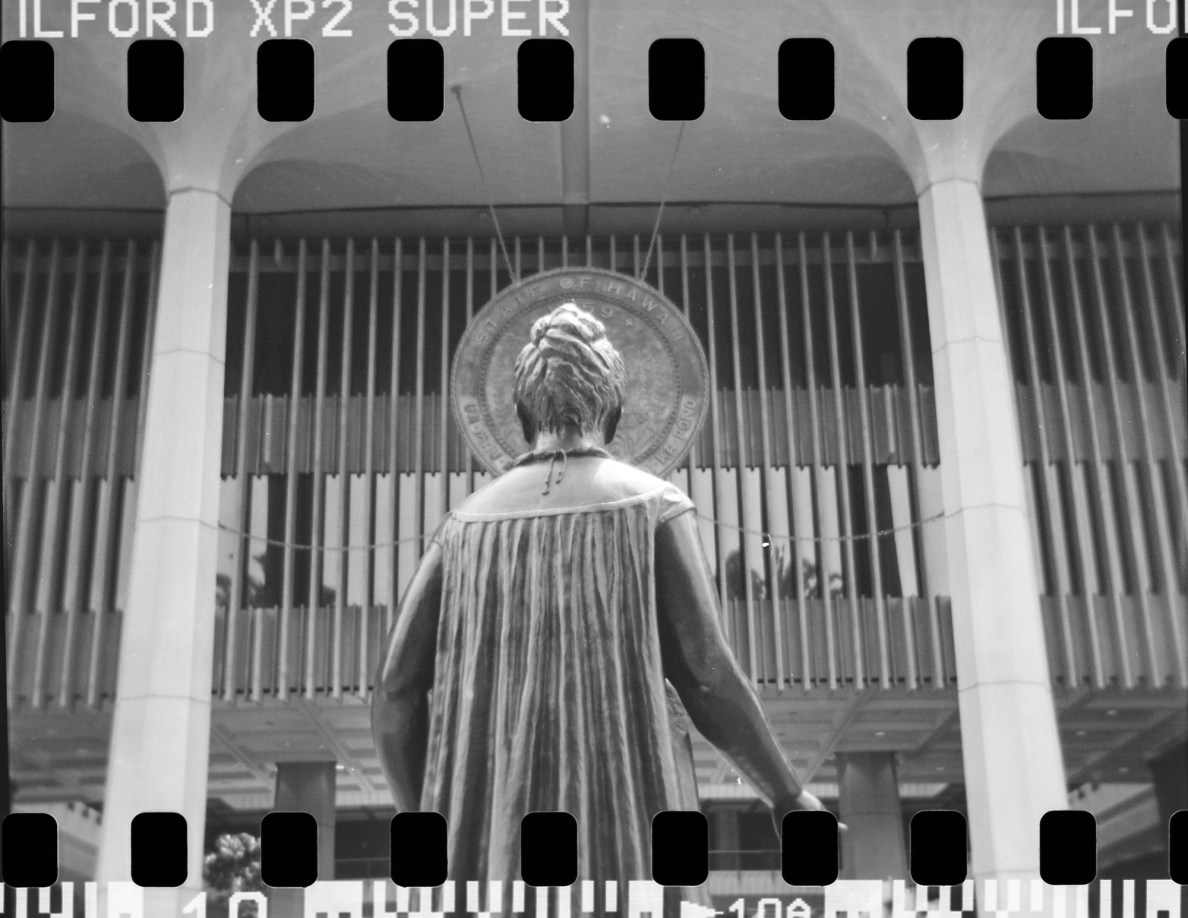
The Queen Liliʻuokalani statue on the makai side of the Hawaiʻi State Capitol is photographed with 35mm film in a Holga test shoot Friday, June 27, 2025, around Honolulu. (Kevin Fujii/Civil Beat/2025)
The graphic elements of the Hawaiʻi State Capitol’s architecture, the seal of Hawaiʻi and the Queen Liliʻuokalani statue framed by the sprocket holes come together. It’s a gamble. You don’t know what you have until it’s processed and scanned or printed. Photographed with 35 mm film in a Holga for a test shoot on June 27 in Honolulu. (Kevin Fujii/Civil Beat/2025)

The placement of the sprocket holes will always be the surprise. Composition is mostly a guess since 35 mm film is smaller than 120 film and can float and move inside the Holga. The above photo worked out with composition and placement.

Moving clockwise: a Holga 120 toy film camera, a roll of gaffer’s tape a box and roll of Ilford XP2 black-and-white 35mm film are photographed Tuesday, June 15, 2025, in ʻEwa Beach. Photographs for John Hill’s project on child abuse were made with these items. (Kevin Fujii/Civil Beat/2025)
Moving clockwise: a Holga 120 toy film camera, a roll of gaffers tape, a box and roll of Ilford XP2 black-and-white 35 mm film photographed June 15 in ʻEwa Beach. (Kevin Fujii/Civil Beat/2025)

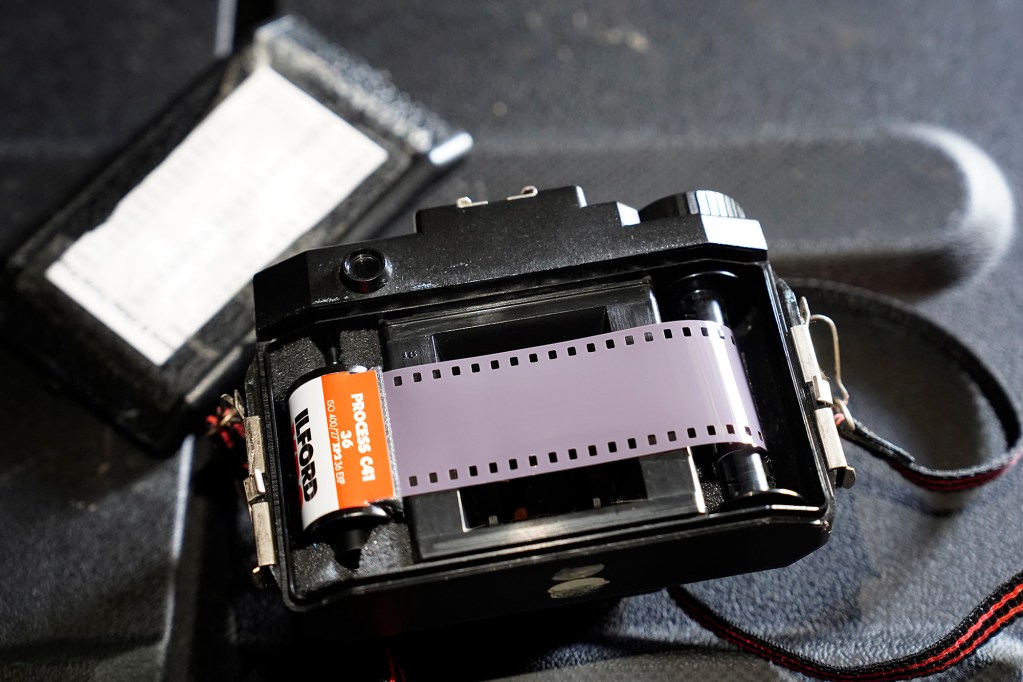
Hacking the Holga to shoot a different size film required some modifications. The internal frame for 120 film was removed. Foam was added to the top and bottom of the space to keep the film cartridge in place.
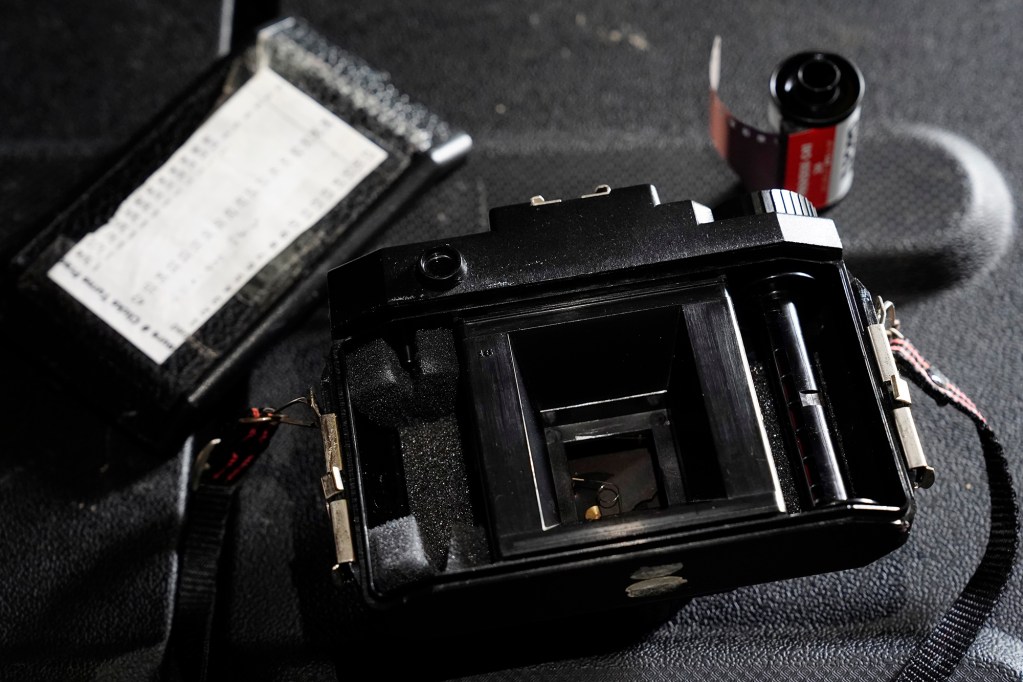
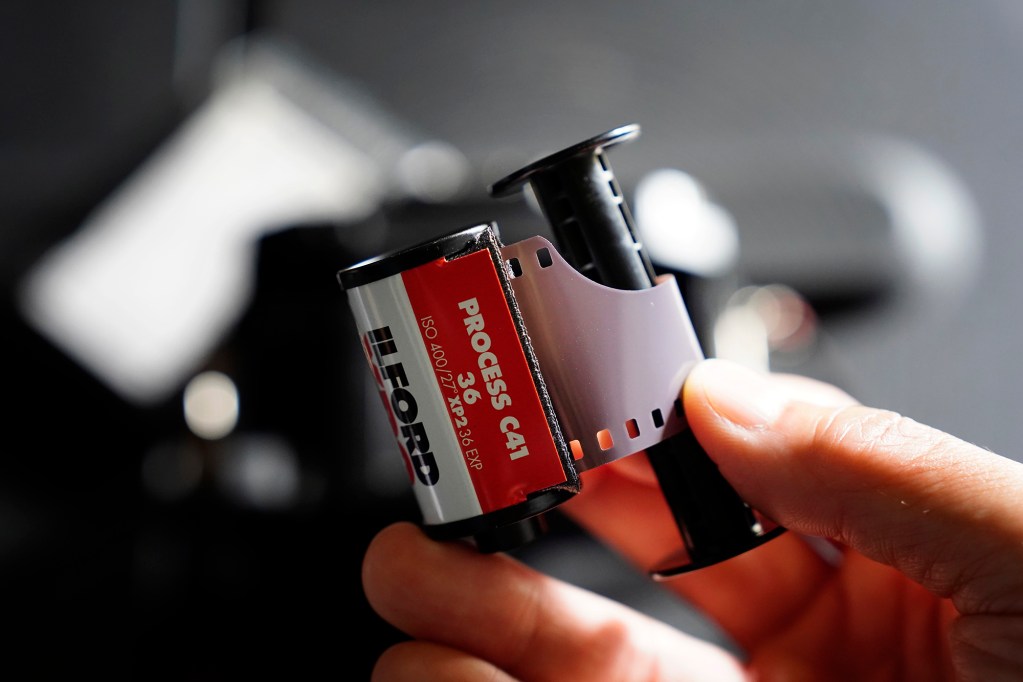
An open Holga 120 toy film camera is ready to load a roll of Ilford XP2 black-and-white 35mm film Tuesday, June 15, 2025, in ʻEwa Beach. Photographs for John Hill’s project on child abuse were made with these items. (Kevin Fujii/Civil Beat/2025)
An open Holga 120 toy film camera is ready to load a roll of Ilford XP2 black-and-white 35 mm film. (Kevin Fujii/Civil Beat/2025)
The leader of a roll of film is wrapped around a take-up spool for a Holga 120 toy film camera Tuesday, June 15, 2025, in ʻEwa Beach. These photos are made for John Hill’s project on child abuse. The photos are of places where alleged abuse took place. (Kevin Fujii/Civil Beat/2025)
The leader of a roll of film is wrapped around a take-up spool for a Holga. (Kevin Fujii/Civil Beat/2025)
Before putting on the back of the camera, the leader of a roll of 35mm film is wrapped around a take-up spool in a  Holga 120 toy film camera and checked to ensure it’s winding Tuesday, June 15, 2025, in ʻEwa Beach. The internal frame-size mask has been removed to give the horizontal 35mm film more exposure area. The space above and below the film show an approximate depth of 120 film which are lost because of 35mm film’s horizontal dimension. But this shows how the film around the perforations or sprockets are exposed. These photos are made for John Hill’s project on child abuse. The photos are of places where alleged abuse took place. (Kevin Fujii/Civil Beat/2025)
Before putting on the back of the camera, the leader of a roll of 35 mm film is wrapped around a take-up spool in a Holga 120 camera and checked to ensure it’s winding. The internal frame mask was removed to give the horizontal 35 mm film more exposure area. The space above and below the film show an approximate depth of 120 film, which is lost because of 35 mm film’s horizontal dimension. This shows how the film around the sprockets is exposed. (Kevin Fujii/Civil Beat/2025)
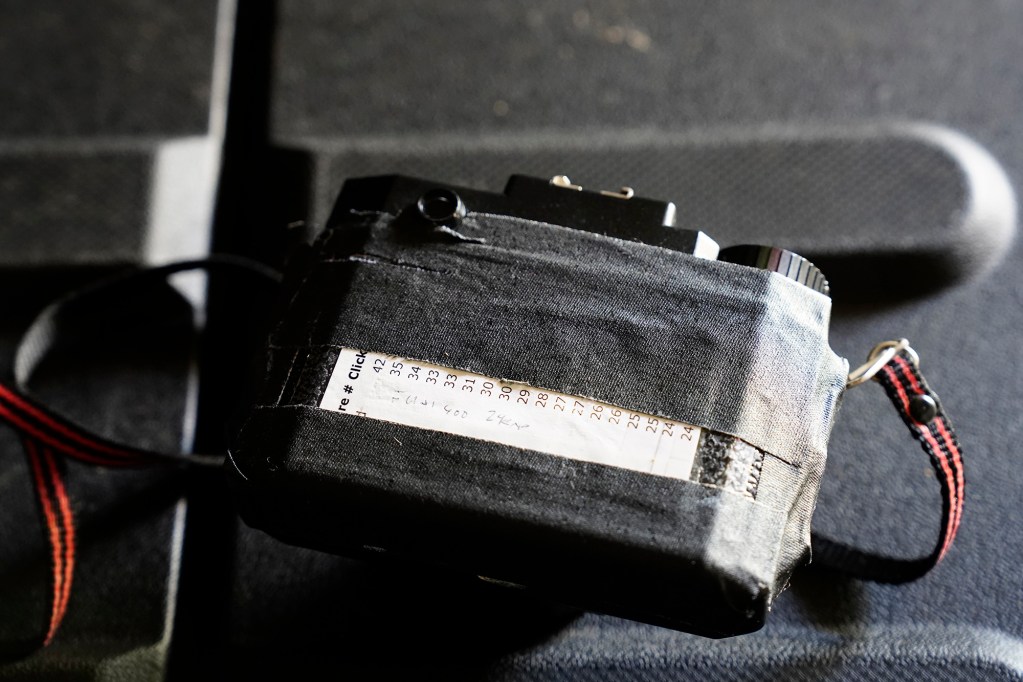
Almost every Holga 120 toy film camera will act differently. But a common theme is the cheap construction allows for imperfectʻions which sometimes results in light leaking into the camera body, photographed Tuesday, June 15, 2025, in ʻEwa Beach. Because of this, gaffers tape is used to help limit the amount of light allowed to leak into the camera body and to keep the back from coming off accidentally which would completely fog (expose to light) the film. These photos are made for John Hill’s project on child abuse. The photos are of places where alleged abuse took place. (Kevin Fujii/Civil Beat/2025)
Almost every Holga 120 toy film camera will act differently. But a common theme of the cheap construction allows for imperfections and sometimes results in light leaking into the camera body. Gaffer’s tape helps limit the amount of light allowed to leak into the camera body and keeps the back from coming off accidentally, which would fog (expose to light) the film. The latter learned from user error. (Kevin Fujii/Civil Beat/2025)

The Holga is loaded and ready to take some pictures … slowly.

ʻIolani Palace is photographed with 35mm film in a Holga test shoot Friday, June 27, 2025, around Honolulu. (Kevin Fujii/Civil Beat/2025)
The composition of ʻIolani Palace and the gate didn’t work out as intended because of parallax. Parallax is, for example, when the photographer lines up something close and something far with both eyes open and the result doesn’t match the original composition. Because the Holga is a rangefinder style camera, similar to having two eyes, where the lens that captures the scene and the viewfinder the photographer looks through to compose are in two different places, framing can change the foreground-background spatial relationship. SLR (single-lens reflex) and mirrorless cameras aren’t affected by parallax as the photographer sees the actual composition. (Kevin Fujii/Civil Beat/2025)
The ceiling of the Hawaiʻi State Capitol is photographed with 35mm film in a Holga for a test shoot Friday, June 27, 2025, around Honolulu. (Kevin Fujii/Civil Beat/2025)
The graphic elements of the Hawaiʻi State Capitol ceiling plays nicely with 35 mm film in a Holga. Photo taken on June 27 in Honolulu. (Kevin Fujii/Civil Beat/2025)

Take one photo, then advance the film 34 clicks, or about one-and-a-half turns, to get a dozen photos on a roll of 36 exposures. This is a challenging pace when my daily cameras shoot nine frames per second.
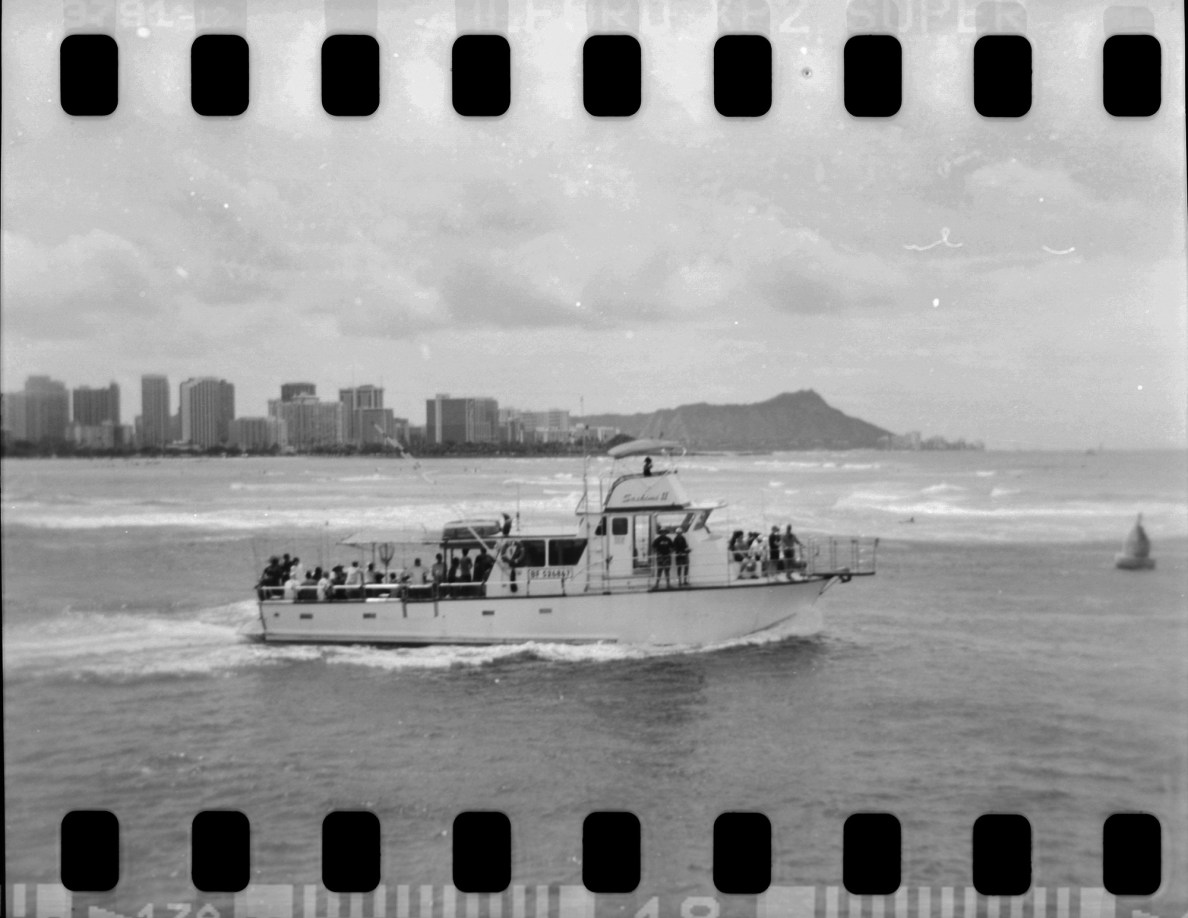
A tourist boat leaves Kewalo Basin during a 35mm film in a Holga for a test shoot Friday, June 27, 2025, around Honolulu. (Kevin Fujii/Civil Beat/2025)
A tour boat leaves Kewalo Basin on June 27 in Honolulu. (Kevin Fujii/Civil Beat/2025)
The Puʻu ʻUalakaʻa State Wayside viewpoint is photographed with 35mm film in a Holga for a test shoot Friday, June 27, 2025, around Honolulu. (Kevin Fujii/Civil Beat/2025)
The Puʻu ʻUalakaʻa State Wayside viewpoint shelter and visitors are photographed with 35 mm film in a Holga. (Kevin Fujii/Civil Beat/2025)
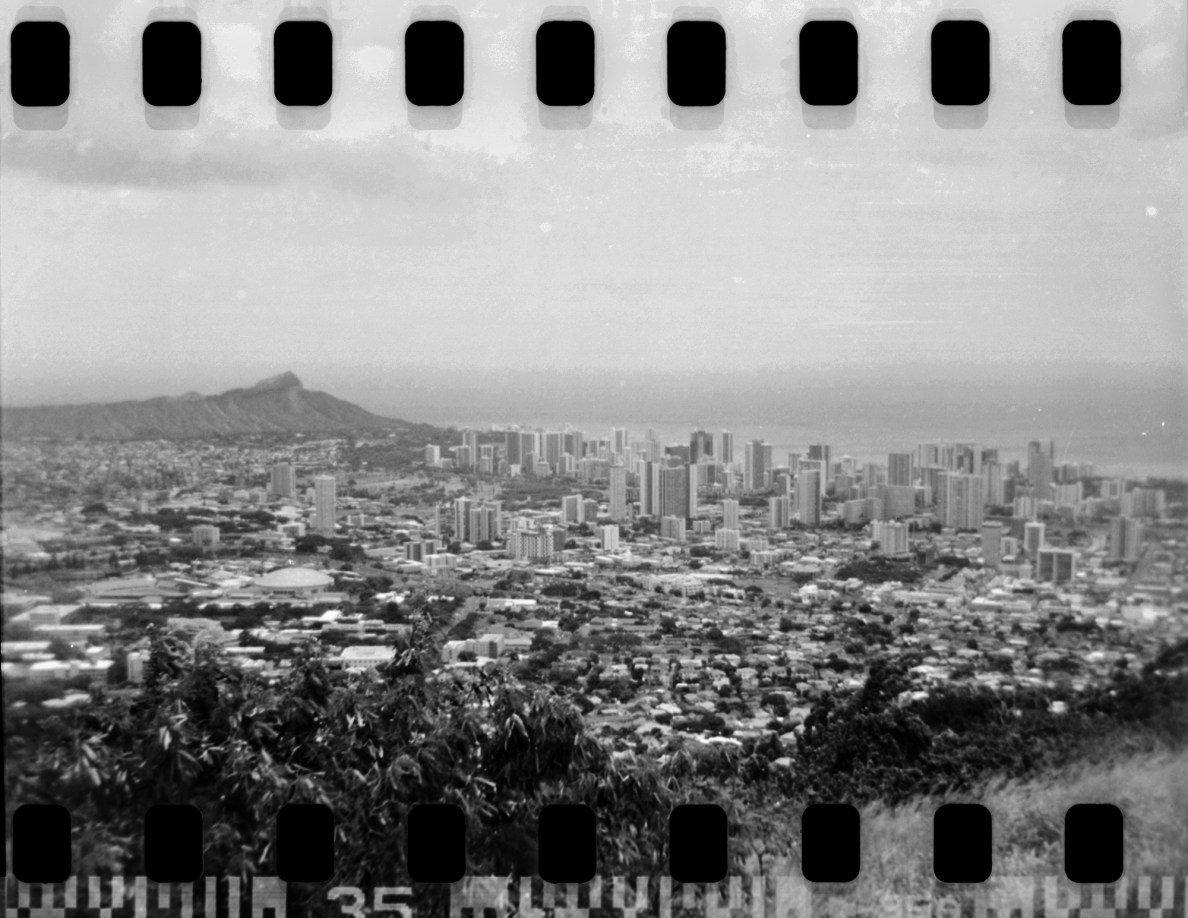
The scene from the Puʻu ʻUalakaʻa State Wayside viewpoint is photographed with 35mm film in a Holga for a test shoot Friday, June 27, 2025, around Honolulu. (Kevin Fujii/Civil Beat/2025)
Diamond Head and downtown Honolulu are seen from the Puʻu ʻUalakaʻa State Wayside viewpoint. (Kevin Fujii/Civil Beat/2025)
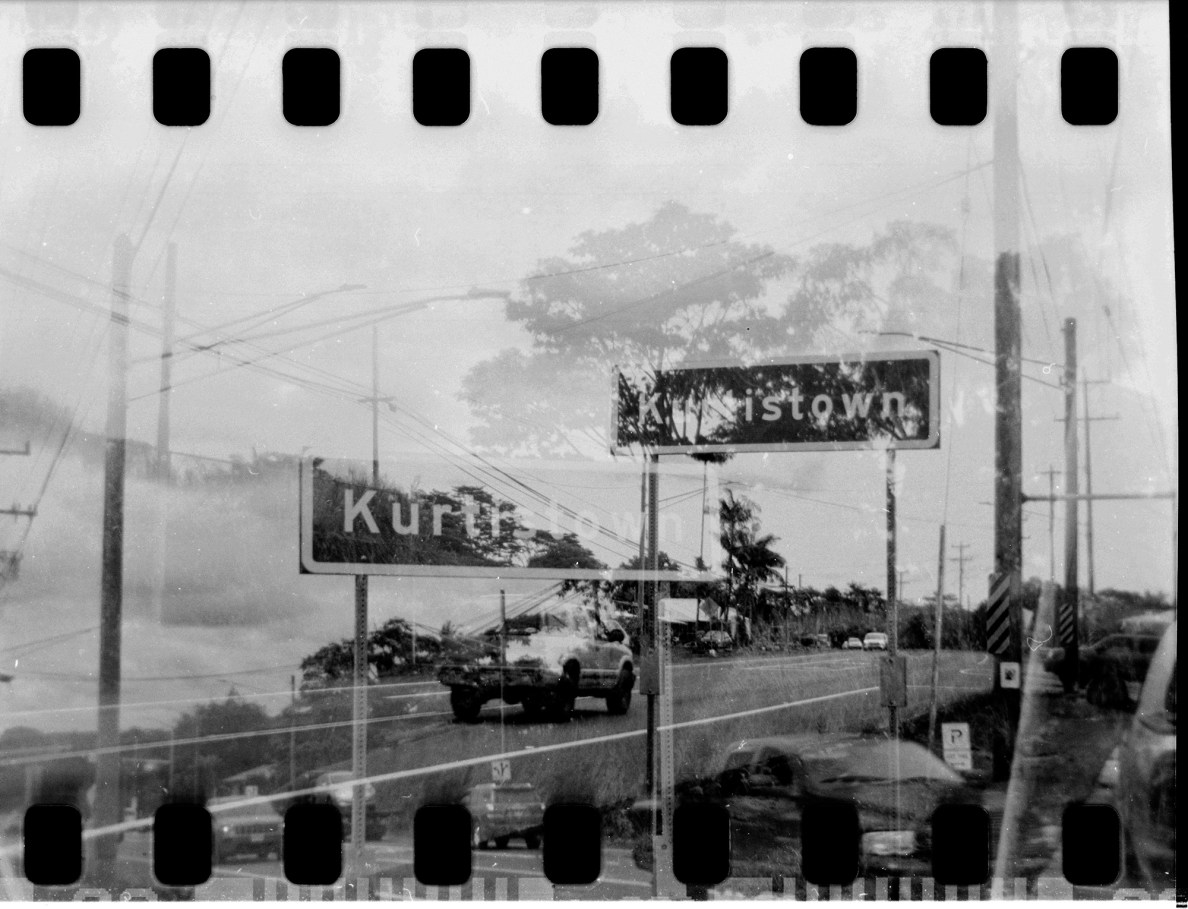
An accidentally double-exposed photo from Kurtistown shows the town where alleged child abuse took place is photographed on film Tuesday, Sept. 2, 2025, in Kurtistown. This is part of John Hill’s project on an accused child abuser and molester moved around Oʻahu and Hawaiʻi islands. (Kevin Fujii/Civil Beat/2025)
An accidentally double-exposed photo of the Kurtistown sign is photographed Sept. 2 on Hawaiʻi island. This frame was exposed twice because the film wasn’t advanced to an unexposed frame. The result is an over-exposed frame with the same sign in two different places. This image ended up leading the third story in the series. (Kevin Fujii/Civil Beat/2025)

After the film is shot, a Holga can’t rewind the film back into its light-proof canister like a traditional 35 mm film camera body. 120 film uses a lightproof paper backing, which protects it after the whole roll has been shot. The Holga was designed to shoot a roll of 120, then open the back to remove it without the need to rewind.
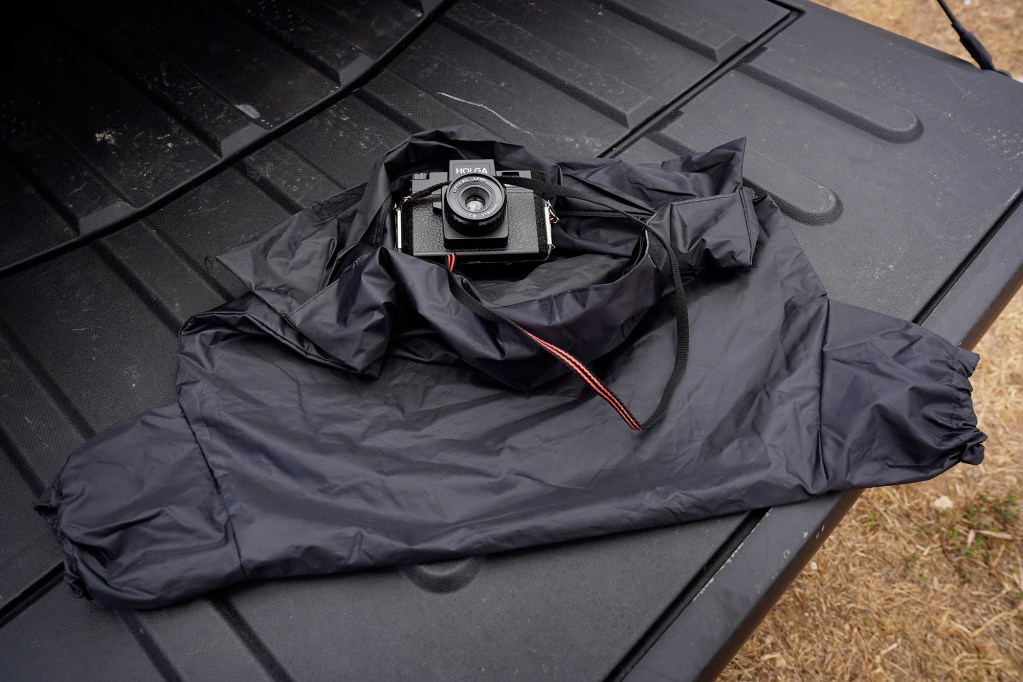
A Holga 120 toy film camera is loaded with 35mm black-and-white film Tuesday, June 15, 2025, in Waimānalo. These photos are made for John Hill’s project on child abuse. The photos are of places where alleged abuse took place. (Kevin Fujii/Civil Beat/2025)
The Holga rests in its lightproof changing bag, which must be used when rewinding the film by hand without a darkroom. (Kevin Fujii/Civil Beat/2025)

Instead the 35 mm must be rewound by hand, winding the spindle to pull the film back into its cartridge. This must be done in a lightproof changing bag in the absence of a darkroom.
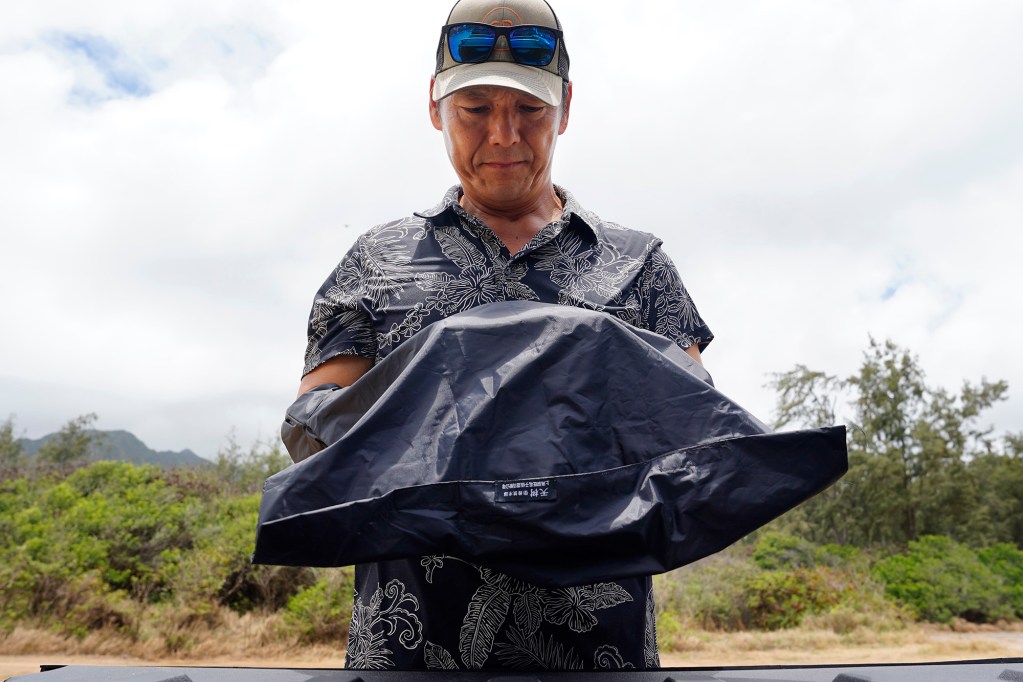
Honolulu Civil Beat staff photographer Kevin Fujii uses a light-tight changing bag to wind film back into its cartridge after using a Holga 120 toy film camera Tuesday, June 15, 2025, in Waimānalo. These photos are made for John Hill’s project on child abuse. The photos are of places where alleged abuse took place. (Kevin Fujii/Civil Beat/2025)
Photographer Kevin Fujii winds film back into its light-tight cartridge. This is done by feel and years of practice handling film before digital photography made this mostly obsolete. (Kevin Fujii/Civil Beat/2025)

Treehouse Photo Lab in Honolulu later processed the film and scanned the negatives. Removing dust and hair on a large flatbed scanning surface is difficult, employees there said.

I selected Ilford XP2 black-and-white film for the ease of processing the film. It’s a C41 process that is the same for most color film. The film is taped to a plastic card and run through a machine.

My preference would have been to shoot Kodak Tri-X or T-Max film if I had been able to process the film myself. I would have very much enjoyed getting back into the darkroom: rolling film onto metal reels in absolute darkness, filling the tank with chemicals to process, banging the tank against the side of the sink to agitate the chemicals against the film. Thinking about it brings back memories of the smell of photography chemicals searing my nostrils.

Another thing I take for granted is passing secure-digital (SD) media cards through airport X-ray machines. With 400 ISO film, I asked the TSA agents to hand inspect it to avoid fogging the film and ruining the images.

I saw the use of the wrong size film in a plastic toy camera as a metaphor for the lives of the children who were abused.

Some blossomed and showed the beauty of humanity, which is reflected between the sprocket holes. Meanwhile, the holes themselves reflect a void in the photograph and the boys’ lives.


About the Authors

What it means to support Civil Beat.

Supporting Civil Beat means you’re investing in a newsroom that can devote months to investigate corruption. It means we can cover vulnerable, overlooked communities because those stories matter. And, it means we serve you. And only you.

Donate today and help sustain the kind of journalism Hawaiʻi cannot afford to lose.