


When No One Is Watching, Part 1 of 4
The 8-year-old boy who would later be known as John Roe 121 arrived at his new foster home in Waimānalo in the midst of a crisis.
JR and his siblings had been taken from their biological parents three years earlier after his mother accidentally hit his brother on the head with a hammer in the midst of being attacked by the children’s drug-addled father.
They stayed for a short time with an aunt. When state child welfare workers showed up, the aunt told 5-year-old JR and two younger siblings to hide in a closet. But they made too much noise. The social workers opened the closet door and took them away.
JR’s next stop was with a neighbor of his mother. Separated from his siblings, he spent three years with her. Now she was telling the state she could no longer handle him.
She said she cared about JR. But on the day in May 1998 when she called for help, JR had accused her of trying to starve him. The boy suggested that maybe he should bang his head against the wall until he died, according to a review of foster care documents by an expert witness in a lawsuit JR would file two decades later.
✉️ To keep up with this series and other Civil Beat coverage, sign up for our daily newsletter:
The state’s Child Welfare Services found him an emergency foster home placement while it tried to get him into Kahi Mohala, an acute in-patient treatment program. It also considered trying to get him into a therapeutic foster home, with foster parents specially trained to deal with complex behaviors of troubled children.
JR kept getting moved around, either because the home was only meant as a stop-gap for a day or two or the foster parents said they couldn’t handle him.
Ten days after that first call to CWS, his latest foster mother introduced JR to a man named John Teixeira. She and Teixeira both bred chihuahuas, and she took JR on a visit to his place in Waimānalo.
Teixeira was known among child welfare workers as a wizard with troubled boys. Starting a decade earlier, he’d fostered dozens of them.
Teixeira had solved a problem for the state, as he had many times before — where to put foster boys no one else wanted.
At his place in Waimānalo, at the end of a palm-lined, gated road with a backdrop of the lava rock columns of the Koʻolau Range, Teixeira lived with five teenage boys, including three foster children, a former foster son who had aged out of the system and another for whom Teixeira had become legal guardian.
Teixeira and the boys looked after the dogs and chickens they raised for sale. Many days, they piled into a truck to go to a horse ranch up the coast where they did chores and some learned to ride.
In the minds of child welfare workers, the rustic lifestyle was just the thing for boys from traumatic backgrounds.
JR took to it right away. On the ride home after that first visit, when his latest foster mother asked if he’d like to live there, JR said he would. For three years, at his first foster home, he had often been locked in his room, he later said. Now, he could breathe fresh air, surrounded by other boys.
“It felt good to have freedom and to be able to play outside,” he said.
Teixeira would also later remember the day JR came to live with him.
He showed JR where he would be sleeping, and they sat down with the social worker who had brought JR to talk through the problems he was having finding a new home and his disruptive behavior.
As if to illustrate the point, on that first day JR pulled down his pants, flashed his butt and ran down the road.
“I yelled, ‘The dog going to bite you,’ and he came running back. Swearing,” Teixeira would later recall.
It seemed like a good place for JR until a bed opened up at Kahi Mohala.
Then, as the weeks went by and JR’s behavior stabilized somewhat, the plan to send him to the inpatient program or a therapeutic foster home somehow evaporated.
John Teixeira is a good foster parent. We need more foster parents like him who can handle our boys.
Child Welfare Services Social Worker
Four months later, when a relative expressed interest in adopting JR, state officials declined. Teixeira, they said, was JR’s “best advocate,” according to the later expert witness report.
So, JR had a home. Teixeira had solved a problem for the state, as he had many times before — where to put foster boys no one else wanted.
That strategy would have a high cost. JR and other foster boys — and eventually the state — would be the ones to pay.
‘Lord Of The Flies’
This is the story of what happened in the two-and-a-half decades after JR arrived at Teixeira’s home.
In 2024, JR would win a major court verdict for the sexual abuse he suffered over several years at the hands of his foster father and three of the older boys. Teixeira molested JR 100 times, the judge found, and also sexually abused another foster boy. Teixeira shared his bedroom – and the boys believed his bed – with a different foster son.
Still another was assaulted by an older foster brother. When Teixeira found out, he told the boy not to ever tell his mother, whom Teixeira knew, and he never did. Teixeira beat the boys, and several tried to run away.
But the 2024 verdict was not against Teixeira, who had already reached an out-of-court settlement with JR. It was against the state of Hawaiʻi’s child welfare system.
That bureaucracy was on trial in the Honolulu courtroom. And many of the failures revealed by the lawsuit have never been fixed.
Foster boys were isolated from their families. Some later said they rarely or never saw the social workers who were supposed to check up on them in person each month.
When bad things started to happen, there was no one to tell. A few reports of abuse did surface only to be discounted or ignored.

The story is a microcosm of what was happening to foster children across Hawaiʻi in the 1990s and 2000s — and, evidence suggests, to this day. Lack of oversight. Failure to thoroughly investigate reports of sexual and physical abuse. Shortcomings in providing for the children’s physical and mental health needs.
All of these were detailed in a federal review of the state’s child welfare program in the early 2000s – even as they were occurring in real time in Teixeira’s foster home, where his reputation as a miracle-worker hid signs that the rustic, tough-love environment had a sinister side.
The foster boys who went through the home are now in their 30s and 40s. They all experienced the trauma of family disruption before they entered foster care, not to mention a myriad of other influences good and bad. Their time with Teixeira also shaped them.
Some have done well, and are quick to credit Teixeira. But among the almost 60 boys who lived with him are serious criminal histories, mental illness, drug abuse, homelessness and — in at least one case — suicide.
This account is based on court records from JR’s later lawsuit, as well as police and autopsy reports, business and property records, social media, newspaper archives, federal reviews of Hawaiʻi’s foster system and interviews with JR, other foster boys and their relatives.
Taken as a whole, they paint a vivid picture of what can happen, then and now, in a foster home when no one is watching.
“Life for a young boy in the Teixeira foster home was a struggle for survival akin to ‘Lord of the Flies,’” the judge in JR’s lawsuit wrote in 2024, referring to the classic novel about castaway children creating a savage society. “The older boys were abusive and Defendant Teixeira, an abuser himself, failed to protect younger boys from them.”
Who Is John Teixeira?
Teixeira was born in 1958 and raised on Koko Head before it became an upscale suburban enclave. His mother Sylvia, a foster mother herself, was an abundant cook known for dishes such as the Portuguese-Hawaiian speciality vinha d’alhos.
His father and both grandfathers were horsemen and Teixeira continued the tradition. After Kalāheo High School in Kailua, he worked at the Turtle Bay Hilton for 10 years as a stable hand. At various times, he was a worker at a chop suey joint in Kāneʻohe, a night cleaner at a bank and a school custodian.
In 1983, he pleaded guilty to first degree theft for trying to steal a welding outfit worth $289.99 from a Sears in Kāneʻohe. He got five years probation and 100 hours of community service.
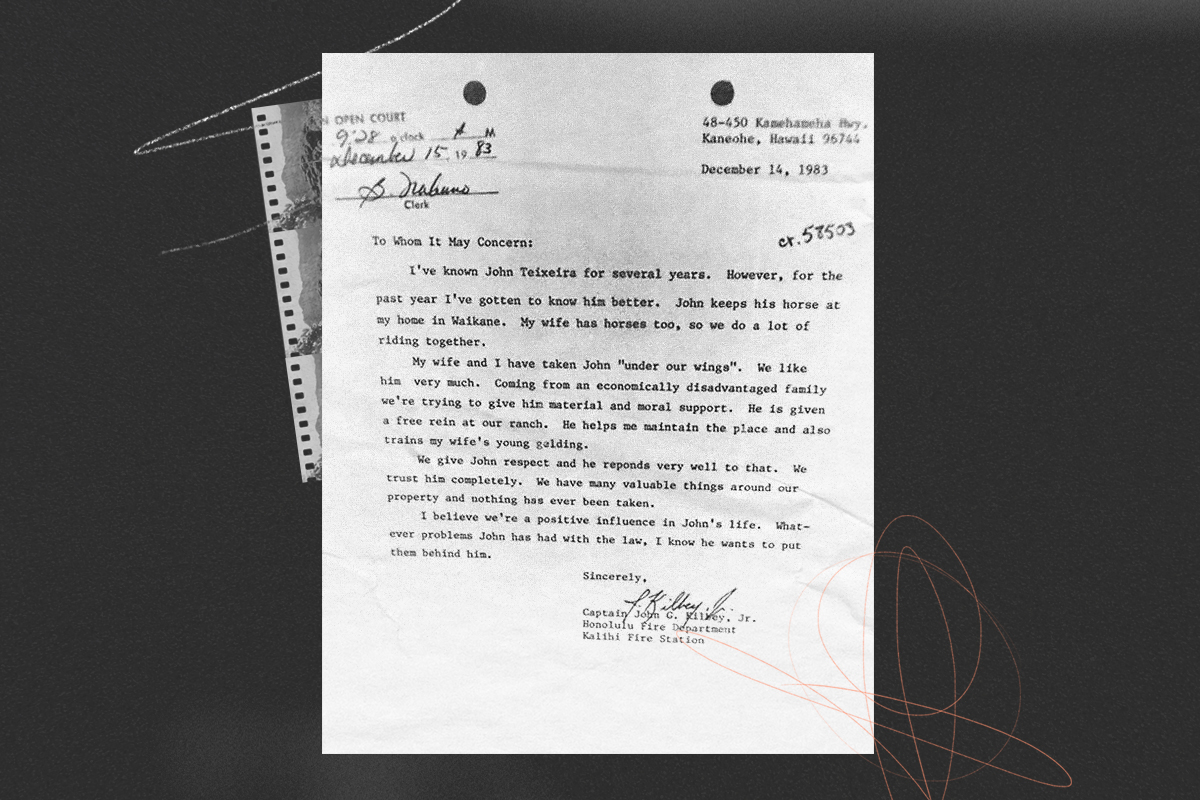
A Honolulu Fire Department captain vouched for him, saying he had known Teixeira for years, especially after Teixeira started keeping his horse at the fire captain’s house in Waikāne.
“My wife and I have taken him ‘under our wings.’ We like him very much,” wrote the fire captain, who died in 2007. “Coming from a disadvantaged family, we’re trying to give him material and moral support. He helps me maintain the place and also trains my wife’s young gelding … Whatever problems John has with the law, I know he wants to put them behind him.”
When Teixeira was in his mid-20s, he got a call that would start him in a new direction — fostering boys.
The caller was a probation officer worried about a teenager who had run away from home and was hanging out on the beach at Turtle Bay, where Teixeira worked. The boy had been stealing from classrooms at Kahuku High School.
The boy had mentioned to the probation officer that he knew Teixeira, and it turned out the two families were acquainted. The probation officer asked if Teixeira would be willing to let the boy live at his Punaluʻu home.
At first Teixeira said no. But after a meeting with the boy’s mother and his own mother, he changed his mind. The boy lived with him for two years before returning home.
This placement had been arranged by the state Judiciary. But when CWS social workers found out what Teixeira was doing, they started asking him to accept their boys as well.
“From then, they just kept plugging kids into my house,” Teixeira, now 67 and living in a house in rural Mountain View on the Big Island, told Civil Beat during a 15-minute phone call in May. Teixeira said he’d ask his attorney about talking more extensively in person, but when a Civil Beat reporter and photographer traveled to the Big Island and contacted him again in September, he declined.
He’d had no special training — just the standard for CWS foster parents. But the court-appointed advocate for JR and other children described Teixeira in 1998 as “a master at handling difficult teenage boys.”
CWS was similarly impressed, according to the later expert witness review of previously confidential documents. “He is an excellent foster parent,” one social worker wrote. “There is something about him that the kids do very well with him.” And a home study, a prerequisite to foster placements, found that “John Teixeira is a good foster parent. We need more foster parents like him who can handle our boys.”
The truth was that CWS had few other choices. When the state placed JR with him, a social worker wrote, “Looks like John is our only option.”
Teixeira himself would later acknowledge as much.
“When the social workers would bring the kid,” he said in a deposition in JR’s lawsuit, “they would tell me that there is no place else we can put him.”
The pressure was intense: the state, like the U.S. as a whole, was putting kids into foster care at record rates. Nationally, the numbers peaked in 1999, the year after JR was placed, at 568,000. The numbers continued to climb in Hawaiʻi, reaching more than 5,000 in 2003.
With so many kids to house, social workers were willing to look past evidence of wrongdoing by foster parents, according to Richard Wexler, executive director of the National Coalition for Child Protection Reform, a nonprofit based in Alexandria, Virginia.
“When it comes to the pressure to ignore abuse in foster care — to see no evil, hear no evil, speak no evil and write no evil in the casefile,” Wexler wrote in an email, “this is the time when it was the worst.”
But it’s still bad, he said: “That pressure has not gone away — and it won’t until rates of removal everywhere are far lower.”
The Country Life
JR had been assessed by educators as very intelligent, and was the best reader in his second grade class. But his behavioral issues were obvious. The expert witness report said he swore at adults and sometimes bit them. At his new foster home, he hit golf balls at horses.
Yet a couple weeks after arriving at Teixeira’s home, his new foster dad was arguing that there was nothing particularly wrong with the boy. If JR’s doctor prescribed psychotropic drugs, Teixeira said he wouldn’t give them to him. He could handle JR on his own.
“He is just a boy,” Teixeira reportedly said.
Teixeira knew boys. There were five others living in his home when JR arrived, and over the years, he would sometimes have many more at any given time.
“It was just chaotic, because there were so many boys,” said Alicia McCumbers, who knew Teixeira through horse-riding circles and stayed for a while at the house. “There was a lot of yelling, because it was five boys and he’s trying to make them do chores and stuff.”
Several months after JR arrived, a 14-year-old foster boy shot his 7-year-old foster brother in the abdomen with a BB gun. JR would later testify that the younger boy was bouncing up and down on a trampoline, telling the older one to shoot him with one of the BB guns they’d gotten for Christmas, never thinking he actually would.
The 7-year-old had to have surgery and spend the night in the hospital. “I remember seeing this centipede-looking scar on his stomach,” JR would recall.
He said that Teixeira told the boys to lie that they had found the gun in a ditch. The state found out about the incident, but apparently never investigated.
Much of life with Teixeira was centered around horses at Gunstock Ranch in Kahuku, where they’d go most days. The boys were becoming such pros at dealing with horses that they carried pocket knives in case one of them were to get entangled in ropes.
Just about anyone who spent any time at the foster home mentions one activity in particular: mucking horse stalls.
The boys would push a wheelbarrow into the stall and shovel out manure and spots where the horses had urinated, which might involve digging down to remove all the muddy soil. Then they’d sprinkle shavings or sand.
“It’s kind of like a rite of passage with horses,” McCumbers said. “You’ve got to learn how to clean the stalls.”
There were other chores, like unloading feed bags. And some of the boys were learning how to ride and rope.
Back in Waimānalo there were more chores involving the chickens and chihuahuas. Lunch was usually soup and sandwiches, with more elaborate meals put together by Teixeira’s mother or neighbors in the evenings. They shopped for clothes at the Salvation Army.
Cut Off From The Outside World
The other foster boys were much older than JR, and they had troubled backgrounds of their own, according to the expert witness review of CWS documents.
One, in eighth grade, had a “weird fascination with animal sex” and had been caught having sex with dogs. He’d also set fire to a car.
Another, who at 19 was no longer a foster child but still lived in the house while he finished high school, had a history of theft and drug use, including sniffing glue. He’d acted inappropriately with girls and abused dogs and horses.
A 17-year-old who was about to age out of the foster system had a track record of drinking stolen liquor, had acted violently toward other children and been caught molesting one.
That young man shared a bedroom with Teixeira. The foster boys found it strange that Teixeira apparently slept in the same bed with him, according to JR and James Pitts, who was placed there as a foster child after JR. Teixeira would say in a deposition years later that the young man slept on the floor.
It didn’t take long for three of these older boys to sexually prey on JR. Within a month, he would later allege in his lawsuit, one pulled down JR’s pants and licked his buttocks. Over the following four to six months, he said that boy repeatedly forced him to take his penis into his mouth.
A second boy masturbated in front of JR. The next night, he woke JR up and also made him perform oral sex. He did the same thing as many as 10 more times, JR would say, and a third made him do it, too.
JR thought about telling Teixeira, but something gave him pause. Maybe it was the fact that Teixeira shared a bedroom with his foster son. Or maybe it was the way he grabbed the crotches and twisted the nipples of the foster boys — which JR found unsettling.
“I would feel awkward, a little bit weird to tell him,” JR would say later in an interview with Civil Beat. “I didn’t know if they learned that shit from him. Maybe he condones it.”
Another possibility would have been telling a CWS social worker. Hawaiʻi had a requirement at the time, as it does now, for social workers to spend time with foster children at least once a month.
But JR said that after a social worker took him for two visits with his siblings in the first month, he never saw her again.
“I felt abandoned by my social worker,” he said.
See no evil, hear no evil, speak no evil and write no evil in the casefile.
Richard Wexler, Executive Director of the National Coalition for Child Protection Reform
Other foster boys who were later sent to the Teixeira home say the same thing. One said he only saw his social worker once after being dropped off, another that he might have had one, but if so, he can’t recall any interactions.
James Pitts doesn’t ever remember seeing a social worker.
If the state is “going to take a kid from their parents and assume custody over them,” Pitts said, it would seem to be the state’s responsibility to check on them.
Isolated in rural settings like that house hidden behind two gates, half a football field from the nearest neighbor, most of the boys were cut off from their former families, too — not only the parents whose conduct or conditions had led to the boys’ removal, but other relatives.
JR’s mother wanted to see him, but CWS discouraged it. JR asked to see his siblings again after two visits during his first month at Teixeira’s, but Teixeira said it couldn’t be done — the siblings’ foster parents said JR was bad.
JR thought, “Maybe I’ve got to try to be better and be good.” But “time went on and eventually I asked again. Same answer.”
Before being placed with Teixeira, James Pitts had been in what he considered a pretty good foster home. Unlike in some of his earlier placements, the foster parents did not abuse him. And they were fair.
But he was going through puberty and acting out, he said, so he was moved to Teixeira’s.
He felt profoundly isolated. “At 16, my sister was given a choice that you can go back with your parents, and I wasn’t given that choice, so I was kind of upset about that.”
Tired of Teixeira’s yelling and swearing, he ran away. But he didn’t go back to the parents he’d been missing. Since no one had visited, he didn’t know where to find them.
For many of the foster boys, Teixeira was their sole connection to the outside world. JR even recalls that when he talked to the therapist who many of the boys went to, Teixeira would sit just outside the door. JR could hear what was being said on the other side of the door, and assumed the same was true in the other direction.
So even there, he never considered disclosing what was happening to him.
The Beatings Begin
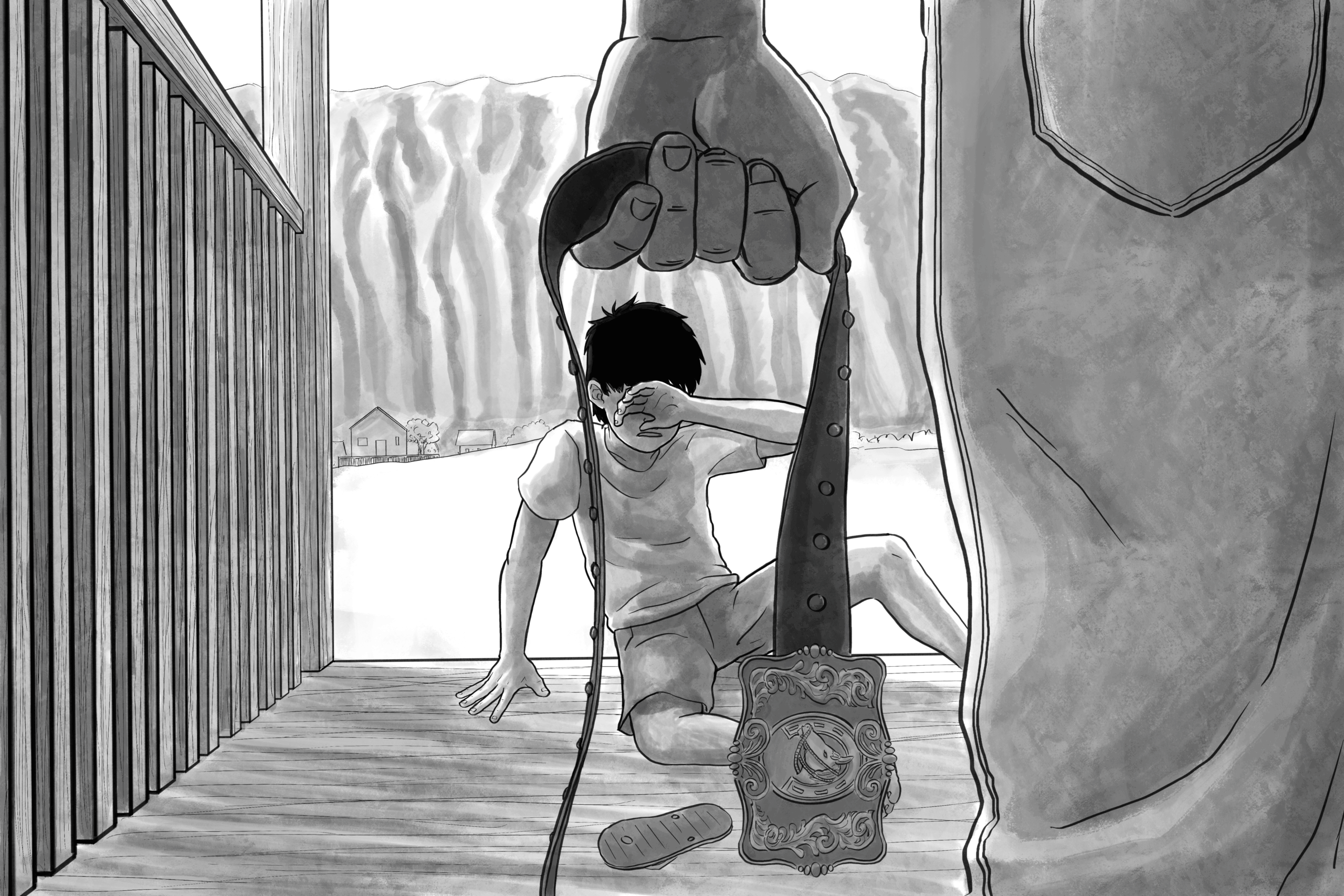
JR had gotten into a fight with the now-18-year-old who slept in Teixeira’s bedroom, and Teixeira was coming after him. He caught up to him on the front porch, grabbed a hank of hair in both hands and lifted him off the ground. He slammed him against a door.
Physical abuse had by now become a part of daily life. JR said all the boys got beatings, with a garden hose or whatever else was at hand. The first time it happened to him, JR recalls, Teixeira used a fancy thick leather cowboy belt with a big buckle, studded with pieces of metal.
“Everybody got lickings,” JR said. His assertion would later be backed up by the accounts of several other boys, as well as at least one adult witness.
“I don’t think he’d get away with it nowadays,” Pitts said. “Things could get physical.”
Pitts, like other foster boys, recalls the nipple-twisting and crotch-grabbing, too. He said it never went beyond that for him. It did for JR.
JR had seen Teixeira grab the crotches of the other boys, so when his foster dad first did it to him he hoped it was just horseplay. But over time, he said Teixeira went from crotch-grabbing to rubbing his genitals through his pants.
Then Teixeira took the next step.
JR recalls it happening as they ran errands like buying feed for the animals in Teixeira’s white Dodge van. Teixeira would drive, and the young man who shared his bedroom would sit on the passenger’s side, with JR between them on the bench seat. JR would later testify that Teixeira would touch his leg, work his hand up JR’s leg, then reach down into his pants and masturbate him.
It happened not just in the van, but around the house, JR testified — maybe 100 times over four or five years. One time, in Teixeira’s bedroom, JR would later testify that his foster father tried to put his mouth around JR’s penis.
Teixeira would later characterize JR as nothing but trouble as a foster son, calling him a “hard, hard case.” He would deny that he sexually abused any of the boys, or knew anything about the older boys preying on the younger ones.
Catalina Freitas-Estores remembers Teixeira having a different attitude toward JR. She was a foster child in the home of Teixeira’s mother, Sylvia, while her brother Hoku was in Teixeira’s care. She saw the boys all the time.
JR, she said, was Teixeira’s favorite.
“He never left his side,” she said. “John made sure that (JR) was always around.”
A Microcosm Of The State’s Foster System
As these events unfolded in Teixeira’s home, the federal government sent analysts to assess the quality of Hawaiʻi’s child welfare system.
It was the first in what would become a series of reports on all of the states’ foster programs.
That report, released in 2003 when JR was 13, reads like a summary of all that was going wrong in the Teixeira household.
A “key concern” was the lack of contact between caseworkers and children in the system. In 68% of cases, the analysts found that there was not enough contact to ensure the safety and well-being of the children.
Instead of the required visits each month, caseworkers were seeing the children on average every three months.
Some kids didn’t know the names of the caseworkers who were supposed to be looking out for them or how to contact them, child welfare workers told the federal analysts. Even when visits did occur, they tended to be in offices, not in the homes where the caseworker could observe what was going on.
CWS didn’t put a high priority on the visits and there were few consequences when they did not happen.
Some within the system said they were concerned with the high numbers of foster children in some homes. Though the limit was five, the total number of children could be higher if biological children also lived in the home, and it could be waived to keep siblings together.
Teixeira was able to exceed the cap by becoming the legal guardian for boys who started off as foster placements. Another potential pitfall of this arrangement was that the state was no longer responsible for overseeing children once they were in the care of a legal guardian.
Teixeira became JR’s legal guardian a year or so after he arrived.
And at times, eight or more boys lived in his home.
JR remembers three bunk beds per room, and some boys sleeping on the floor of the room they called the parlor.
When a social worker would drop off another kid, “I would think to myself, I wonder if they’re going to go and look in the rooms and see how much children they put all together in one home,” he told Civil Beat.
This mattered because foster parents could not reasonably be expected to supervise too many children, especially if, like the ones at Teixeira’s, they had a history of alarming behavior.
Boys as troubled as JR — and likely the older boys — warranted placement in a therapeutic foster home with specially trained parents.
But the federal report found a dire shortage of such homes. Those who worked in the system said the requirements to be placed in one were so restrictive that many children who would have benefited did not qualify. It didn’t help that those homes were run by the separate Department of Health.
The result was that run-of-the-mill foster parents were not equipped to handle children with trauma and complicated emotional needs. Like JR, they often ended up being shuttled from one home to another.
And even when it came to standard foster homes, the federal report noted that licensing regulations had been lowered so the state could recruit more foster parents.
Foster kids weren’t getting the assessments or treatment they needed, from mental health counselors to doctors and dentists. Several of the boys fostered by Teixeira said as much. One would testify in a later deposition that he never saw a therapist, doctor or dentist in the year he lived there.
Lastly, and perhaps most dire, the federal report found that Hawaiʻi’s foster children were being mistreated at a rate almost double the national standard.
A Trip To The Feed Store
JR was now in his early teens and wanted badly to distance himself from Teixeira. He’d started boxing at a Waimānalo gym and was getting stronger.
One day, on an errand in the Dodge van, Teixeira put his hand on JR’s thigh as he had many times before.
This time, JR pushed his hand away. Teixeira tried again, with the same result.
Finally, JR exploded, “Don’t fucking touch me.” He recalls the look on Teixeira’s face — offended, like JR was being stubborn.
“I’m not one weak little kid anymore,” JR remembers saying.
That would be the last time it happened, at least to JR.
Other boys would try to raise the alarm about the “Lord of the Flies” foster home. For two decades, their warnings would go nowhere.
Come back tomorrow for Part 2: When No One Is Watching
How We Did These Stories
To report and write these stories, Civil Beat relied on thousands of pages of documents, including those that became public in a civil lawsuit filed by a plaintiff known as “John Roe 121,” who we call JR in the stories.
Among those court files were summaries of confidential Hawaiʻi Department of Human Services memos, file notes, assessments and communications in the cases of JR and other foster boys under the care of John Teixeira, as well as state child welfare policies from the time.
Several of the key players, including Teixeira himself, were deposed in the lawsuits. Civil Beat examined these transcripts, as well trial testimony from expert witnesses, state officials and John Roe 121.
Civil Beat interviewed JR, as well as other former foster boys and their relatives, witnesses and experts. We also obtained and reviewed related police reports, court records in several separate cases, property records, business records, probation files, an autopsy, social media and stories published over the years by other media outlets.
We reviewed reports written by the state and by federal regulators measuring the performance of Hawaiʻi’s child welfare system.
The stories do not name the individuals who were victims of sexual abuse in keeping with Civil Beat policy. Others were found by the judge in the civil lawsuit to have abused younger children, but because they were never charged in criminal court, they are not named.
Civil Beat’s investigation into foster care received support from the Fund for Investigative Journalism.
When No One Is Watching examines a foster home rife with sexual and physical abuse for two decades as a case study of dysfunction in Hawaiʻi’s child welfare system.
Reporting by John Hill. Illustrations by Will Caron. Photography by Kevin Fujii. Graphics and art direction by April Estrellon. Project editing by Amy Pyle and Jessica Terrell.
