

Fatal HPD Chases Cost City Millions. Will New Law Change That?
As Honolulu looks to settle with the family of a teenager killed in a 2021 chase, efforts to regulate police pursuits continue to draw criticism.
Four years after 16-year-old Iremamber Sykap was fatally shot by Honolulu police officers during a police pursuit, members of a City Council committee today will consider whether or not to approve a settlement for his family.
The International and Legal Affairs Committee will vote on whether to recommend approval of the settlement to the full council. The proposed amount has not been publicized.
The Micronesian teenager’s death in April 2021 sparked grief and outrage among community members and raised questions about the officers’ use of force and decision to pursue the white Honda Sykap was driving. Initially, one officer was charged with murder and two with attempted murder, but a judge later threw out their cases.
It was one of multiple high-profile, pursuit-related incidents over the past four years that resulted in deaths, serious injuries and at least $34 million in city payouts to victims and their families.

Frustrated by a lack of statewide law or policy governing police pursuits, lawmakers this year passed Act 210, which limits when police chases can be initiated and requires law enforcement agencies to report annual data to the state Attorney General’s office on all pursuits.
The law does not go into effect until 2027, and police departments around the state say they are reviewing their own policies now to ensure future compliance.
But some law enforcement officials say the law oversteps and that developing pursuit policies should be left up to the departments and the Law Enforcement Standards Board, which is charged with creating a model policy for the state.
“It’s well-intentioned, but it’s going to be very confusing for patrol officers,” Deputy Attorney General Adrian Dhakhwa, who is chair of the board, said of the law. “Officers are going to err on the side of not pursuing.”
The board came up with a draft policy this month that drew opposition from the ACLU of Hawaiʻi, which said it did not comply with the law.
Dhakhwa said he would have preferred to create a statewide policy that allows for more officer discretion in deciding when to pursue a vehicle, but now that Act 210 has passed, the board is constrained by its restrictions.
“The Legislature has lost faith in the ability for police departments and law enforcement agencies to conduct and train their officers properly,” he said. “That’s the bottom line of Act 210.”
Police reform advocates, however, say laws like Hawaiʻi’s will lead to fewer pursuit-related injuries and save lives.
“Police vehicle pursuits are highly dangerous, posing risks of serious injury or death to members of the public and police officers,” said Josh Parker, deputy director of policy for New York University’s Policing Project, a police accountability organization that worked with Hawaiʻi representatives to craft Act 210. “Before this law was enacted, there was no state law or guidance in Hawaii that provided clear standards for when pursuits are permitted and how officers are to engage in pursuits.”
Dangerous Pursuits Cost Lives, And Money
At the time of Sykap’s killing, Honolulu police had a relatively loose pursuit policy that did not specify that the person being chased had to be suspected of committing a serious crime.
A 2021 Civil Beat review of pursuit reports from the Honolulu Police Department between 2017 and 2019 found that about a third of chases involved collisions, and injuries were documented in over 42% of those collisions.
In 2019, 40% of pursuits began as traffic violations and only 12% began as felony crimes.
The new law lays out strict standards for what justifies a pursuit.
For example, officers cannot pursue unless the suspect poses a serious risk of harm to others and the danger of failing to apprehend the person outweighs the potential risks of pursuing them. It also lists crimes the person must be suspected of committing, including felonies involving physical injury, sexual offenses, kidnapping, robbery, first-degree assault, abuse of a family or household member, first-degree escape or driving under the influence.
Police began pursuing Sykap because he was in a white Honda Civic that had been reported stolen.
Police tried to get the car to pull over near Kawaikui Beach Park in East Honolulu, but it did not stop. The high-speed pursuit continued into Waikīkī until the Honda stopped at the intersection of Kalākaua Avenue and Philips Street. An officer standing behind the car shot 10 rounds into the car, striking Sykap eight times.
Eric Seitz, who is representing Sykap’s mother and grandmother in their lawsuit against the city and the police department, said he doesn’t know whether this law would have prevented police from pursuing Sykap, but he said he agrees with the law.
“I think every review of these kinds of practices is helpful,” he said. “Everything that imposes an additional thought process, understanding that these events unfold very quickly.”
A judge ultimately threw out the case against the officers involved in the Sykap pursuit because he ruled it was unreasonable for prosecutors to say the officers were not in danger when they shot into the car.
In 2019, a suspected drunken driver being chased by police struck eight pedestrians, killing three. The city later paid $10 million to the family of one of the men killed.
In 2021, six people were seriously injured during a police chase in Mākaha. That pursuit began after officers responded to a noise complaint at Māʻili Beach Park and later engaged in a pursuit of the Honda Civic in an unmarked vehicle without activating their police lights.
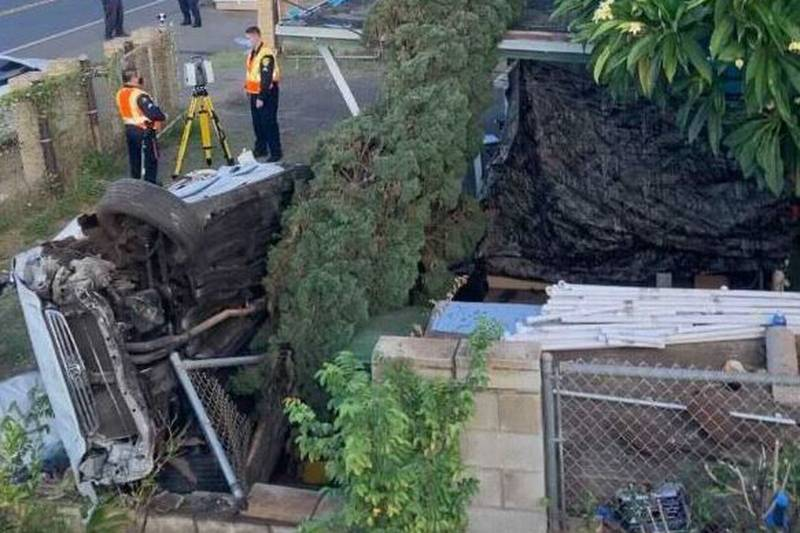
The city paid $4.5 million total to four of the passengers and nearly $7 million to a 17-year-old who was left partially paralyzed. The driver, who suffered a traumatic brain injury, received a record $12.5 million payout from the city.
Dhakhwa noted that the officers in the Mākaha pursuit were already acting outside of department policy and the law and are facing criminal charges. Joshua Nahulu is charged with fleeing the scene of a crash involving death or serious bodily injury and Jake Bartolome, Erik Smith and Robert Lewis are charged with hindering prosecution.
Their criminal case is on hold while Nahulu appeals, arguing his charge should be dismissed because there was no actual collision between his unmarked police SUV and the Honda Civic. The vehicle hit a curb, then trees and went over a concrete wall.
Do Pursuit Rules Protect The Public?
Law enforcement officials say overly restrictive pursuit laws can be unsafe for officers and the public.
In Washington last year, lawmakers reversed many of the restrictions laid out in a 2021 law governing police pursuits.
Much like Hawaiʻi’s current law, the Washington law prevented officers from pursuing a vehicle unless they suspected the person fleeing had committed certain crimes, including violent offenses and drunk driving.
According to the Washington Association of Sheriffs and Police Chiefs, the number of people fleeing state troopers more than doubled after the law took effect. This put the public in danger from reckless drivers fleeing police and allowed more criminals to escape, said Darrell Lowe, police chief in Redmond, Washington, and executive board member of the association.
“The criminals pay attention, they know they can’t be chased,” he said. “It just emboldens them to flee from officers, and that puts the greater community at risk.”
Parker disagrees, saying stricter pursuit policies lead to fewer dangerous chases.
Between 2017 and 2022, at least 3,336 people were killed nationally in police vehicle pursuits, and 27% of those killed were bystanders, according to a national analysis by the San Francisco Chronicle. Around half of the pursuits that resulted in fatalities started as a traffic stop.
Major police departments across the country are adopting stricter pursuit policies.
The New York City Police Department, the nation’s largest municipal police force, announced a policy limiting vehicle pursuits to only felonies and violent misdemeanors in January.
The department said a quarter of its more than 2,000 pursuits in 2024 ended with a crash, property damage or injury.
New York City Police Commissioner Jessica Tisch said in a statement that “advanced tools of modern-day policing make it possible to apprehend criminals more safely and effectively than ever before, making many pursuits unnecessary.”
Some of these tools include automated license plate readers that can easily capture plate numbers and help investigators identify drivers, Parker said. GPS tracking darts can also be fired at fleeing vehicles, allowing police to track a suspect’s location and find them later.
Parker said by passing Act 210, Hawaiʻi is following the way other major departments are handling pursuits.
“I think the law enforcement leaders who have looked at this issue closely and have studied the data,” he said, “have reached the conclusion that restrictive vehicle pursuit policies like that one reflected in the new Hawaiʻi law save the lives of both officers and members of the public.”

