Hawaiʻi’s New Remote Weather Stations Boost Wildfire Risk Assessment
The state has installed 16 new weather stations across Maui County since the deadly fires in August 2023 and plans to install more soon on other islands.
At first glance, a device sitting just across Honoapi‘ilani Highway from Māʻalaea Harbor looks almost like a space rover. With its long antenna that reaches several feet toward the sky and three spindly legs, the white metal structure seems as though it could be found traversing Mars or collecting rocks from the moon.
“To me, it looks a little like an alien ship,” said Lance DeSilva, the Hawaiʻi Department of Land and Natural Resources’ forest management supervisor on Maui.
The contraption is actually one of several dozen new remote weather stations that have been installed by local, state and federal government agencies around Maui and across Hawaiʻi in the last two years.
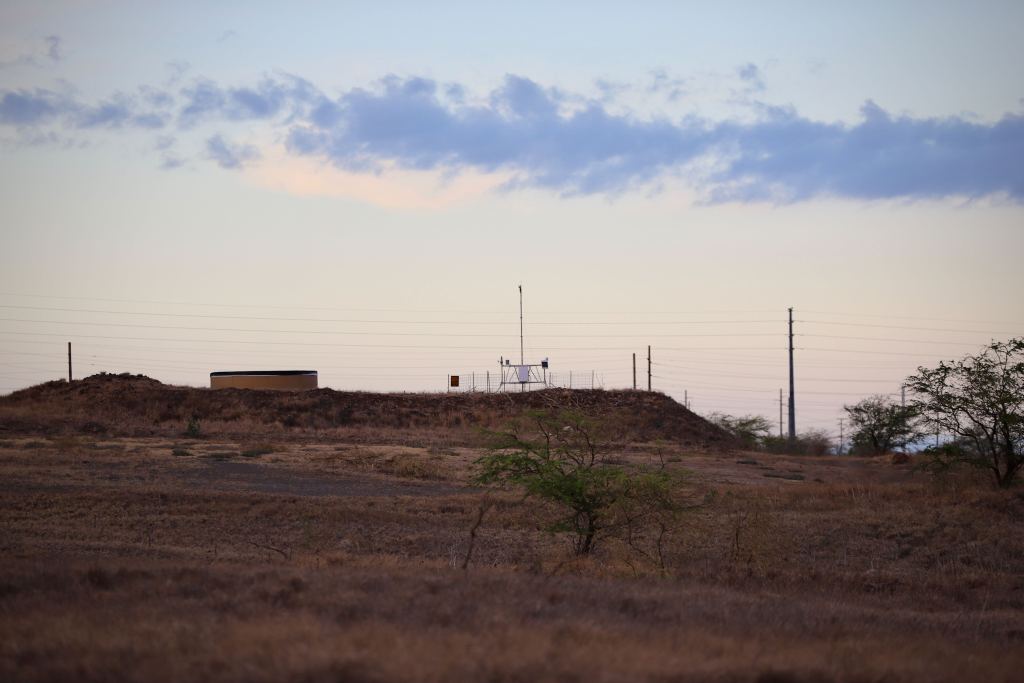
The solar-powered weather stations are capable of measuring multiple factors that contribute to weather conditions that make wildfires more likely, including air temperature, humidity and wind speed, according to DeSilva.
“It provides better information — more real-time, sound information — to make better judgments on resource management and responses,” he said.
There were no remote automatic weather stations in West Maui at the time of the Aug. 8, 2023, wildfires, an issue identified in a report stemming from the state Attorney General’s investigation into the fires. This restricted the data available about the islands’ diverse microclimates, according to the Fire Safety Research Institute’s Lahaina fire analysis report the state commissioned.
“Since RAWS were not placed in high fire danger areas like West Maui, the weather data for these regions was not included in the dataset needed to determine when parts of the island were approaching or experiencing Red Flag conditions,” the report said, noting that the red flag weather determinations come instead from an automated system near the Honolulu airport.
After the August 2023 fires on Maui, the state set out to nearly triple the number of remote weather stations statewide, adding 40 more to the 22 it already had as part of a broader effort to better prepare for wildfires.
The Hawaiʻi Department of Transportation and DLNR have since installed 23 new weather stations, including 16 in Maui County, and have plans to install another 13 throughout the rest of the state by March 31, according to data provided Wednesday by DLNR spokesperson Andrew Laurence. The state also has acquired four portable weather stations that can be repositioned based on need.
For Maui County, four stations were installed on Molokaʻi, one on Kaho‘olawe and 11 on Maui island. Two are planned for Lānaʻi.
“Now we have weather stations put into certain areas of the island that never had weather stations before,” DeSilva said.
That should help improve things, he said, like when and how the National Weather Service shares that there is a red flag warning — and eventually make it possible to declare such a warning for certain areas instead of the whole state.
Spreading Across The State
The new weather stations installed by the state are in addition to others placed on Maui by federal agencies and private companies such as Hawaiian Electric Co., according to Will Aheue, a forecaster with the National Weather Service in Honolulu.
As of Tuesday, there were roughly 150 to 200 weather stations across the state, he said, with between 50 and 100 of those added since the 2023 fires on Maui.
“They’ve done pretty good at kind of spreading them all across the state,” Aheue said, particularly on the leeward sides that are drier and more prone to fires. “Every island has pretty much got their fair share of new weather stations.”
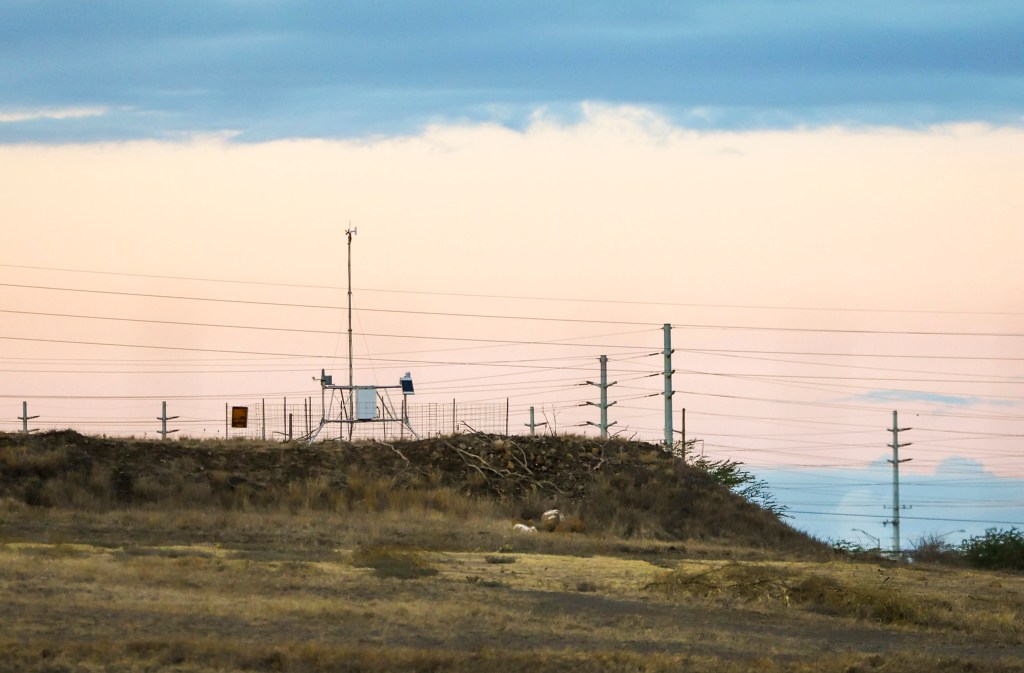
The new stations provide constant wind and temperature readings from different parts of the state that allow officials and forecasters like Aheue to provide more accurate predictions at the local level, DeSilva said.
“There are things that were maybe missing in the past, and now we can see them better,” Aheue said, adding that forecasts had been somewhat “based off of our intuition or pattern recognition.”
On average, the National Weather Service issues five red flag warnings per year, Aheue said. The agency has issued two red flag warnings so far in 2025. There were four in 2024, 2023 and 2022, five in 2021, and three in 2020, he said.
Local and state officials in Hawaiʻi have been working with representatives from the National Park Service and the National Weather Service to establish a more robust system for measuring the current wildfire risk in a specific area, Maui Fire Department Assistant Chief Alexander Parker said. That updated system, using data collected from the weather stations, will be able to help officials and residents identify the likelihood of fire, even when there is not an active red flag warning, he said.
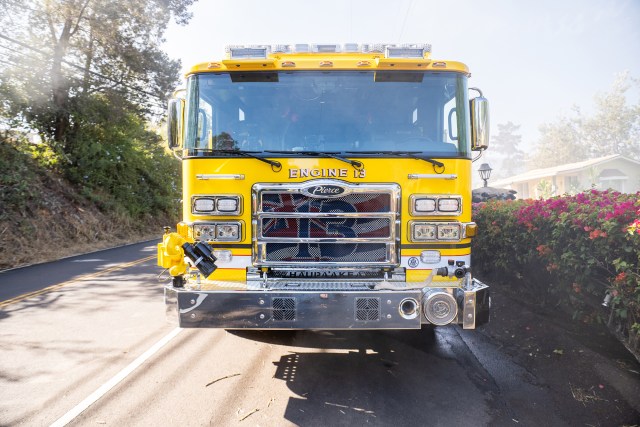
“You will be able to know that the leeward side of Haleakalā right now has a medium level of fire danger,” he said as an example. “We’re going to be getting the information, and that means everybody else gets that information.”
The objective of the collaboration is to improve the reliability of the region’s weather monitoring network and better use the data collected through that network to benefit fire and emergency management agencies, said Eric Johnson, a fire management officer for the National Park Service and U.S. Fish and Wildlife Service. In 2026, officials hope to start producing a daily significant fire potential seven-day outlook for Hawai’i, similar to what is already produced for other states.
“Maui, like the other mountainous islands of Hawai’i, has incredibly complex fire weather,” Johnson said in a statement Wednesday. “The winds and moisture as one travels windward, leeward, mauka and makai are strikingly divergent on any given day of the year. As our weather monitoring network is being expanded into those microclimates, it gives meteorologists and fire managers insight into the wildland fire potential in those locations each day.”
He said that knowledge has been utilized in recent months in “wildfire response staffing, fire restrictions, and public messaging leading up to and throughout critical weather events.”
“All of the people responsible for any kind of fire response on Maui have been kind of yearning for better data, and the state has put out a lot of their stations to kind of help with that,” Parker said.
Gordon Firestein, the local Firewise community leader in Launiupoko, said he was happy to hear that officials were doing more to better prepare for and educate the public about wildfires.
“Everything helps,” he said.
Civil Beat’s coverage of Maui County is supported in part by a grant from the Nuestro Futuro Foundation. Civil Beat’s coverage of environmental issues on Maui is supported by grants from the Center for Disaster Philanthropy and the Hawai‘i Wildfires Recovery Fund and the Doris Duke Foundation. Civil Beat’s coverage of climate change and the environment is supported by The Healy Foundation, the Marisla Fund of the Hawai‘i Community Foundation and the Frost Family Foundation.