Green Suggests Hawaiʻi Might Scale Back On Income Tax Cuts
The governor also says he will likely tap into the state’s “rainy day” reserve to draw down hundreds of millions of dollars to balance the state budget.
Gov. Josh Green won’t be releasing his proposed new budget for another two weeks, but he is already floating the idea that he and lawmakers may reduce the scope of the whopping state income tax cuts they approved in 2024.
Green has been warning in his public statements that the state is facing significant budget problems, citing federal budget cuts and other recent actions by the federal government he says will cost the state an estimated $3 billion in lost revenue over the next six years.
The situation is so serious Green has said it may require tapping the state’s emergency budget reserve fund — better known as the “rainy day fund” — for several hundred million dollars to balance the state budget.
Last year’s state tax cuts figure into next year’s budget scenario because the state government will see its cash flow from state income taxes dramatically reduced thanks to House Bill 2404, which Green signed into law last year in an effort to lower the cost of living for struggling Hawaiʻi residents.
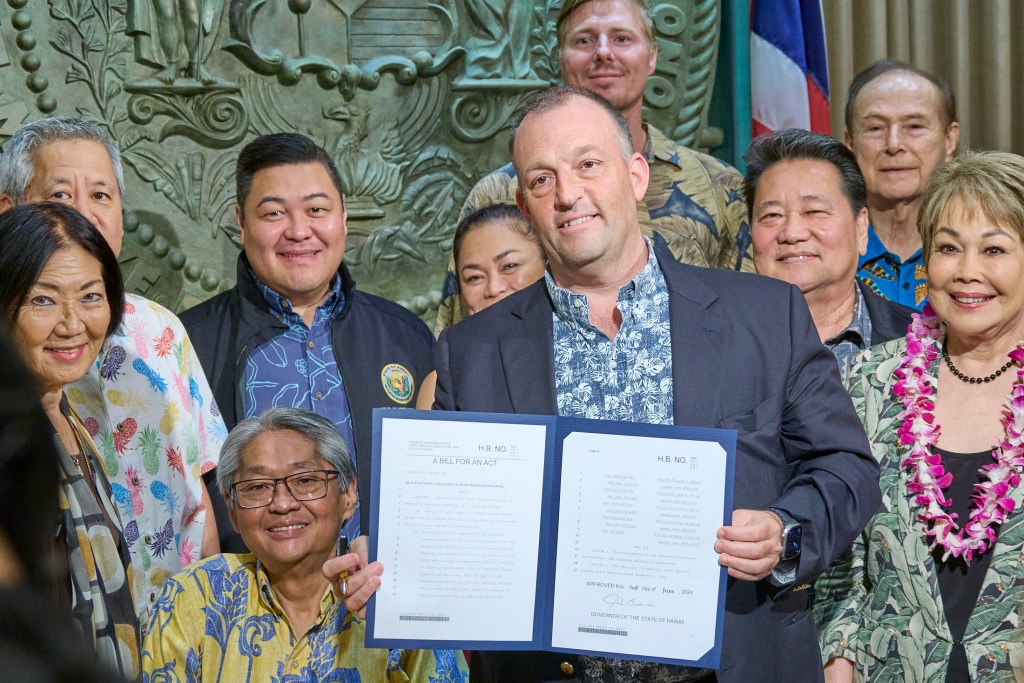
Given the increasingly alarming budget situation, Green has been suggesting at public events he and lawmakers may limit the tax benefits that higher income Hawaiʻi residents would otherwise receive from the tax cut bill.
Green told reporters at a gathering of governors in Arizona last month that “we will have to see whether we can still keep the out years (later years) of our tax breaks for the more wealthy individuals that were going to benefit.”
Big Tax Relief At A High Cost
The tax bill has been praised as the largest state income tax cut in state history. It is designed to cut taxes by increasing the standard deductions in a series of steps from 2024 to 2031, and by lowering tax rates for all tax brackets in another series of steps.
The state Tax Department projects the income tax cuts, coupled with another measure to eliminate excise taxes on certain medical services, will cost the state $630 million in lost revenue this fiscal year, and another $817 million in the fiscal year that begins next July 1.
But the structure of the tax bill with its phased-in benefits causes the impact on state revenues to increase each year.
Together, the income and excise tax cuts are expected to reduce overall state tax collections by about $1 billion in fiscal year 2028, and reduce tax collections by more than $1.1 billion the following year, according to the Tax Department.
The state general fund currently collects a total of about $10 billion a year, so while the tax cuts provide some relief to residents they also represent a substantial hit to state finances.
Some critics questioned the structure of the tax cuts from the beginning, citing analysis by the Institute on Taxation and Economic Policy that concluded nearly half of the savings from the income tax cuts would go to the top the top 20% of earners, meaning people who earn more than $147,000 annually.
It now appears Green may be taking those arguments to heart.

Green declined a Civil Beat request that he elaborate on those remarks in an interview, but he suggested in an appearance on Hawaiʻi News Now’s “Spotlight Now” on Nov. 18 he is eying the state tax breaks granted to high-earning Hawaiʻi taxpayers.
Green noted families with incomes of more than $250,000 got a “big (tax) benefit at the federal level,” and suggested the state might be able to save as much as $1.8 billion by curtailing the state tax cuts for those families.
He also suggested this savings could be used by the state to assist residents with food and housing security.
“I’m not going to let people go hungry. I’m not going to let people go without housing,” he said. “But on the flip side, it becomes more and more difficult to have all of that tax package if they continue to hit us like they are.”
“What may happen is we get a recommendation in partnership with the Legislature that we continue all the tax breaks, but we don’t further deepen them,” Green said in the “Spotlight” interview. “We don’t even lower taxes further, mainly because the federal government collapsed taxes on a lot of people, so people are paying less taxes at the federal level.”
Mixed Reviews For The Idea
Senate Ways and Means Chairman Donovan Dela Cruz and House Finance Committee Chairman Chris Todd did not respond last week to requests for comment on Green’s remarks, but the issue has been a subject of some discussion at the Legislature.
Devin Thomas, director of tax and budget for the Appleseed Center for Law and Economic Justice, said his organization has been quietly advocating for rolling back the tax cuts, particularly for high earners.
A major rationale for the income tax cuts in the first place was to help lower income families who are struggling with the cost of living in Hawaiʻi, “so really there’s no need to be extending these tax cuts to the higher brackets,” Thomas said.
He said there seems to be an understanding among many lawmakers that the state would not be able to afford the entire package of tax cuts when it fully took effect.
“No one wants to be the first to step forward and say it out loud,” Thomas said, “because it’s not a popular thing.”
Tom Yamachika, president of the Tax Foundation of Hawaiʻi, said he interprets Green’s “Spotlight” remarks as establishing “a line of demarcation” of $250,000 for a family of four, below which he does not want to touch the tax cuts. “Above that, he thinks an adjustment is fair game,” Yamachika said.
“There certainly are consequences to what’s going on in Washington. I think every state is feeling it and we are by no means exempt,” Yamachika said. But he suggested lawmakers and the Green administration should also consider alternatives to rolling back the tax cuts.
The Tax Foundation has argued the state should do a better job of using other federal funding, including tapping hundreds of millions of dollars in unused federal funds for Temporary Assistance for Needy Families in Hawaiʻi.
Green said on “Spotlight” no decisions have been made yet regarding the tax cuts, and the issue must be debated by lawmakers. He is expected to submit his latest budget proposal to the Legislature on Dec. 22.