

Hawaiʻi Governor’s Proposed State Budget Anticipates More Federal Cuts
Facing reductions caused by President Trump’s policies, the state’s budget will prioritize essential services such as health care and food security.
Hawaiʻi Gov. Josh Green’s $20.4 billion supplemental budget for fiscal year 2027 doesn’t envision a major increase in the state’s operating budget.
Instead, Hawaiʻi’s focus will be on requiring departments to work within their existing budgets, and to fund priority programs and services. That includes about $100 million for food stamps, tiny homes for the homeless and access to health care, among other services.
But the budget doesn’t address large tax cuts for Hawaiʻi residents passed by the Legislature in 2024 that the governor has already talked about scaling back. Civil Beat reported earlier this month that the cuts, approved by Green and the Legislature, are expected to cost the state a total of more than $7 billion between now and 2030.
The reason for the leaner budget is largely because of the impact of the Trump administration’s policies on the national and state economies and Hawaiʻi’s vulnerability to reduced funding from Washington — something that all states are experiencing.
“Across the nation, evolving federal policies have presented new complexities for states, requiring ongoing adjustments and careful planning to navigate economic trends,” according to the budget’s executive summary. “While we cannot control what happens at the federal level, we can control how we respond here at home.”
Green was not available Monday for an interview for this story. But Makana McClellan, his director of communications, responded via text to a question about exactly how dire the national situation may be for Hawaiʻi.
“We’re monitoring the federal government situation closely, but Hawaiʻi is in a relatively strong position compared to other states with solid reserves, conservative budgeting and a strong tourism brand that has weathered major uncertainty in the past,” she said.
Highlights of the budget, which was released Monday, include:
- $13.4 million to continue administering the Supplemental Nutrition Assistance Program for direct food relief to families;
- $8 million to expand kauhale programs statewide to provide shelter and “pathways” to permanent housing;
- $8.1 million for air transport services to provide rapid, specialized medical aid for residents, especially in rural areas;
- $45 million to maintain access to Medicaid and $30 million for Medicaid technology upgrades to meet new federal requirements; and
- $8 million in general funds for Hawaiʻi State Hospital psychiatric beds and critical staffing for overtime.
The administration is also expected to implement the first year of what’s known as the green fee, a dedicated source of funding from hotel taxes to protect environmental resources and sustain the tourism industry.
The budget submitted Monday contained few details about the green fee, however, as the administration said it plans to work with the Legislature in the new session beginning next month to consider recommendations from a recently formed Green Fee Advisory Committee.
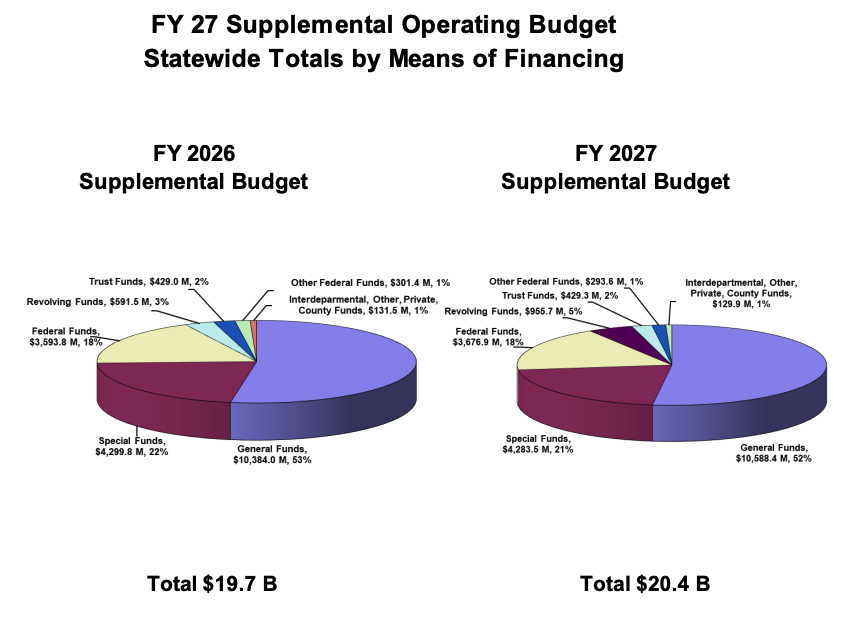
The administration also proposes to add $903 million in general obligation bonds in fiscal year 2027, bringing its total bond fund spending to $1.32 billion. The supplemental budget includes $50 million in general obligation bond funds for the West Hawai‘i Medical Office on Hawai‘i island.
The Hawaiʻi Constitution requires the governor to report to the Legislature his budget intent by late December. The supplemental is the second part of the two-year budget that was submitted last year at this time.
More budget and policy details are expected to come Jan. 26, when the governor presents his annual State of the State address and submits the administration’s bills to lawmakers.
Much could change between then and now, however, as the governor told Hawaiʻi News Now’s “Spotlight” last week. This includes a Hawaiʻi Council on Revenues update to the state’s economic forecast on Jan. 7, which is expected to show another reduction in growth and revenue from earlier projections.
Other factors influencing the drawing of a tighter budget: The One Big Beautiful Bill Act, signed by President Donald Trump in July, shifted costs related to Medicaid and SNAP to the state to absorb. There was also the costly shutdown of the federal government this fall and the lingering uncertainty of Trump’s tariff policies.
The Council on Revenues has also cited the 2024 state income tax cut, hailed at the time as the largest in Hawaiʻi history, as lowering the revenue stream into state coffers.
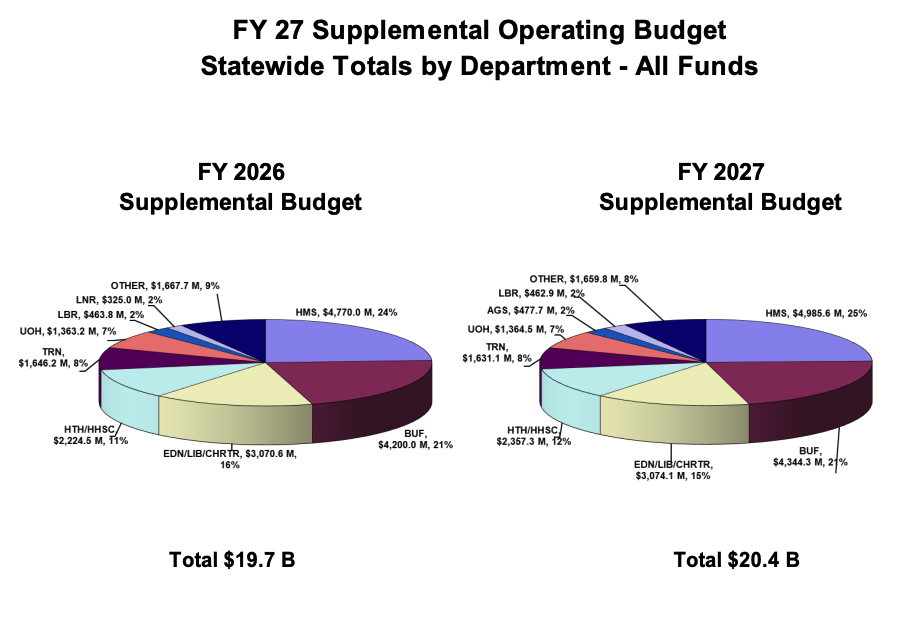
While Green made no mention of the tax cuts in his supplemental budget, he told HNN, “We project that we’re about $3 billion down over the course of this year, and so our state government has to have a balanced budget, so we have to make that up.”
To do that, Green is proposing working with the Legislature “to pause deeper tax breaks” that were scheduled to take effect over the next several years in order to recoup $1.8 billion.
Green told HNN he did not want to cut programs to balance the budget, nor does he want to dip into the state’s $1.6 billion “rainy day” fund — although he allowed that it was possible. Civil Beat reported that it may be necessary to draw several hundred million dollars from the fund to balance the budget.
And he pointed to potential economic growth in the gradual return of the Japanese tourism market and a greater emphasis on promoting sporting events like having the Los Angeles Rams train in the islands.
Asked for comment on the governor’s supplemental budget, House Speaker Nadine Nakamura said in a statement Monday, “The House will carefully review the Governor’s proposed budget ahead of the 2026 Legislative Session. We remain mindful that the full federal budget has yet to be approved by Congress, that economists warn of a mild recession, and that we are experiencing a slow down in the visitor industry.”
Sheryl Turbeville, director of Senate communications, said the Senate leadership had not yet received the executive budget from the governor as of Monday afternoon and so it would be “premature” to comment.
House and Senate leaders will present their own legislative and budget priorities on Jan. 21, the opening day of the 2026 session.

