Beth Fukumoto: Hawaiʻi Isn't The Only State Struggling With Federal Policy
Fiscal and policy pressures are impacting everything from the budget to health care to social and legal issues.
January 25, 2026 · 6 min read

About the Author

As a lawmaker, I constantly tracked what other states were doing in case Hawaiʻi could borrow their ideas, a habit I’ve kept up. With more than 40 state legislatures back in session this week, coverage in News From The States and the National Conference of State Legislatures’ 2026 forecast show the same issues dominating headlines everywhere: budgets, Medicaid and immigration enforcement.
That repetition isn’t a coincidence. These topics aren’t just trending. They’re symptoms of a wider reality. Federal policy is pushing states to act, whether they want to or not. As Hawaiʻi’s session begins, we need to decide how to respond to these pressures and what to avoid.
Budgets come first. The post-COVID surplus era is fading, revenue is flattening and states are urged to plan cautiously. Federal tax, trade and tariff decisions add to the uncertainty. States must balance their books even though they lack control over those levers.

You can see states making those exposure calculations in real time. In Indiana, lawmakers are moving to opt out of portions of Trump-era federal tax cuts, choosing more state revenue certainty over automatically mirroring federal policy. In Arizona, the fight is playing out as a veto and a consequential partisan battle about the size of the hole conformity could blow in state finances. Meanwhile, Georgia is leaning into new tax cuts alongside other spending priorities, betting that growth and the state’s fiscal position can carry the risk.
Different politics, same governing choice: do you tie your revenue base to federal decisions you can’t predict, or do you build a little insulation even if that means residents don’t automatically get every federal tax benefit?
Hawaiʻi is already deep in that same conversation. Civil Beat’s session preview makes clear that taxes and the larger fiscal picture will drive much of the Legislature’s agenda this year, largely because the margin for error is shrinking. Gov. Josh Green has raised the possibility of pausing or limiting portions of the income tax cuts passed in 2024 to keep the state budget balanced.
According to the Department of Taxation, the full package of tax cuts is projected to cost the state more than $7 billion over six years. At the same time, the administration is warning about less predictable federal funding and economic uncertainty tied to tariffs and other pressures. In other words, Hawaiʻi is facing the same choice other states are making: whether to fully mirror past policy commitments and hope growth fills the gap, or to slow down, preserve flexibility and accept that restraint.
Medicaid is where budgets get tightest. It makes up about 30% of state spending and over half of all federal dollars to states, so even small federal changes have big impacts. States have little discretion when federal rules shift.
You can see legislatures responding already. Idaho leaders are openly discussing Medicaid cuts as projected deficits emerge. Missouri lawmakers are tapping into their general fund for the first time since voters mandated a Medicaid expansion in a ballot measure. They are also considering another ballot measure to require Medicaid work requirements in the state constitution. New Hampshire is requiring some recipients to pay premiums for their coverage, which the state expects could raise up to $23 million.
Hawaiʻi isn’t exempt. Our Medicaid program relies on federal matching funds, so federal policy changes quickly affect the bottom line. Green’s budget proposes absorbing extra costs, seeking $45 million in state funds and $65.4 million in federal funds for FY27, plus $30 million for system upgrades to comply with new federal requirements.
SNAP is facing similar pressure. With federal policy reducing its share of administrative costs, Hawaiʻi will use state funds to keep the program running, including shifting over 100 positions to state funding.
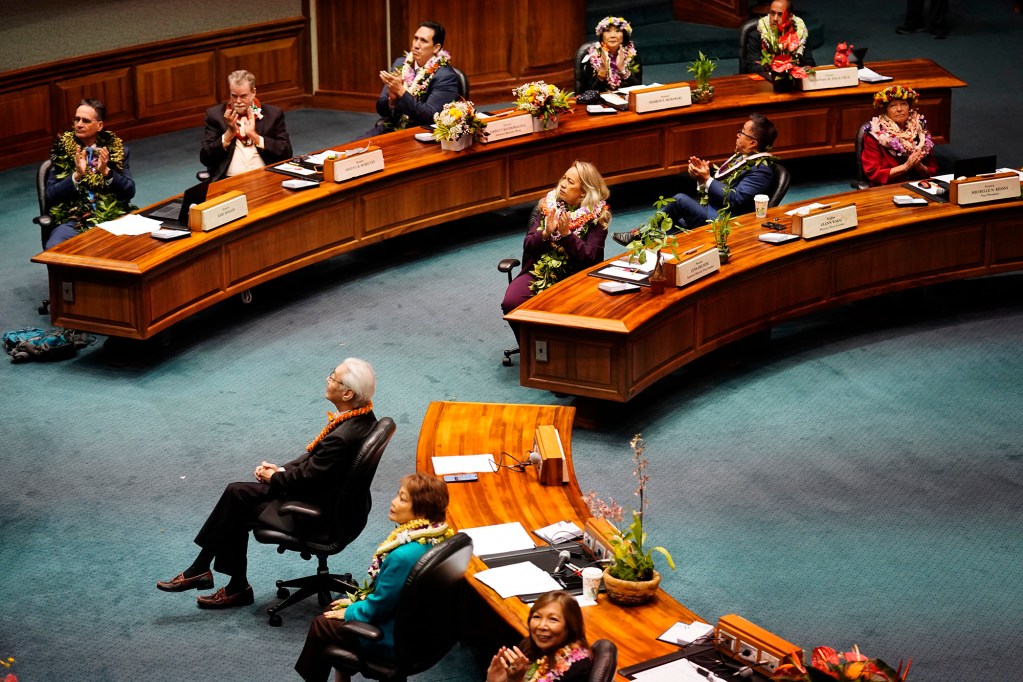
The strain of these fiscal and policy pressures doesn’t stop with budgets or health care. States are also being forced to navigate the intersection of federal expectations and local choices on issues that touch values as much as spreadsheets, nowhere more so than with immigration enforcement.
Across the country, statehouses are treating immigration enforcement as a question of values and governance. In New Jersey, lawmakers passed bills restricting when police can assist federal immigration agents, drawing a clearer line between public safety and federal enforcement. Nebraska introduced a bill to unwind a state–federal agreement that turned a former prison into an ICE detention facility, questioning the state’s role in immigration detention, even as leasing the facility to ICE brings in over $14 million. In Tennessee, Republicans are aligning with the White House, explicitly modeling their enforcement agenda as a national template. Different approaches, but the core question remains: Should a state partner with federal enforcement, or set its own boundaries, and at what cost?
Like every other state, Hawaiʻi is being forced to answer the same basic questions: how much are we willing to comply with federal immigration enforcement priorities, how much are we willing to push back, and what costs — political or fiscal — are we prepared to absorb either way. Those questions have become harder to avoid as immigration arrests and detentions in Hawaiʻi have surged, with 2025 far exceeding 2024 levels. That increase has sharpened calls for state action, but lawmakers have yet to respond. This session, advocates are again pushing “protective” legislation designed to limit how state and local systems interact with federal enforcement after similar bills failed to advance in prior sessions.
Hawaiʻi has also refused a federal request for years of detailed SNAP applicant data, citing privacy concerns. Federal agencies have threatened to withhold administrative funding that supports food assistance for over 160,000 residents. Immigration enforcement pressures now often surface through data and compliance demands, not just arrests.
Overall, budgets, Medicaid, and immigration enforcement show how federal policy sets the parameters, leaving states to manage the consequences. Deciding where to draw boundaries with the federal government isn’t just a values question, and it isn’t just a budgeting question. It’s both. Our budgets are one of the clearest ways we signal what we’re willing to stand behind and what we’re willing to pay for.
As lawmakers return to the State Capitol, the real risk isn’t just choosing wrong. It’s pretending these debates are separate, when they’re all symptoms of the same federal-state tension, and discovering too late that the costs — financial or otherwise — have already been set.
 Sign up for our FREE morning newsletter and face each day more informed.
Read this next:
Local reporting when you need it most
Support timely, accurate, independent journalism.
Honolulu Civil Beat is a nonprofit organization, and your donation helps us produce local reporting that serves all of Hawaii.
ContributeAbout the Author