

By Resisting Feds’ Demand For Personal SNAP Data, Hawaiʻi Could Face Cuts
Hawaiʻi is one of 22 states that have called the USDA’s demand for food stamp recipients’ information unprecedented and unlawful.
After declining to turn over data on residents who use food stamps to the federal government, including their immigration status, Hawaiʻi faces the threat of losing tens of millions in funding to operate the food aid program.
Brooke Rollins, secretary of the U.S. Department of Agriculture, vowed in December to withhold the federal funds used to administer the Supplemental Nutrition Assistance Program from states that have not complied.
The state chose not to provide the data because it “is committed to protecting the personal information of individuals applying for and receiving SNAP,” said Scott Morishige, who heads the Department of Human Services division that manages the program.
For Hawaiʻi, that could mean a loss of up to $33 million in federal funding in 2026.
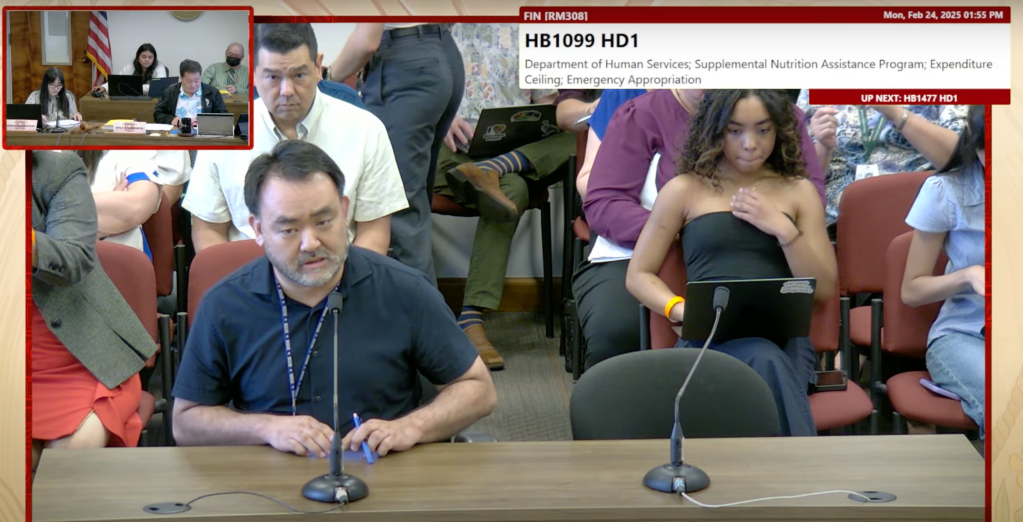
“DHS is currently reviewing potential options if federal funds are withheld,” Morishige said.
Such an event would force the state to make tough decisions about hiring freezes, delays in technology upgrades and perhaps layoffs of administrative staff and eligibility workers, said Colin Moore, a political scientist at University of Hawaiʻi Mānoa.
Even if the money is not withheld, the predicament foreshadows other changes in SNAP funding the state will have to confront later this year.
“I don’t think you would see the effect necessarily on SNAP recipients immediately,” Moore said. “It’s about slow erosion of the infrastructure that supports the program.”
‘Strategic Pressure On States’
The USDA in February first demanded that states share five years of details including names, addresses and immigration status about SNAP recipients. Rollins said it was necessary to root out fraud.
She leveled her latest threat in early December at Hawaiʻi and 21 other states that sued the department in July over what they called an unprecedented and unlawful request. The states said they already verify beneficiaries’ eligibility and never share such “large swaths” of personal data with the federal government. Those states, and the District of Columbia — which also joined the legal challenge — all are led by Democrats.
Rollins targeted administrative funding, not funding that goes directly to recipients, which Moore called “a very strategic way for the federal government to put pressure on states; it’s both evil and clever.”
“It avoids the political backlash of cutting benefits that would probably be unacceptable to the vast majority of voters,” he said. “It targets the state level bureaucracies, and that means it really puts pressure on the governors of these blue states and their bureaucratic leaders, which is a far less sympathetic constituency than families who need food.”
The legal challenge to the USDA request is ongoing. In October, a federal judge in San Francisco temporarily barred the USDA from collecting the data from states that had not yet turned it over; Rollins did not address that order when she made her December statements at a Trump administration cabinet meeting. Twenty eight states have shared their SNAP recipient data with the USDA, Rollins said.
“It’s a very strategic way for the federal government to put pressure on states; it’s both evil and clever.”
Colin Moore, political scientist, University of Hawaiʻi, Mānoa
The demand for SNAP data echoes the administration’s efforts to obtain historically confidential personal information, such as taxpayer and Medicaid records. Those moves have been explicitly framed as ways to bolster Trump’s anti-immigrant campaign as well as to cut waste and fraud.
And the push has been in the works starting soon after inauguration day, if not before. The conservative Project 2025 blueprint that Trump disclaimed knowledge of during the election but has taken full pages from — co-author Russell Vought is a top administration official — outlined information sharing between federal and state agencies as a way to enhance immigration enforcement.
“It is essential to use all available legal authority to end any incentives in (USDA) benefit programs that encourage illegal immigration,” Rollins wrote in a February letter to state and local governments.
Changes On The Way
Undocumented immigrants are not eligible for SNAP, but their children are if born in the U.S. COFA citizens — those from the Federated States of Micronesia, the Marshall Islands or Palau who are in the U.S. under the Compacts of Free Association agreements — Cuban and Haitian immigrants and certain lawful permanent residents also can qualify for benefits. In Hawaiʻi, at last count, there were 13,190 people with unspecific citizenship or identified as non-citizens receiving SNAP, Morishige said.
Yet a 2025 Congressional Research Service report found fraud in the $100 billion program rare. For example, in 2021, it said, states tried to recover $54 million in benefits that were “trafficked” — sold for cash — or where fraud was committed during the application process. Errors made by state agencies, in the form of SNAP benefit payments that were too large or too small, were a greater source of financial loss – some $10.5 billion in 2023.
Hawaiʻi had an error rate of 8% in fiscal year 2024, down from about 21% the previous two years. That’s compared to a nationwide error rate of 11.7% in 2023.

Rollins said that based on information from states that have submitted the requested data, 186,000 dead people are receiving SNAP benefits nationally and 500,000 people are getting double benefits. That reflects .4% and 1.2% respectively of the 42 million people receiving the benefits monthly.
About 162,000 Hawaiʻi residents rely on SNAP and, in September, received an average of $343 each.
Even if the USDA does not follow through on Rollins’ promise to withhold funding, Hawaiʻi will face a somewhat similar scenario in late 2026. At that point, changes to SNAP outlined in the domestic budget bill Trump signed in July will take effect and states will be forced to pick up a larger share of the program’s administrative costs.
Now, the federal government pays 50% of the state’s administrative costs. Under the changes that are to take place in October, that share drops to 25%.
Other changes the bill contained included stricter eligibility requirements and work requirements that kicked in in November. Some estimates are that the changes could cause 13,000 Hawaiʻi residents to lose at least some SNAP benefits.
Civil Beat’s reporting on economic inequality is supported by the Hawaiʻi Community Foundation as part of its work to build equity for all through the CHANGE Framework; and by the Cooke Foundation.

