

Hawaiʻi Judges Face More Threats. Courts Want Armed Guards To Help
The Judiciary is seeking $3.25 million to hire private security as the Department of Law Enforcement, which protects the courts, faces staffing shortages.
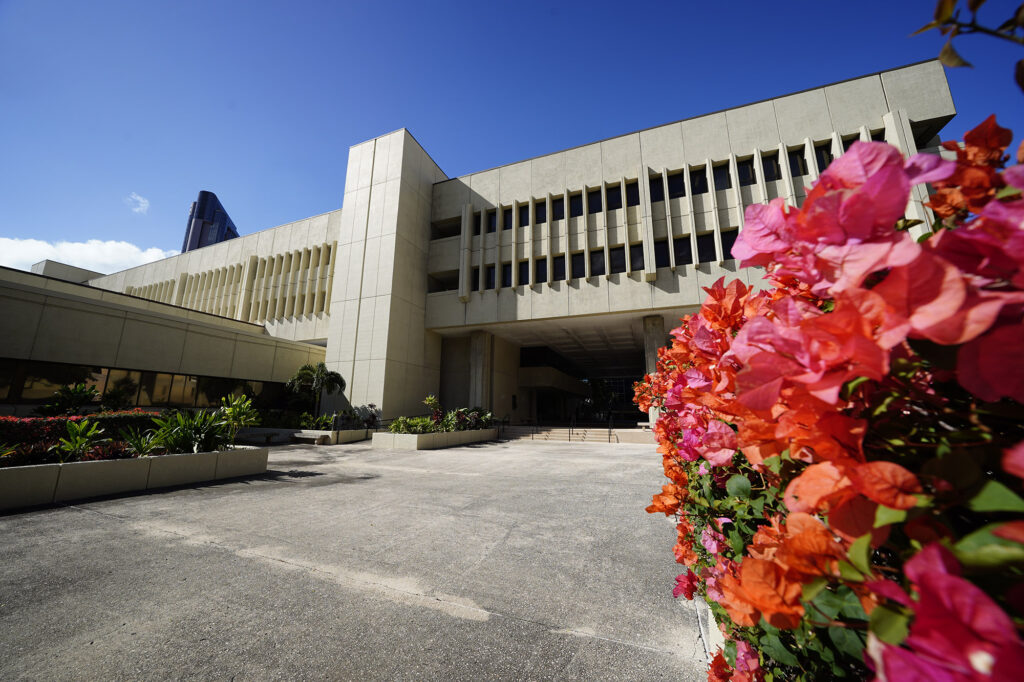
Days before Mark Browning retired as a 1st Circuit Court judge in December 2023, an aggrieved party in a case that had been pending before family court broke into his Kailua home.
Browning’s adult son was there at the time and saw the person come through a window. He called the police, and the intruder ran back outside and fled in a vehicle.
Browning’s reaction was a mix of anger, shock and, mostly, relief that his son was okay. After serving nearly three decades as a judge, he was used to people taking out their frustrations with the justice system on him.
“I trained myself to compartmentalize my reactions to these things so that it didn’t affect my duties and my responsibilities and how I perform on the bench,” he told Civil Beat.
He and his fellow judges had received dozens of threats over the course of their careers, Browning said, but the problem has gotten worse in recent years, according to the Judiciary.
Instances of threats or inappropriate communication towards Judiciary staff jumped to 140 last year from 69 in 2024.
Members of the Judiciary worry the state’s courthouses are becoming less safe as staffing shortages within the Department of Law Enforcement, which has jurisdiction over state buildings, including courts, mean fewer armed sheriffs standing guard.
Brandon Kimura, administrative director of the courts, asked the Senate Ways and Means Committee for $3.25 million to hire 18 private armed security guards for the courthouses at a hearing earlier this month.
State Sen. Samatha DeCorte said during the hearing she would rather see the funds the Judiciary requested for private security go to state employees.
“If there is going to be funds that are going to be allocated to patrol these areas I don’t see why we wouldn’t just give that over to DLE,” she said, “so we can staff up on the state side.”
Mike Lambert, director of the Department of Law Enforcement, said about a quarter of his agency’s positions are vacant. Despite this, he said the courts have the highest rate of staffing compared to the other areas under the agency’s jurisdiction, such as harbors and airports.
Rather than contracting private security, he would like to see the money go to bonuses for sheriffs to help make it easier for him to recruit.
But Kimura told committee members he feels private security guards are necessary to supplement the state sheriffs and described a series of recent safety issues at courthouses across the state, including people showing up with firearms, BB guns and brass knuckles.
“We appreciate all that DLE can provide and does provide; we’re not looking to replace them,” Kimura said. “But the fact is that we just need more bodies.”
Increasing Threats
Kimura told legislators about several incidents courthouse staff have faced in recent years.
In April 2023, a 33-year-old man brought a gun to the entrance of Honolulu’s 1st Circuit Court.
In May 2023, employees at a Kona courthouse saw a person lurking outside with what appeared to be a long gun. It was later determined to be a toy.
In December of that year, someone showed up to the Wailuku courthouse’s screening station with a pitbull.
There were five mass shooting threats at Judiciary locations statewide last year.
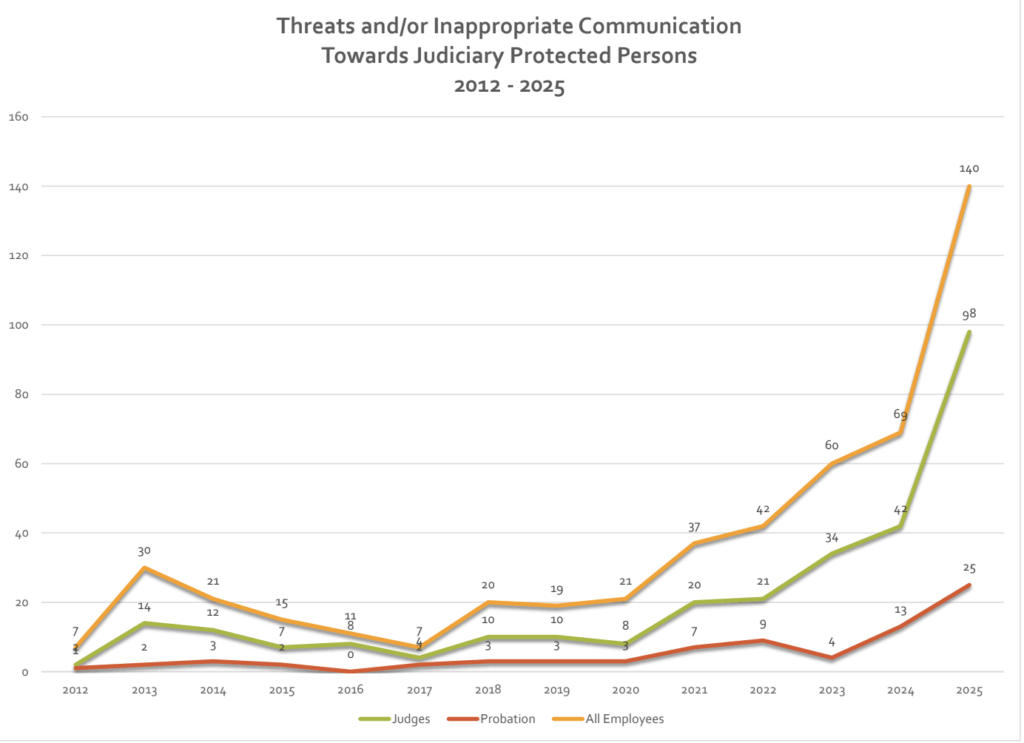
These incidents highlight an increasingly threatening atmosphere at Hawaiʻi courthouses. There were 140 instances of inappropriate communication and threats to Judiciary employees last year compared to seven in 2012.
Inappropriate communications are “menacing messages” that require an assessment of whether a crime, like harassment or terroristic threatening, has been committed, according to a statement from Judiciary spokesman Brooks Baehr. Inappropriate communications can also include “excessive and unwelcome” communications in writing, through phone calls or text messages or personal contacts.
That coincides with national trends. A 2021 audit found security incidents involving officials protected by the U.S. Marshals Service, who include judges and other judicial personnel, increased 89% between 2016 and 2019.
Violent attacks on judges and their families have made headlines in recent years.
The son of a federal judge in New Jersey was killed in 2020 by a gunman who was targeting the judge. In 2024, a defendant jumped over the bench in a Las Vegas courthouse and attacked a judge. That year a Kentucky judge was shot to death in his office by a sheriff who was distraught over a lawsuit he was facing.
In 2016, two Big Island residents were charged with setting fire to the Kona drug court. Kainoa Lindo was charged with arson and given a deferred acceptance guilty plea after a four-year probationary period. Randi-Keli Banagan was sentenced to five years in prison on two felony terroristic threatening counts.
Early last year, state sheriffs had to provide personal security to a judge who was threatened, Lambert said.
In the case of the break-in into Browning’s house, no one was arrested, according to the Honolulu Police Department.
Browning said he lost count of the number of times he’d been threatened over the years.
In 1998, a year after he became a family court judge in Honolulu, Browning was presiding over a custody case involving a man who had been charged with domestic violence. Browning decided the man was a danger to his children and granted full custody to the man’s ex-wife.
“What happened next is the guy threatened to blow me up,” Browning said, “plant a bomb and blow up my house.”
While judges have been dealing with threats for years, he thinks the rise in violence could be due to an increasing sense of anger people have for government institutions.
“The anger’s not justified,” he said. “But it’s put there in the hearts and minds of people who have really no understanding of the ramifications of their conduct.”
Sheriff Vacancies
Legislators have taken action on this issue due to increasing threats. In 2024, they passed a bill allowing judges and other public officials to request to have their personal information, including home address and telephone number, removed from public-facing websites.
Kimura told legislators the fact that the increasing threats has coincided with staffing shortages at the Department of Law Enforcement “has left us with facilities that we believe are not as safe as they could and should be.”
Although the Judiciary reported 140 instances of threats or inappropriate communication toward its employees last year, Lambert said his department only opened 20 investigations into crimes committed in courthouses. Most of these investigations were related to assaults between members of the public, not attacks on Judiciary staff, he said.
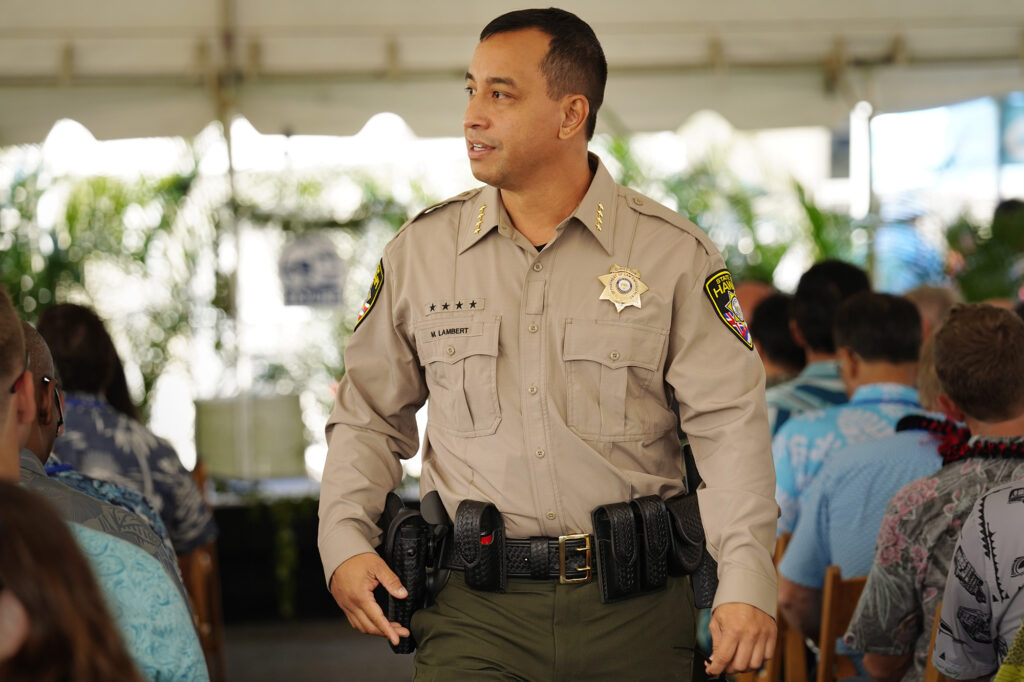
“Statistically, our courts are extremely safe,” he said.
Deputy sheriffs stationed at Judiciary buildings have the lowest rate of vacancy, Lambert said. Courthouse sheriff positions are 17% vacant, compared with 20% vacancies in the specialized services division, which is tasked with protecting the governor and lieutenant governor, and 27% vacancies in the transportation division, which staffs airports and harbors. Lambert said he was citing preliminary numbers.
“I definitely want the courts to feel supported,” he said. “But it’s a significant amount of my agency that’s there.”
Lambert said the biggest barrier to recruitment for the Department of Law Enforcement is the fact that sheriffs make on average $20,000 less per year than county police officers. The bargaining unit that represents sheriffs, which falls under the Hawaiʻi Government Employees Association, is in negotiations, but Lambert said he isn’t confident it will result in a meaningful raise for sheriffs.
He would like to see them make at least $10,000 per year more. The Legislature doesn’t control sheriff salaries, but it can make money available for bonuses. Lambert said he’s advocating for a bill that would provide a $15,000 bonus to sheriffs to help with recruitment and retention.
But providing $3.25 million for private security could undermine his efforts, he said. Private security firms often offer higher salaries than the Department of Law Enforcement, which offers a starting pay of $55,500 to deputy recruits.
Lambert said if he’s able to hire more sheriffs, even if they are permanently staffed at the Judiciary, they can still be called upon to support other areas of the state on overtime.
CORRECTION: This story has been updated to reflect Brandon Kimura’s current title.

