

A New Insight Into Mysterious Tiger Shark Mating Behavior Off Maui
New research reveals what is attracting tiger sharks to areas off of Olowalu during whale breeding season.
Midwinter marks the annual return of humpback whales to Hawaiʻi, swimming down from Alaska to breed in the warmer waters. Tiger sharks start showing up in greater numbers soon thereafter from across the islands, but new research shows they may be joining the whales for more than just an easy meal.
A study released last week from the University of Hawaiʻi Mānoa has found that tiger shark mating events in Hawaiʻi may directly coincide with humpback calving season. Tiger shark mating behavior has long been mostly a mystery because of their solitary nature, but scientists have now collected six years of data that supports concurrent mating off of Olowalu, Maui.
“This is actually kind of a big one in the world of tiger sharks, which is really exciting for me,” said Paige Wernli, the study’s lead author.
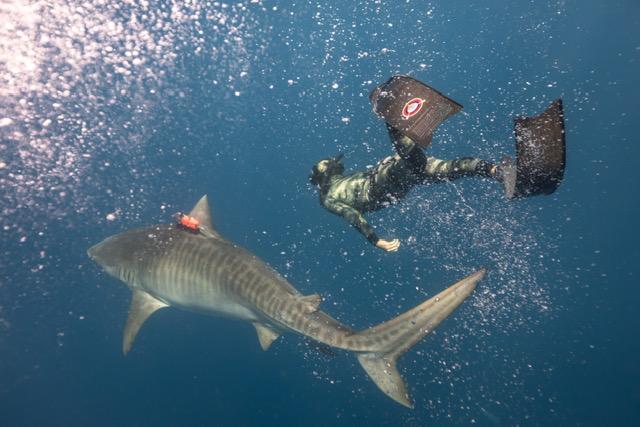
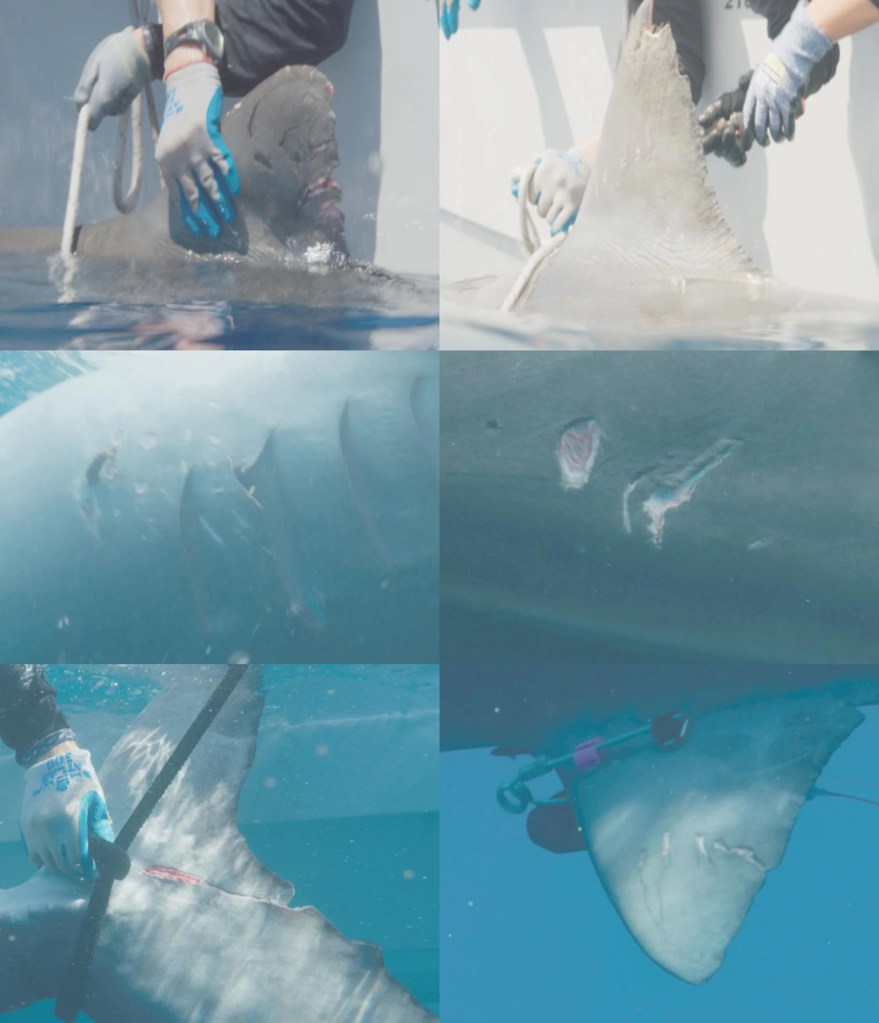
A lot of work has gone into tagging local tiger sharks by the Shark Research Lab at the Hawaiʻi Institute of Marine Biology to better understand human-shark interactions around Maui. While tagging those sharks, Wernli and others began to notice signs of mating — bite marks on the female dorsal fins and skin abrasions on males — around February.
That indicated the sharks were multitasking, mating as they gathered to feed on whale placenta and target calves. By assessing data collected by the tags, the scientists were able to see that this phenomenon extended beyond Maui to Oʻahu.
“It was really exciting going through the data and finding these patterns,” Wernli said.
Before this research, it was generally unknown whether tiger sharks mated through chance encounters or if there were intentional reproductive events. These newly identified mating events may have been harder to spot because the number of sharks that congregate is much smaller than that of other species.
Wernli said it is the first evidence of the mating behavior “anywhere in the world.”
Riskier Time For Swimmers?
Funding for the study came from the Pacific Islands Ocean Observing System and the Hawaiʻi Department of Land and Natural Resources. DLNR was interested in learning more about tiger shark behavior around Maui to better educate the public about the dangers of interacting with sharks, according to biologist Russell Sparks.
“The more we know, the better we can inform the public, and people can make informed decisions about their own behavior and activities,” Sparks said.
So far, however, no measurable rise in shark attacks has been connected to the February mating season, unlike the uptick during shark pupping season in October.
Increased food availability associated with the humpback whales in the area could play a role. Sparks compared it to fishing in Alaska during the salmon runs.
“Brown bears are like walking right up the stream past all the fishermen and totally ignoring the people,” he said, “because there’s more than enough food for them to just pick up and eat.”
Civil Beat’s coverage of Maui County is supported in part by a grant from the Nuestro Futuro Foundation; coverage of environmental issues on Maui is supported by grants from the Center for Disaster Philanthropy and the Hawai‘i Wildfires Recovery Fund and the Doris Duke Foundation; and coverage of climate change and the environment is supported by The Healy Foundation, the Marisla Fund of the Hawai‘i Community Foundation and the Frost Family Foundation.

