Divers Are Dying Near The Surface. Now There’s A Call For Safety Warnings
Freediving is one of the leading causes of fatal drownings for Hawaiʻi residents. Now lawmakers and safety advocates want labels on equipment — and more.
Niki Roderick has noticed a troubling trend when teaching safety protocols to young people interested in spearfishing through her nonprofit FreediveSafe! Hawaiʻi: People don’t know enough about the risk of losing consciousness underwater.
Recently, she had a class of 30 young divers and spearfishermen. Only two raised their hands when she asked if they understood one of the sport’s biggest killers.
Shallow water blackout is one of the leading causes of fatal drownings for Hawaiʻi residents, with more than 50 free divers dying in the last decade. Even the most experienced divers have had close calls more than once.
The danger happens when a lack of oxygen in the brain causes divers to pass out as they rise to the surface. The condition particularly impacts spearfishermen, who often dive without air tanks and stay submerged for extended periods in pursuit of prey.
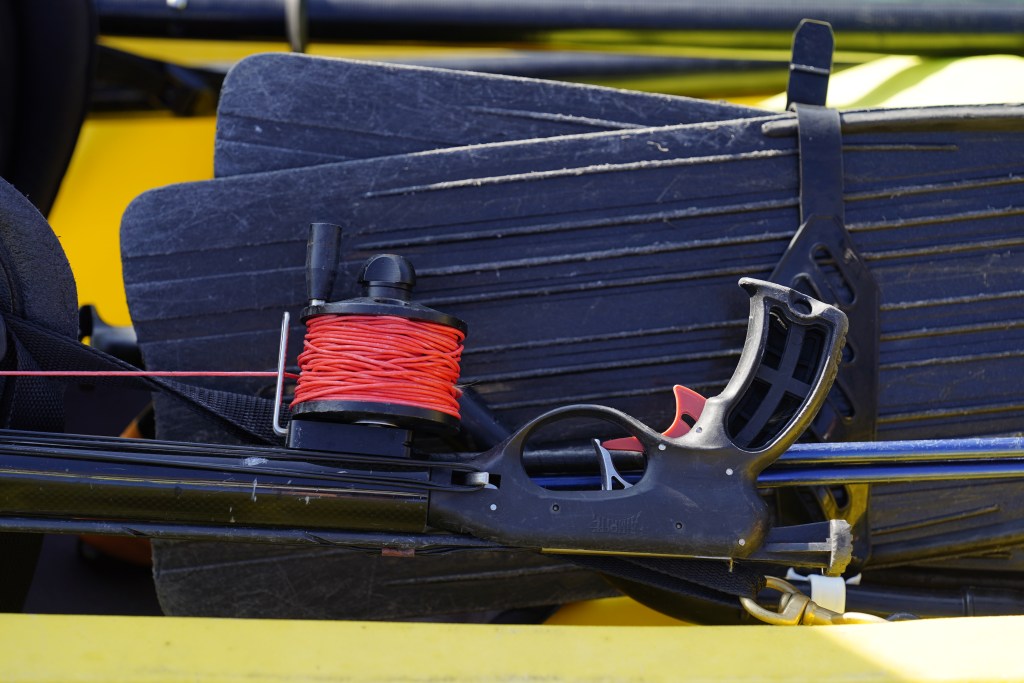
This year, lawmakers are considering a bill championed by Roderick to warn divers about the danger. The proposal would require spearfishing gear sold or rented in Hawaiʻi to have labels with information about shallow water blackout.
“It’s easy to assume that everyone understands the risks, but in reality, people don’t,” Roderick said. “Awareness isn’t as universal as we think.”
Lack Of State Investment
About half of the people who drown in Hawaiʻi’s waters live here. Between 2020 and 2024, 187 Hawaiʻi residents drowned in the ocean. Many were experienced in and around the water – longtime fishermen and ʻopihi shellfish pickers, experienced spearfishermen, solid surfers.
But the state has historically lacked investment in drowning prevention targeting locals. While money has gone to campaigns and signs targeting tourists, the Department of Health, which is tasked with injury prevention, spends less than 0.01% of its budget on drowning.
Freediving has claimed more lives than almost anything else, second only to swimming and accidents caused by a fall or a powerful wave pulling people off the rocks. At least 58 people have died while freediving between 2014 and 2025.
Roderick said 2020 was a particularly difficult year for the spearfishing community – and one of the deadliest on record – with 13 deaths in a single year, including 15-year-old Noʻeau Lima and 20-year-old Malcolm Davis.
The tragedies kicked Roderick into gear. The lifelong competitive spearfisher and ocean safety trainer formed FreediveSafe! Hawaiʻi to teach spearfishing safety protocols to young people for free. The group has reached 3,000 students in about five years, offering trainings at schools and in communities where subsistence fishing is a way of life.
Now Roderick has turned her attention to the Legislature, pushing for a new bill – House Bill 1765 – to reach people through their gear. The idea is simple: every new speargun or pole spear sold, leased or rented in the state should be affixed with a warning label that reads “Danger: spearfishing involves breath-hold diving. Prolonged submersion or improper breathing may cause hypoxia, loss of consciousness, or death. Never dive alone.”
The proposal would task the state Department of Health with enforcing the new safety measures and determining any languages that the warning should be translated into.
Some local manufacturers are already doing this. Skee Saplan, a subsistence fisherman on the Big Island, started putting warning labels two years ago on the custom-made pole spears that he sells under the name SkeeProng. FreediveSafe! Hawaiʻi provided the stickers, which include information about hypoxia and shallow water blackout and cost just 30 cents.
Saplan wants to see this effort expanded. “It’s an easy win for safety that shouldn’t be delayed,” he wrote in support of the bill.
It won’t be hard for dive shops to embrace warning labels, said Byron Kay, owner of Kona Freedivers and Kona Honu Divers on the Big Island, where he sells spearfishing gear and teaches freediving courses. And it’s worth it. Safety training should be foundational, he said. But not everyone has that experience. Sometimes, for example, he said parents come into his shop to buy gear for their kids without understanding the risks.
“At least, if you warn them, they can be aware,” he said. “Everything you can do to get the desired end result is a net benefit.”
He hopes that warning labels will encourage people to enroll in training courses and become more educated about safety protocols.
More Education Needed
While the bill has overwhelming support from divers and water safety advocates, some want to go further. There needs to be more effort to reach spearfishermen who already own the gear, Ryan Kanakaʻole, acting chair and director of the Department of Land and Natural Resources, wrote in testimony to lawmakers.
“Hawaiʻi’s spearfishing community over the years has mourned the loss of multiple individuals who have succumbed to shallow-water blackout, some of whom had decades of experience in deep-water breath-hold diving,” Kanakaʻole wrote.
Spearfishermen also aren’t the only ones practicing deep-water breath-hold diving. More and more people are diving for wildlife viewing, shell collecting or underwater photography, according to Kanakaʻole.
Another legislative proposal aims to address the state’s high rate of drownings by drilling down more on state action. Drowning is the leading cause of death for children ages 1 to 15 in Hawaiʻi, but half of children can’t swim, in large part because lessons are often inaccessible.

Senate Bill 3191 would create a Department of Water Safety and Drowning Prevention to develop and implement water safety programs across the state. The director of this new agency would be in charge of collaborating with the Department of Education and county parks departments to find aquatics facilities for swimming education. Proponents of the proposal argue that doubling down on water safety and making swimming lessons available to more kids statewide is crucial to decreasing the state’s resident drowning rate.
Even as an experienced free diver, Roderick has lost consciousness below the waves five times. She knows warning labels are just the start, especially as the sport grows in popularity. Divers also need to be aware of other essential safety measures, such as always going out with a buddy and taking turns dipping below the surface.
“Education is essential,” she said. “However, we’re currently reaching youth after they’ve already entered the sport, and a warning label provides an upstream prevention and awareness at that moment of access.”