

National Fight Over Immigration Enforcement Roils Maui County
County’s agreement with FBI provokes alarm among activists and, now, council members
A nationwide reckoning over tactics of the federal government’s immigration crackdown is boiling up in Maui County, forcing its way onto the local political landscape amid fears the turmoil engulfing Democratic strongholds on the continent could touch down in Hawaiʻi.
The focus is Bill 92, a long-standing agreement between the Maui Police Department and the FBI that came up for renewal last year, which has suddenly prompted deep soul searching among County Council members.
Even the county’s police chief, who has strongly endorsed his department’s partnership with the FBI’s special task force on terrorism, now wants to add language to that agreement to prevent his officers from being pulled into the fray.
Whether such edits would make a difference if Trump’s deportation campaign were to roll into Hawaiʻi with the same force it has in other politically blue locales remains an open question.
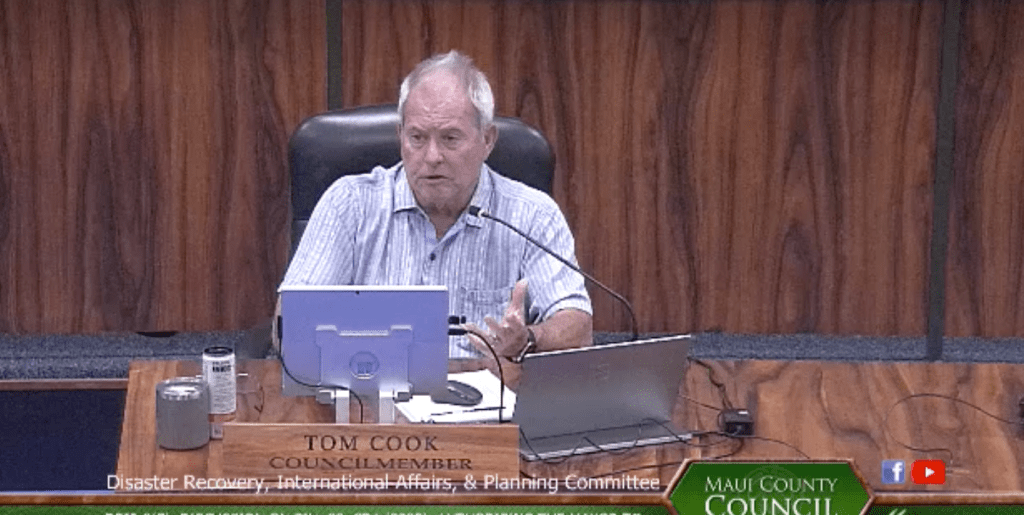
“Could you … let me know where the county is if someone came and started doing this stuff like on the mainland, do we have jurisdiction?” council member Tom Cook asked at a meeting held four days after nurse Alex Pretti was shot and killed by border patrol agents in Minneapolis.
Deputy corporation counsel Thomas Kolbe responded: “That is a pretty complicated question.”
The agreement is up for review Tuesday at the council’s Budget, Finance and Economic Development Committee. It calls for Maui police officers to be deputized as members of the FBI-Joint Terrorism Task Force for a minimum of two years, assigned to its mission of investigating and countering terrorism threats.
Four months ago the committee recommended council approval but now appears to be leaning in the other direction.
Pretti was killed on Jan. 24, shot 10 times as he lay on the street after a handgun he’d been legally carrying had been taken from him. On Jan. 28, the political wind shifted in Maui.
At a committee meeting that day, activists with Maui Indivisible outlined their objections to Bill 92. Council members also expressed unease about how the Trump administration is pursuing its deportation goals and its liberal definition for what constitutes domestic terrorism.
Police Chief John Pelletier — who submitted the agreement to the council last July because a change in leadership at the Honolulu FBI office required a renewal — reiterated his support for it.
“It’s not about politics, it’s about public safety,” Pelletier said.
“Because of what the feds are doing nationally, I just can’t support what we’re doing with them locally.”
Gabe Johnson, Maui County Council member
But the chief also told the council that he wanted the agreement “pulled back” so he could make it clear that it won’t authorize his officers to join most forms of immigration enforcement.
In a statement to Civil Beat, Pelletier, who declined an interview request, said: “the language we are suggesting to be in the latest proposed agreement explicitly states that it is not conveying the authority to enforce administrative violations of immigration law.”
Similar language is already included in the department’s MOU with Homeland Security Investigations, Pelletier said.
Council member Gabe Johnson told Civil Beat that he understands terrorist threats exist and need to be investigated. But he said the agreement — which he also previously supported — will no longer cut it.
“What they’re doing nationally with ICE, they’ve really gone off the cliff …,” he said. “Because of what the feds are doing nationally, I just can’t support what we’re doing with them locally.”
‘Am I Going To Say No?’
All Hawaiʻi police departments have similar agreements with a range of federal law enforcement agencies. But the escalating aggression and clashes with the public raise questions about what situations local police might be forced into.
“People are thinking about what do we do if what is happening in Minnesota happens here? That’s a question we’re getting a lot of on a community level,” said Emily Hills, senior staff attorney with the ACLU of Hawaiʻi. “If the community is asking those questions, I would hope that police departments would be asking the same or related questions.”
The U.S. Constitution’s 10th Amendment prohibits the federal government from commanding state or local governments to provide resources and support to enforce federal laws such as those governing immigration, Hills said. But arrangements with federal agencies of the sort that Maui leaders are wrestling with can put local law enforcement in tough spots.

“If police officers are asked to do something that they’re not required to do, it will sort of be up to their decision in the moment of, ‘Am I going to say no, I don’t want to do this,” Hills said. “And does policy say, ‘I don’t have to do this or not?’”
Even though Maui’s agreement with the FBI does not mention immigration enforcement, a broad spectrum of federal agencies have increasingly overlapped in such activities nationwide.
For example, the ICE agent who shot protester Renee Good dead in Minneapolis last month was a team leader in the same FBI joint terrorism task force as the one featured in the Maui agreement, the agent told a court in December. In Hawaiʻi, agents with Homeland Security Investigations, a unit of ICE traditionally focused on drug smuggling, human trafficking, money laundering and cyber crimes, have joined in immigration enforcement operations, as have Drug Enforcement Administration agents.
Trump administration officials and their supporters have blamed “agitators” and Democratic leaders such as Minnesota Gov. Tim Walz and Minneapolis Mayor Jacob Frey for instigating public resistance to legitimate law enforcement operations, and endangering federal agents in the process.
They have also labeled Good and Pretti domestic terrorists and said they were intending to commit domestic terrorism — of the very sort the FBI task force might investigate.
“We’re seeing the administration use the phrase ‘domestic terrorist,’ or calling people terrorists really indiscriminately these days, and saying pretty much anybody that protests is a terrorist.”
Emily Hills, Senior Staff Attorney, ACLU of Hawaiʻi
And a National Security memo Trump issued in September characterizes domestic terrorism as anti-fascism that opposes “foundational American principles” such as “support for law enforcement and border control,” which can take the form of “extremism on migration.”
That makes Maui’s agreement with the FBI potentially dangerous ground, Hills said.
“We’re seeing the administration use the phrase ‘domestic terrorist,’ or calling people terrorists really indiscriminately these days, and saying pretty much anybody that protests is a terrorist,” she said. “So that would seemingly fall under the purview of this joint terrorism task force.”
A Step Further
If the Maui council rejects the agreement, they would go further than their Big Island council counterparts did in April, when they approved a resolution authorizing the police chief to sign agreements with the FBI, ICE and Homeland Security Investigations but added a qualifying amendment.
The amendment contained language similar to what Pelletier wants to add directly into Maui’s agreement with the FBI. It said that nothing in the MOUs authorized Hawaiʻi police officers “to take any enforcement action against administrative violations of federal immigration law.”
Activists with the group Maui Indivisible are pushing for more — for the county to get out of the existing agreement entirely. It’s not clear how or if that could happen.
The agreement says the “mutual consent” of the FBI and the Maui Police Department is required to terminate it. However, the agreement also says agencies in the task force can withdraw with 60 days’ written notice. And Pelletier said the department does not need the federal agency’s approval to cancel an MOU.
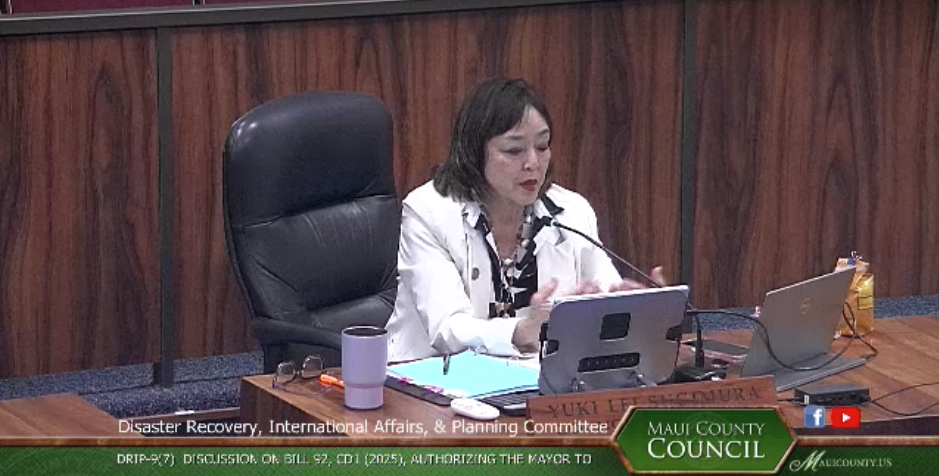
The exact terms of the existing agreement are muddy, in part because nobody can find a copy of it, said council member Tamara Paltin. She oversaw the January hearing about the agreement as chair of the Disaster Recovery, International Affairs and Planning Committee.
That makes it tough to know precisely how or if the proposed new MOU might differ from the previous one.
“We would be speculating without having ever read the prior contract, and that’s a big part of the problem,” Paltin said. “It’s frustrating.”
Regardless, she said, she is turning against the agreement.
“The big fear under this administration is who or what is defined as a terrorist,” Paltin said.
Council Chair Alice Lee first wants a full outside legal analysis to clarify the new agreement’s terms, and she plans to argue for that step when it comes back to the full council.
“We should not be forced to vote on something that is not clear,” she said, adding that if the council does not agree with taking that extra step, she, too, will oppose the bill.
A Long Political Road
Politically, the agreement traveled a winding, long road to the Jan. 28 meeting.
After Pelletier submitted it for approval in July, the agreement first moved from the budget committee, which recommended its approval, to the full council. Then it bounced back to the budget committee so its financial implications could be reviewed.
The key question then was whether the agreement imposes a financial obligation on the county because that determines whether the council would have to approve it before the mayor could sign off on it.
In November, Kolbe said the agreement did not present the county with financial obligations, and did not need the council’s authorization. But in January, Kolbe said the county’s finance department had determined that the agreement would in fact create financial obligations, so did require the council’s OK after all.
After Bill 92 had spent nearly four months at the budget committee, Paltin asked for it to come to her disaster recovery committee for an informational hearing. She told Civil Beat that a monthslong letter writing and phone call campaign by Maui Indivisible prompted her to call for the hearing.
“Those guys were calling and emailing consistently,” she said. “That’s when they got some traction because prior to that nothing was really happening.”
A Change Of Heart
One council member who changed her mind on the agreement and now opposes it was budget committee chair Yuki Lei Sugimura, who in January announced her candidacy for mayor.
Maui Indivisible activists had criticized Sugimura for keeping the bill in the budget committee for months, charging that she had bottled it up because until the full council votes on it, the existing agreement remains in effect.
In meetings with Maui Indivisible, Sugimura said she “viewed the position of opposing the (task force) as radical,” said Jake Carton, special projects leader for the group. “She was underestimating the general public’s opinion about this.”
Sugimura said she didn’t know what Carton was referring to, and noted her husband’s family and her own grandfather were imprisoned in U.S. government camps during World War II.
“They’re singing my song, except I don’t express myself the same way that they do. But I feel it.”
Yuki Lei Sugimura, Maui Council Council member
“It’s hurtful to think that these people who don’t even know me and my culture, my history, my family would even accuse me of acting like what we’re seeing in the nation, because I know firsthand what it could do,” Sugimura told Civil Beat.
Sugimura said far from bottling it up, she kept the bill at her budget committee so Maui Indivisible’s concerns could be thoroughly researched.
At the Jan. 28 disaster recovery committee meeting, Sugimura said she would urge the budget committee at Tuesday’s meeting to recommend the full council vote against the agreement.
She attributed her change of heart to the escalation and nature of federal immigration enforcement actions since her budget committee first looked at Bill 92 last fall, along with public outcry, including from Maui Indivisible.
“We have heard the community loud and clear, throughout the whole nation, the fear of what’s going on,” she said. “They’re singing my song, except I don’t express myself the same way that they do. But I feel it.”
Maui Indivisible members are celebrating the shift in political momentum.
”It takes the finger out of the dike for real democratic action here on Maui,” said Marnie Masuda, lead organizer with the group.
Cops In A Tough Spot
While Maui Indivisible wants any agreement with the FBI to be terminated, others say they are inclined to trust revisions Pelletier might make to it.
“We’ve built a really constructive, productive and mutually respectful relationship with the chief and I believe that he understands and factors in our concerns,” said Kevin Block, an immigration attorney and founder of Roots Reborn, an immigrant advocacy group on Maui.
Block shares concerns that President Donald Trump and others have characterized opponents of their immigration enforcement activities in ways that might make them targets of a terrorism task force.
“We don’t want to get scrutiny or targeted as domestic terrorists when we’re just trying to help our community,” he said.
He remains confident that Pelletier will do right by Maui’s immigrants and those advocating for them.
“If he says he wants to put in some guardrails that take into consideration our position, I believe that that’s what’s going to happen,” Block said.
Other immigrant advocates say they empathize with local police departments that want to pursue partnerships with federal agencies but find themselves in a new reality as ICE’s enforcement tactics continue to cross political and legal limits despite repeated judicial attempts to rein them in.
“Every local law enforcement agency basically wants to have every potential tool for policing to be available to them,” said Liza Ryan Gill, co-coordinator of the Hawaiʻi Coalition for Immigrant Rights. “But when those tools are connected to federal agencies that are not submitting to Congressional oversight or that are blatantly running afoul of the Constitution, that puts them in a really tough position.”
Erin Nolan contributed reporting to this story.
Civil Beat’s coverage of Maui County is supported in part by a grant from the Nuestro Futuro Foundation.

