

Trash Pickup: 1 In 5 Chance Yours Could Run Late On Kauaʻi
The Garden Isle has also explored waste diversion and landfill expansion.
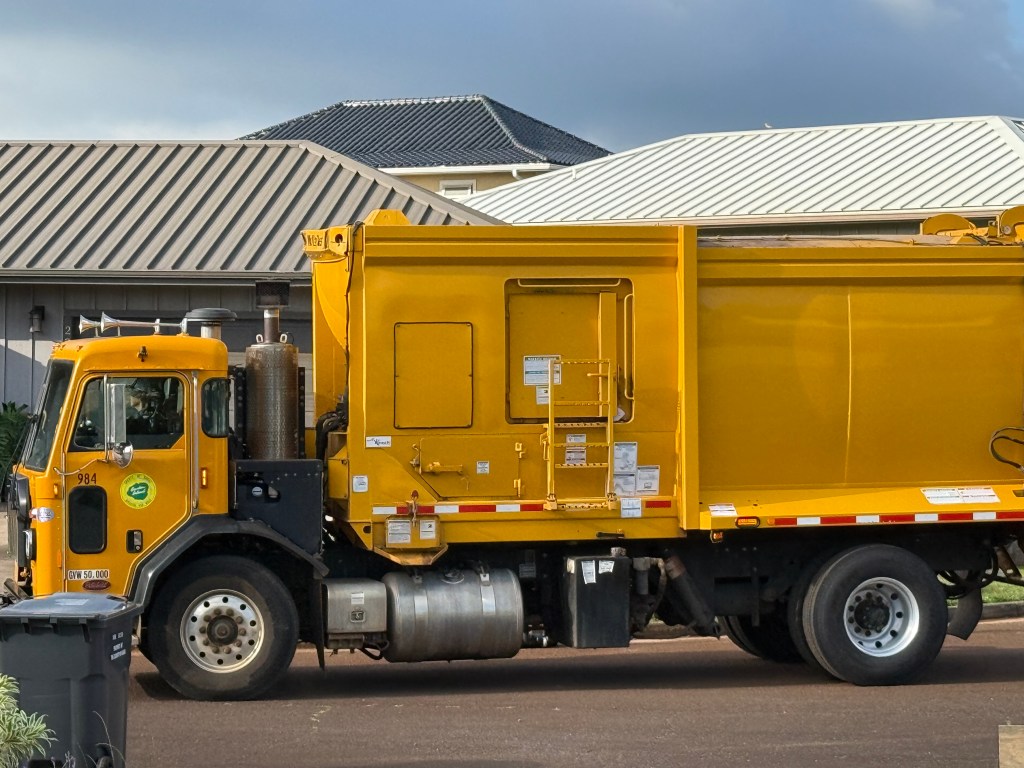
Residential trash on Kaua‘i is only picked up four days a week, but over the last nine months there’s been a nearly 1 in 5 chance on any given service day that at least one area of the island would experience a delay.
Keola Aki, the county’s solid waste manager, said these delays have been unusually frequent and are largely due to a shortage of drivers as people retire or leave for other reasons. Staffing issues caused delays on 22 days.
“We have people stepping up working long hours, but we only have so many staff that can cover the routes,” he said.
Between May and the end of January, pickup services were delayed on 29 days, according to a Civil Beat analysis of the Solid Waste Division’s public notices. Some months only had one or two days of delays. But September had six and December had seven. Most delays occurred on Mondays, followed by Thursdays.
Certain geographic areas were impacted more than others. Kalāheo had delayed services on eight days. Wailua Homesteads, Kapa‘a and Kekahā followed with seven days each, according to the division’s public notices.
Filling Vacancies
The Solid Waste Division manages seven routes, each of which serves 800 to 1,000 homes a day. Together they pick up 550 to 575 tons of residential garbage over four days of service.
Right now, the division has eight available drivers and three vacancies. The job postings for the vacancies – a main driver and two backup drivers – closed at the end of January.
Aki said once hiring is done, it can take several weeks to a month to get employees fully trained on the refuse trucks. The county is the only organization on the island that uses curbside refuse trucks with automated arms. It’s also the main provider of residential trash pickup and serves 22,500 homes.
“Once we get these people in the position, we should be doing much better,” he said.
He added that trash pickup times can also vary when there’s a backup driver. Each driver decides how they’ll get their route done, so while a route’s usual driver may serve homes on the Eastside of their route in the early morning, a backup driver may get to that area later in the day.
Equipment issues contributed to delays on nine days. The division cycles through a fleet of 14 trucks, but some fixes can’t be done until parts or personnel are shipped in, Aki said.
Some delays were impacted by both equipment and staffing, with one issue affecting one area while the other affected other areas. Construction in the surrounding area impeded service on one day.
Garden Isle Garbage
Chris Faye, who lives in Kekahā, said the delays in trash pickup can sometimes last longer than a day for her area.
Sometimes, that’s convenient because she has time to throw more trash in her bin. But, on the other hand, trash sitting out can attract more flies.
“The longer it sits out there, the more potential for dogs to overturn your trash and things of that nature,” she said.
Her home is close to the landfill, so she also drops her trash there when time allows.
Other residents don’t see the delays as major issues. In a Civil Beat callout, nine Kaua‘i readers said the impacts have been minimal.
Douglas Shannon, a resident of Wailua Homesteads, said the delays resulted in pickup being done in the afternoon instead of the early morning or, at the latest, the next day.
“The drivers do an excellent job and are to be commended,” he said.
Rebekah Magers lives in Kapa‘a and doesn’t use the county’s trash pickup services. Instead, she takes her trash to the Kapa‘a transfer station and composts her food waste. She said she hopes residents are patient with the county during the delays and that it is an opportunity to have more discussions about waste diversion.
She co-owns Compost Kaua‘i, a six-year-old business that processes up to 75,000 pounds of food waste a year through residential pickup for members living in Wailua, Kapa‘a and Kapahi, plus drop-off sites in Līhu‘e and Kīlauea.
Some residents are compelled to sign up for Compost Kaua‘i’s service because the Kekahā landfill is nearing capacity. The county is planning to prolong the landfill’s life to 2030 by expanding the maximum height of the facility’s mauka side. It’s also in the preliminary design stage for a planned expansion of the facility’s makai side.
That second expansion is intended to give the county more time to find and build a new landfill. Finding a new location and then designing, permitting and building a new landfill could take a decade.
Other waste diversion alternatives have been considered. A June county report found that it would cost $15.5 million a year — roughly $65 per household per month — to start a weekly curbside recycling program and develop and operate a material recovery facility.
While the curbside recycling program would divert 2,500 more tons from the landfill a year, that’s only a 2% increase for overall materials diverted. The county’s recycling drop bin program currently diverts about 2,100 tons a year.
“From what we’ve seen from our research, it’s infeasible economically to start up those processes,” Aki said. “It’s so little material collected for a super high cost.”
With this conclusion, Magers said she hopes more residents will take steps to reduce their waste.
“If we all work together to do that, we can move in the right direction,” she said.
Civil Beat’s reporting on Kauaʻi is supported in part by a grant from the G. N. Wilcox Trust.

