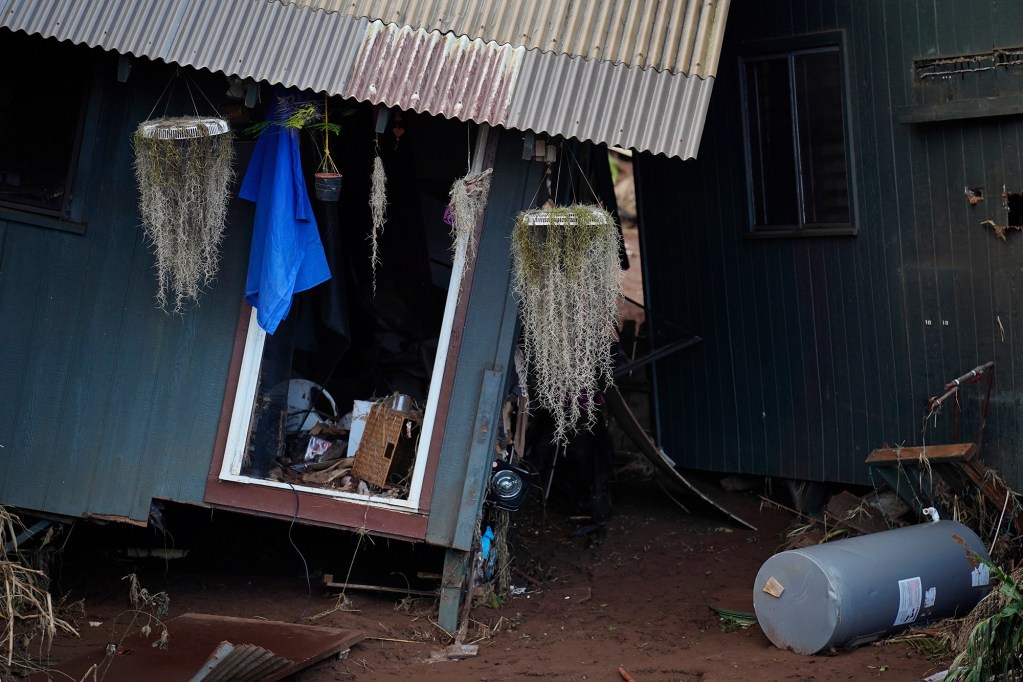
Otake Camp, situated on the bank of Kaukonahua Stream, was among Oʻahu’s hardest hit areas after a recent storm devastated the island’s North Shore.

In the aftermath of a Kona low storm system that caused catastrophic flash floods in parts of Waialua and Haleʻiwa, community members, government officials and private entities came together to help clean up the mess.

More than 4,500 tons of debris were removed by Wednesday afternoon, according to the city. Many more will follow. Such a herculean effort requires big machinery and people who know how to use it. 

Waialua community leader Levi Rita walks near Otake Camp homes washed off their foundations Wednesday, March 25, 2026, in Waialua. The former plantation residential neighborhood received damage from the second Kona Low storm. (Kevin Fujii/Civil Beat/2026)
Waialua community leader Levi Rita walks near Otake Camp homes knocked off their foundations. (Kevin Fujii/Civil Beat/2026)
Hanging plants show the correct vertical orientation compared to askew Otake Camp homes which were dislodged from their foundations during a Kona Low storm flood Wednesday, March 25, 2026, in Waialua. The former plantation residential neighborhood received damage from the second Kona Low storm. (Kevin Fujii/Civil Beat/2026)
Plants hanging straight down contrast with a home thrown askew at Otake Camp. (Kevin Fujii/Civil Beat/2026)

Otake Camp, the neighborhood of plantation-era houses behind the grocery store T. Otake and Sons, experienced some of the worst effects, with lopsided houses and wrecked cars left behind in a sea of mud. Sitting next to Kaukonahua Stream, the neighborhood is usually one of the first areas to experience flooding. Three evacuation orders were issued there in the span of a month. 

Community leader and rancher Levi Rita came to Otake Camp early Wednesday morning to help coordinate the cleanup. 

“Everybody’s going to be coming in for work,” he told Civil Beat. “So you guys can see who shows up.”

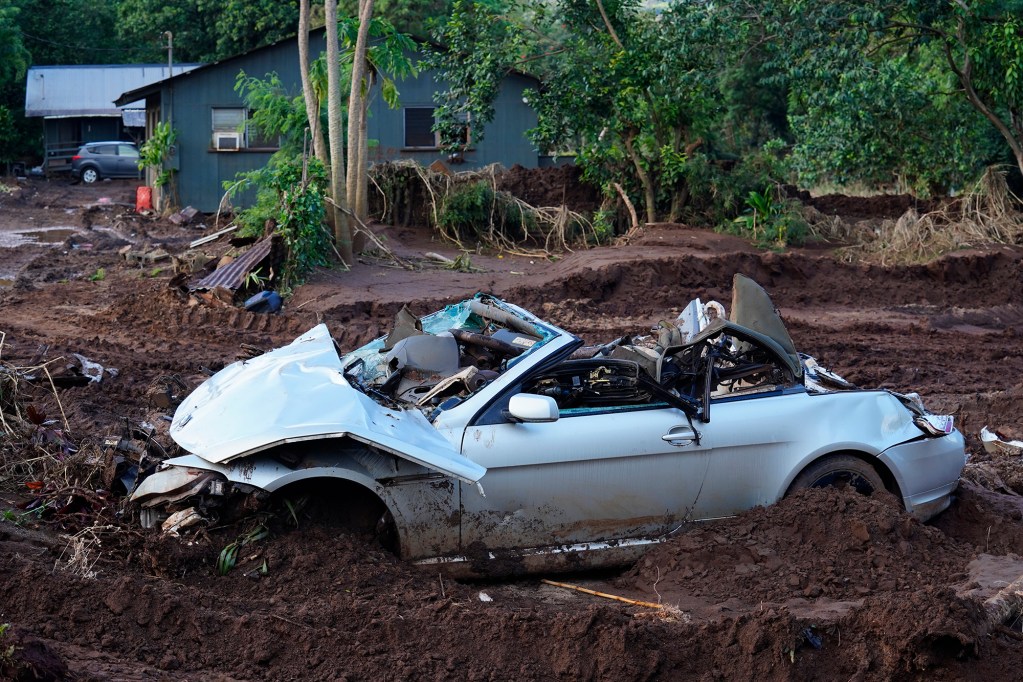
One of numerous Otake Camp homes and vehicles are photographed in deep mud Wednesday, March 25, 2026, in Waialua. The former plantation residential neighborhood received damage from the second Kona Low storm. (Kevin Fujii/Civil Beat/2026)
The former neighborhood for plantation workers was badly damaged in the second Kona Low storm. (Kevin Fujii/Civil Beat/2026)
A damaged vehicle at Otake Camp is photographed Wednesday, March 25, 2026, in Waialua. The former plantation residential neighborhood received damage from the second Kona Low storm. (Kevin Fujii/Civil Beat/2026)
Some cars were left in a mangled state by the force of the floodwaters. (Kevin Fujii/Civil Beat/2026)

Construction workers whose jobsites had been rained out volunteered their time and expertise to help. One of them, Michael Cruz of Royal Contracting, said he’s been in the field for about 35 years. He lives around the corner, just past the muddy Kaukonahua Stream.

“When I was growing up we used to swim in there,” he said.

Fifty years ago, he said, the water was crystal clear. Wednesday morning, it was somewhere between light brown and dark orange. 

After the floods, he helped smooth out Kaupē Road, the road that leads to Otake Camp which had become messy with mud and rocks. 

Trucks and construction equipment came through on Wednesday to remove debris and dredge the stream. Looking down at the water from the bridge, Haleʻiwa resident Kekoa Herron marveled at the amount of mud deposited on its bank. 

“All of this is one river before,” he said. “All of this is a river. It’s supposed to flow.” 

A compact excavator works to remove silt blocking a Kaukonahua Stream channel under the Otake Bridge as larger hydraulic crawler excavators wait for more room under the bridge to work Wednesday, March 25, 2026, in Waialua. All heavy machinery are privately owned. (Kevin Fujii/Civil Beat/2026)
Larger excavators wait for more room under the bridge to work. All heavy machinery is privately owned. (Kevin Fujii/Civil Beat/2026)
A privately owned compact excavator works to remove silt blocking a channel under the Otake Bridge as Department of Transportation director Ed Sniffen, blue shirt, talks story with community members and others over the Kaukonahua Stream Wednesday, March 25, 2026, in Waialua. (Kevin Fujii/Civil Beat/2026)
A privately owned compact excavator removes silt blocking a channel under the Kaukonahua Stream Bridge as Department of Transportation Director Ed Sniffen, wearing a blue shirt, talks with community members. (Kevin Fujii/Civil Beat/2026)

Directly next to the bridge, Jennifer Piltz and Jeffrey Ramos of Kaʻala Healing Arts were assessing their business’s extensive damage. The two opened the center in 2002 as a husband and wife team, and even though they’re divorced now, they still work together.

Their business offered services such as massages, acupuncture and counseling. 
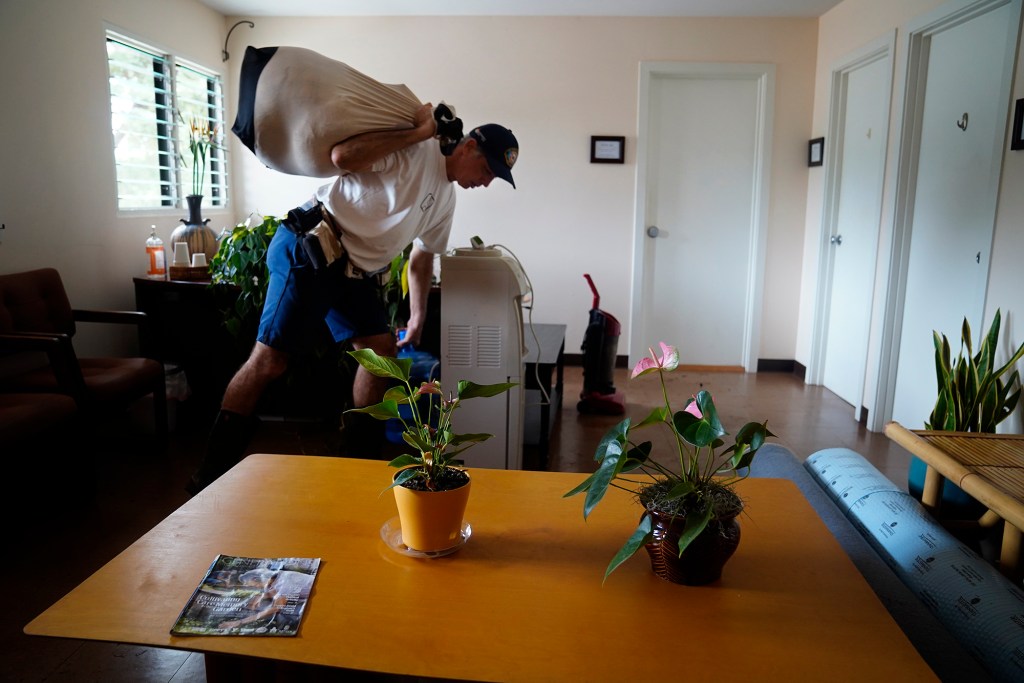
Ka‘ala Healing Arts building manager and tenant Jeff Ramos clears out some of his belongings Wednesday, March 25, 2026, in Waialua. The building is next to the Otake Bridge which flooded during the second Kona Low storm. (Kevin Fujii/Civil Beat/2026)
Ka‘ala Healing Arts owner and manager Jeffrey Ramos clears out some of his belongings. (Kevin Fujii/Civil Beat/2026)

“We used to get a lot of compliments on how nice it looked inside,” Ramos said. One office, operated by esthetician Sarah Matthews, was painted a soft gray color called Quiet Time.

“I had stuff from our home here, and now it’s all just gone,” Piltz said.

A stack of books her children used to read – Eyewitness Books about birds and explorers, a Minecraft guidebook, a coloring book with Christmas doodles – sat a few feet away from her stained with mud.

Piltz said she left her office on the day of the storm without any inkling there would be a flood. If she had known, she said, she wouldn’t have left behind her family’s books and photo albums.

“I’m mystified as to how we got such bad information about the intensity of this storm,” she said. 
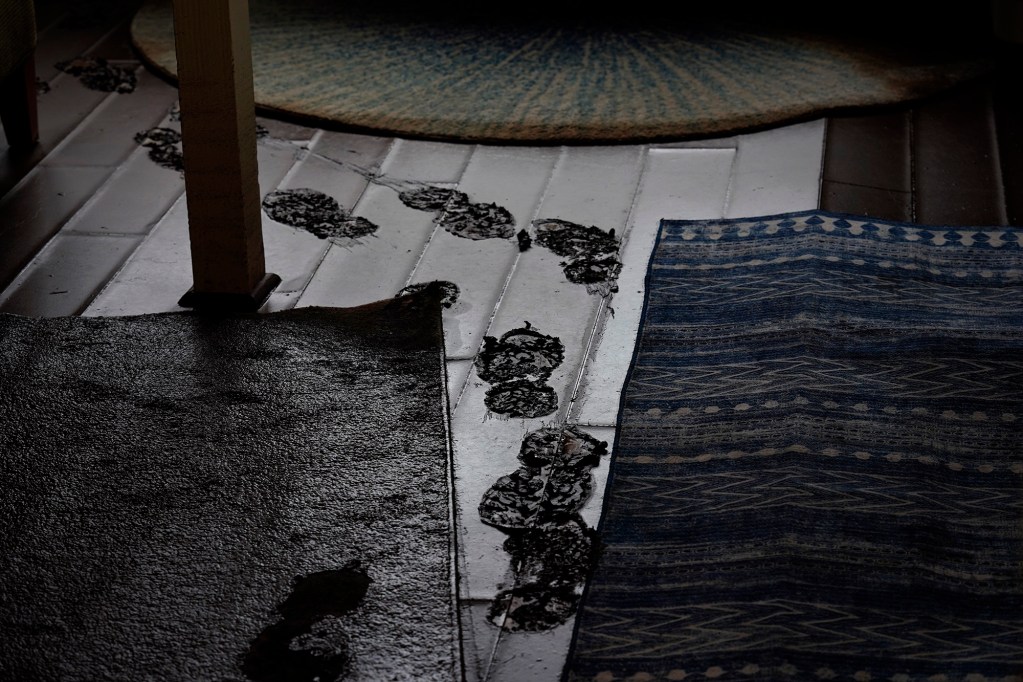
Footprints in the mud are tracked through the Ka‘ala Healing Arts building next to the Otake Bridge Wednesday, March 25, 2026, in Waialua. The building sits on the bank of the Kaukonahua Stream which flooded Otake Camp behind this building and more homes further downstream. (Kevin Fujii/Civil Beat/2026)
Muddy footprints left a trace in the Ka‘ala Healing Arts building. (Kevin Fujii/Civil Beat/2026)
Hoku Hale aesthetician Sarah Matthews cleans mud off photos she found in Otake Camp Wednesday, March 25, 2026, in Waialua. Matthew’s studio was flooded in the Ka‘ala Healing Arts building on the bank of the Kaukonahua Stream. Sarah’s phone number is 808-436-6217. She has been flooded three times. This third and most recent flood, she didn’t move things off her floor and take important paperwork. She said she doing it twice before with little to no damage made her complacent. (Kevin Fujii/Civil Beat/2026)
Hoku Hale esthetician Sarah Matthews cleans mud off photos she found in the storm’s wreckage. Matthews’ studio was flooded in the Ka‘ala Healing Arts building on the bank of the Kaukonahua Stream. (Kevin Fujii/Civil Beat/2026)
A restroom in the Ka‘ala Healing Arts building next to the Otake Bridge shows were Kaukonahua Stream floodwaters reached Wednesday, March 25, 2026, in Waialua. The former plantation residential neighborhood received damage from the second Kona Low storm. (Kevin Fujii/Civil Beat/2026)
Mud-stained walls in a Ka‘ala Healing Arts restroom show how high Kaukonahua Stream floodwaters reached. (Kevin Fujii/Civil Beat/2026)

More construction equipment could be on the way.

On Wednesday, two representatives from Hawthorne Cat, the construction equipment supplier, came to Otake Camp to assess the community’s needs. The idea is to help the cleanup effort by donating rental equipment for short periods of a few days and offering a 50% discount for longer periods of a month or two, rental representative Mark Krause said.

Privately donated diesel fuel tops off a privately owned hydraulic crawler excavator to work on cleaning up Otake Camp Wednesday, March 25, 2026, in Waialua. The former plantation residential neighborhood received damage from the second Kona Low storm. (Kevin Fujii/Civil Beat/2026)
An excavator was fueled by donated diesel fuel. (Kevin Fujii/Civil Beat/2026)

Rita, the community leader, felt that government officials had been absent as neighbors rescued each other from floodwaters and cleaned up their own community. He and Mayor Rick Blangiardi verbally sparred at a neighborhood board meeting Tuesday night as Rita demanded an apology and Blangiardi defended his team, saying they had put in a lot of work during the previous four days.

One of the only government officials who had stepped up, Rita said Wednesday morning, was state Department of Transportation director Ed Sniffen, who had arrived on scene a few times in the previous days to help coordinate the cleanup.

“He’s been awesome,” Rita said.
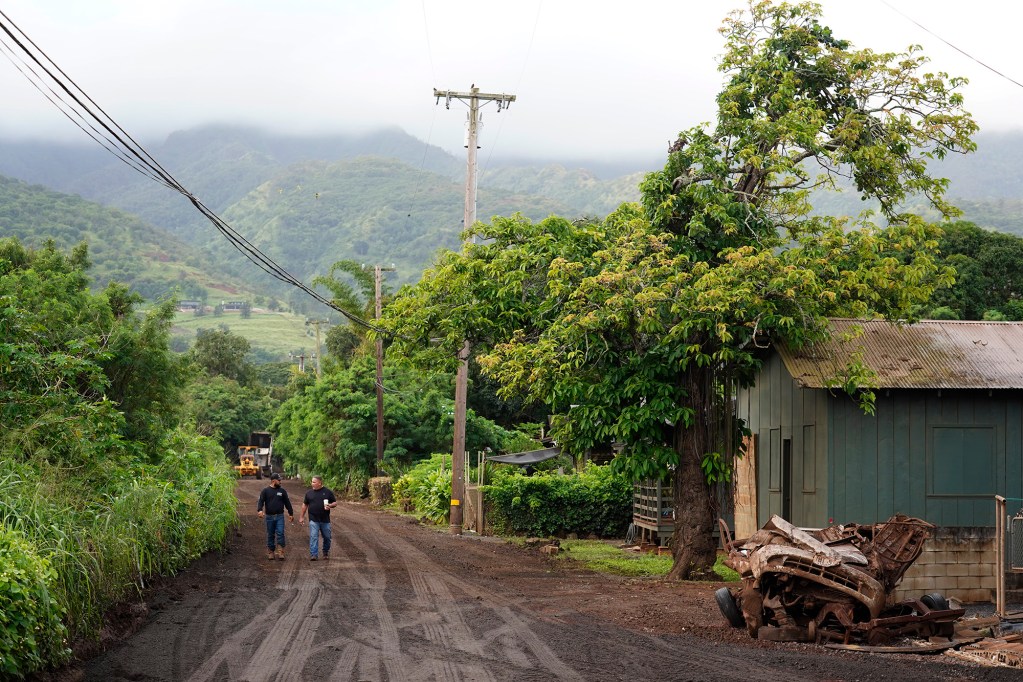
Community leader Levi Rita, left, and Deputy Director Facility Maintenance Warren Mamizuka walk out of Otake Camp Wednesday, March 25, 2026, in Waialua. The former plantation residential neighborhood received damage from the second Kona Low storm. (Kevin Fujii/Civil Beat/2026)
Community leader Levi Rita, left, and Warren Mamizuka, deputy for the city’s facilities maintenance department, walk out of Otake Camp. (Kevin Fujii/Civil Beat/2026)

Other government workers came Wednesday, too. Warren Mamizuka, deputy director of the city Department of Facility Maintenance, brought a giant city dump truck to help remove debris. Police officers and members of the U.S. Army helped remove rubbish from people’s yards.

A city press release Friday said 15 city dump trucks are currently hauling out debris from Waialua, and a vacuum truck is clearing storm drains. These efforts will continue through the weekend. As of Friday afternoon, almost 5,500 tons of debris have been removed, at a pace of about 500 tons per day.


What it means to support Civil Beat.

Supporting Civil Beat means you’re investing in a newsroom that can devote months to investigate corruption. It means we can cover vulnerable, overlooked communities because those stories matter. And, it means serve you. And only you.

Donate today and help sustain the kind of journalism Hawaiʻi cannot afford to lose.

About the Authors