Hawaiʻi Income Tax Cuts: Lawmakers Chip Away At Promised Savings
House Republican Minority Floor Leader Diamond Garcia called the Democrats’ proposal a “slap in the face” to struggling working families.
Republicans at the State Capitol pounced on Democrats’ plans to defer a huge income tax cut that was promised to state residents in 2024, using prolonged floor debate Tuesday to scold the Democrats for reneging on the original tax cut.
The ruling Democrats shrugged off that criticism and easily mustered the votes they needed to win preliminary approval Tuesday in both the House and Senate for two bills that would water down the original tax-cutting plan.
Democrats pointed out the bills they crafted this year will extend or sweeten tax credits to provide extra benefits to working families, and House Finance Committee Chair Chris Todd said the House proposal will benefit families making $50,000 nearly as much as the original plan would have.
At the halfway mark of the 2026 Hawaiʻi legislative session, which ends May 8, lawmakers in both the House and Senate are generally following through on their priorities of creating more affordable housing, protecting immigrants, strengthening safety net programs and stimulating economic growth while trying to better safeguard the environment.
Still alive are bills to require counties to allow more housing near designated transit hubs like rail stations and bus corridors, remove masks from law enforcement officers, establish a SNAP application process for inmates nearing release, promote and market local film production and set up a green fee “transparency and accountability” program and dashboard to track spending mandated by last year’s landmark environmental law.
‘Protecting The Most Vulnerable’
In the Senate, tax policy was a priority issue, with majority Democrats saying they had a responsibility to honor the landmark tax cuts approved just two years ago, even while confronting fiscal headwinds.
Sen. Donovan Dela Cruz reminded his colleagues that Act 46 of 2024 “was landmark legislation” that provided comprehensive tax relief for Hawaiʻi residents.
“However, our financial outlook has significantly changed since then — the uncertainty brought by the federal budget cuts and the shutdown in 2025, stagnating tax revenues and modest economic growth have all impacted the state’s general fund,” he said.
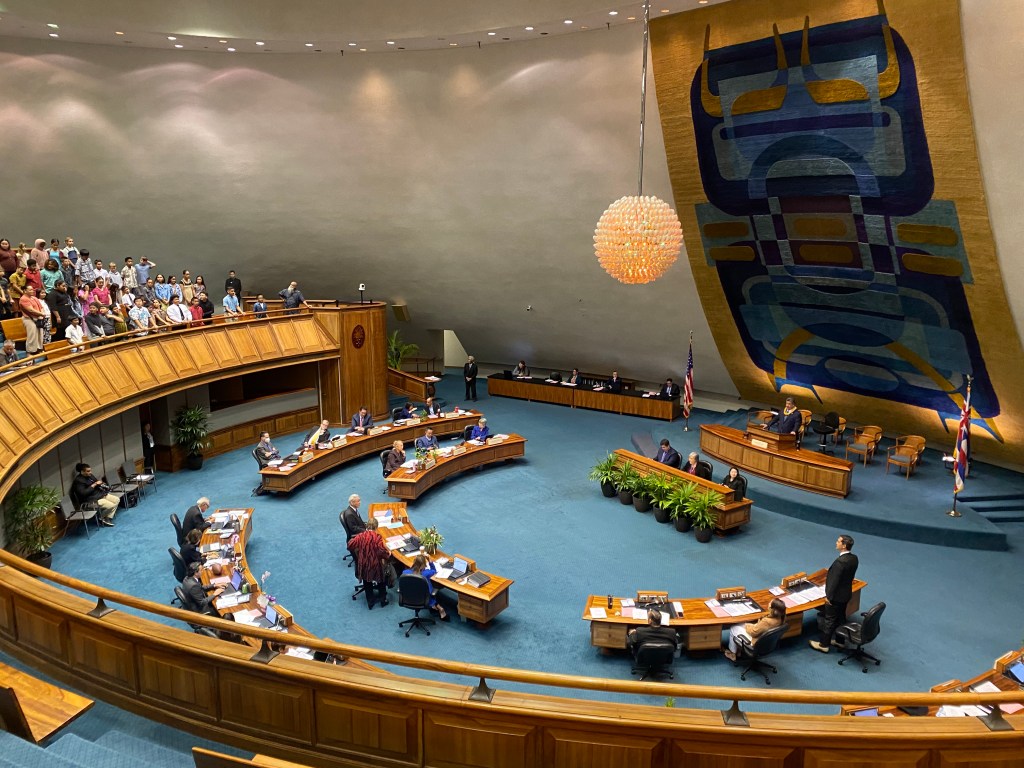
Dela Cruz, who chairs the Senate Ways and Means Committee, said the state “must tighten its belt before asking taxpayers to do so, to deliver on our promise for working families.”
He said WAM is looking at “all avenues to maintain financial stability. This approach includes commonsense things like sun-setting tax credits, cutting long-standing vacant positions, transferring excess balances in non-general fund accounts, and reducing overall spending to live within our means.”
The Senate vehicle for that is Senate Bill 3125, which Dela Cruz said would continue the promised tax relief for households earning less than $350,000 for joint filers, $262,500 for head of household filers and $175,000 for individual filers.
The measure also extends the sunset date of the Earned Income Tax Credit and Food Excise Tax Credit and makes structural changes to the Child and Dependent Care Tax Credit.
Supporters of SB 3125 include Senate President Ron Kouchi, who said that he and his colleagues had always sought “a balance in dealing with the federal cuts while protecting the most vulnerable in our communities. And I think that this bill goes a long way to try to articulate what are the goals of the majority of the Senate.”
Two of the Senate’s three Republicans voted against the bill, however, complaining that Hawaiʻi has for far too long been one of the most expensive places to live in the country.
“There were families and local businesses that were looking forward to these tax breaks, not so that they could live lavish and splurge, but so they could save so they could grow their business or maybe even help their kids with a down payment,” Sen. Samantha DeCorte said.
In the House, Republican Rep. Joe Gedeon said he understands the state may be in a different fiscal situation today than in 2024, “but before we consider taking back something that was promised to the people, we should first exhaust every option on our end.
“That means taking a hard look at government spending and making sure we act responsibly with taxpayer money,” he said. “At this point, I do not believe that we have done that.”
House Minority Floor Leader Diamond Garcia was more adamant, declaring: “This bill is a slap in the face to the people of Hawaiʻi. Families across Hawaiʻi were just beginning to feel a small glimpse of that relief this year, just starting to see a little more breathing room in their paychecks, and now we’re telling them ‘Never mind.’ “
House Bill 2306, which would scale back the 2024 tax cuts while extending and expanding some tax credits, passed in a 39-11 House vote. That bill now goes to the Senate for further consideration.
SB 3125 — a similar measure that would also defer portions of the 2024 tax cuts — passed the Senate in a 23-2 vote. It now advances to the House for further consideration.
Another Tax Fight
House Republicans also sparred with the majority Democrats over a proposal to overhaul the state conveyance tax on home sales.
Housing Commitee Chair Luke Evslin, who is the lead sponsor of the bill, said House Bill 2049 would increase conveyance taxes on sales of homes worth more than $2.2 million, with “significant increases on the higher value properties.”
The measure would raise an extra $170 million for the state, but Evslin said the bill would actually reduce the conveyance tax or leave it unchanged for 75% of home sales in Hawaiʻi.
Evslin said $60 million of the extra revenue from the tax increase would be delivered to the state Department of Hawaiian Home Lands to fund housing development, and $40 million would be used to install infrastructure such as roads, sewers and water service for transit-oriented development projects.
Another $40 million would be provided to the state Rental Housing Revolving Fund to help finance affordable rentals, and $10 million would go to the Legacy Land Conservation Program.
Evslin said he supports the bill in part because “when we have lots of out-of-state money flowing into Hawaiʻi and propping up luxury home sales, I think it’s important that we should honestly be increasing taxes on these and ensure that if you are purchasing a home in Hawaiʻi, especially if you are out of state coming in, that you should be supporting DHHL, you should be supporting rental housing in Hawaiʻi, you should be supporting infrastructure and land conservation.”
The bill prompted objections from House Minority Floor Leader Garcia, who said taxing the owner of a $2 million home “doesn’t mean you’re taxing the rich. There are families with generational homes which will be affected by this. Local families will be affected by this.”
Garcia argued that state should already be providing substantial, regular funding for DHHL from the state general fund instead of increasing taxes to do so. “It is our duty, it is our constitutional obligation to fund and operate the Department of Hawaiian Home Lands.”
“This is not the path forward, this is another burden on Hawaiʻi’s local families,” he said. The measure passed easily in a 42-8 vote.
Schools and Immigration
Other bills passing the Senate Tuesday were Senate Bill 3334, which would cap the total number of superintendent-level positions within the Department of Education. The bill has drawn the support of the Hawaiʻi State Teachers Union but the fierce opposition of the Hawaii Government Employees Association, which has called the bill’s sponsor, Sen. Donna Kim, a bully. Kim chairs the Senate Education Committee.
SB 3334 passed unanimously, but it drew eight yes votes “with reservations,” an indication that one third of the Senate is uncomfortable with the controversial legislation. Its success in getting through the House is an open question.
Senate Bill 3322, which would restrict the use of masks for all law enforcement officers — federal, state and county — also crossed over to the House.
“The offense up on the continent, especially in Minnesota, where U.S. citizens were shot dead by ICE officers, is something I would very much not like to have repeated here in Hawaiʻi,” said Sen. Karl Rhoads, the bill’s author.
All three Senate Republicans opposed the bill. Sen. Kurt Fevella argued that the bill could actually result in harm to local law enforcement.
“I think by restricting the protection it’s only endangering the community and our law enforcement, because they protect us,” he said.
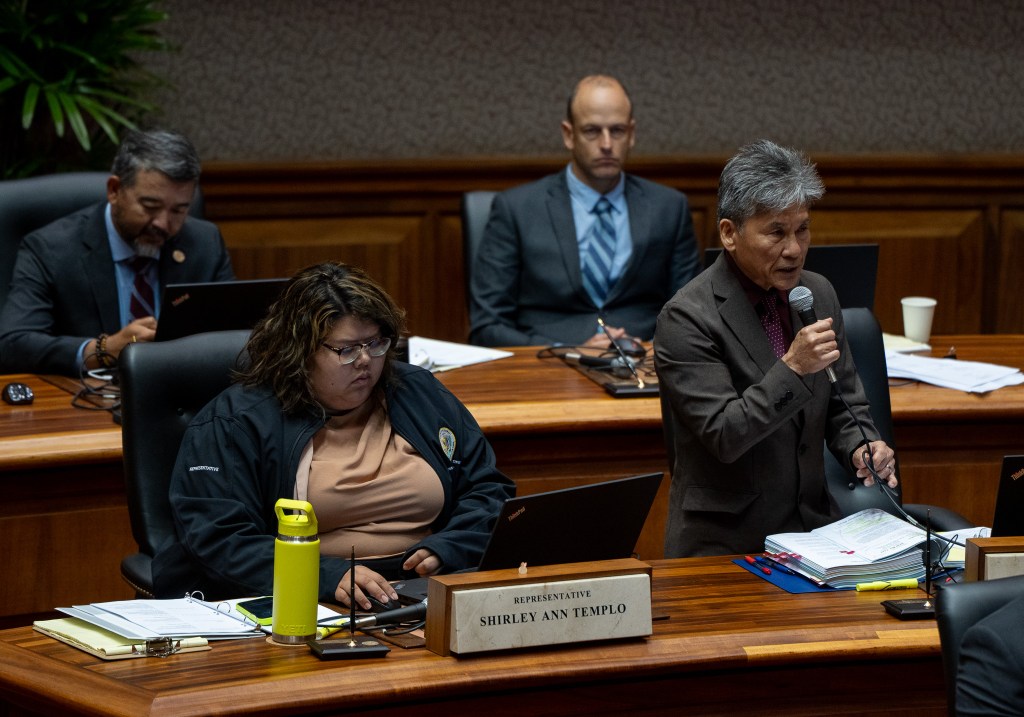
House floor voting also featured debate over a series of bills designed to protect the rights of immigrants and limit cooperation between state and local agencies and federal immigration authorities.
House Bill 1886 would generally prohibit law enforcement officers from wearing masks, while House Bill 2540 would prohibit police officers from stopping people to ask them about their immigration status and limit collaboration between local and federal law enforcement for purposes of immigration enforcement.
Another measure would require state and county police agencies to advise people in custody of their rights before they are interviewed by federal immigration agents.
Republican Rep. Garner Shimizu worried that some elements of the bills “may unintentionally create barriers to effective collaboration between our state and federal law enforcement partners.” He said cooperation between agencies is often essential to protecting local communities.
House Judiciary and Hawaiian Affairs Chairman David Tarnas defended each of the measures, including one to prohibit state and county law enforcement agencies from entering into agreements that would allow the local agencies to participate in immigration enforcement.
“What this bill really does is just makes it clear that immigration enforcement is the purview of the federal government and not the state government,” Tarnas said.
Local law enforcement can still have agreements with federal agencies to cope with crimes such as money laundering and drug trafficking, he said, but “entanglement between local law enforcement and federal immigration enforcement erodes the trust in government institutions and undermines public safety for the entire community.”
House Minority Floor Leader Garcia disputed that, calling the bill bad policy.
“This is going in the wrong direction,” he said. “We should have more collaboration in regards to public safety, and immigration enforcement is public safety.”
All of the House immigration measures passed easily in floor voting
The Senate passed nearly 100 bills Tuesday and sent them over to the House for its consideration, while the House passed more than 200 measures. First crossover voting will conclude Thursday in both chambers.
Not making the cut Tuesday were bills to allow gaming on cruise ships, a casino in Honolulu or at the new Aloha Stadium, and the regulation of sports wagering. All had died earlier in session.
Legislators also killed bills that would have asked voters to decide via constitutional amendment whether personal use of marijuana for people 21 years and older should be legal.
A House bill prohibiting prediction markets, such as betting on catastrophic events and the deaths of major figures, is set for a vote Thursday.