Neighborhood Parking Limits Off To Choppy Start In Kalihi Valley
Residents in this Honolulu neighborhood clamored for parking restrictions. Now they’ve got mixed feelings about it.
A decade ago, Kalihi Valley residents along Wilson and Jennie streets complained that their neighborhood was losing street parking.
The neighboring public housing complex had started enforcing stricter rules about who could park in their lot, sending drivers across Likelike Highway to the two streets.
Residents celebrated when a city program restricted outsiders from leaving their cars there overnight. Now, though, the city is charging for the parking permits, and residents aren’t happy with the cost.
As of January, cars must have an annual residential permit or a $10 visitor’s day pass to park on the street between 6 p.m. and 6 a.m. Before the city temporarily slashed prices in half in December, the base price for a year-long permit for a household’s first car was going to be $125 a year. It would have cost twice that for a second car, three times for a third car and four for a fourth.

A large family or multiple people living at the same address could end up paying $1,250 to park four cars on the road.
“If I knew that was going to be like that, I wouldn’t have bought a house over here,” resident Melvin Jacob said while sitting outside after work. “It’s too much.”
Restricted parking zones exist in other cities, including Seattle and Washington, D.C., but have been a long time coming to congested Honolulu. In Seattle, the program that started in 1979 is so popular that most zones have sold more permits than there are available street spaces.
Not so in Honolulu’s first foray in Kalihi. As of the middle of this month, the city had sold 212 permits for the neighborhood’s roughly 390 parking spaces, according to city spokesperson Travis Ota, with 100 of those for first cars.
Over the years the permits were free during the pilot program, which was supposed to last one month in 2017 but became so popular it never truly wound down. The city gave out at least 570 permits.
Chris Clark, chief planner for the city Department of Transportation Services, said only about 20% of those who live in the restricted parking zone have bought passes.
“That means the other 80% of the residents either don’t need it,” he said, “or are kind of giving up their access to that space in front of their house.”
‘Sticker Shock’
Despite sitting right next to Likelike Highway, the Kalihi Valley neighborhood tends to be quiet. Residents out walking their dogs say hello when they pass each other.
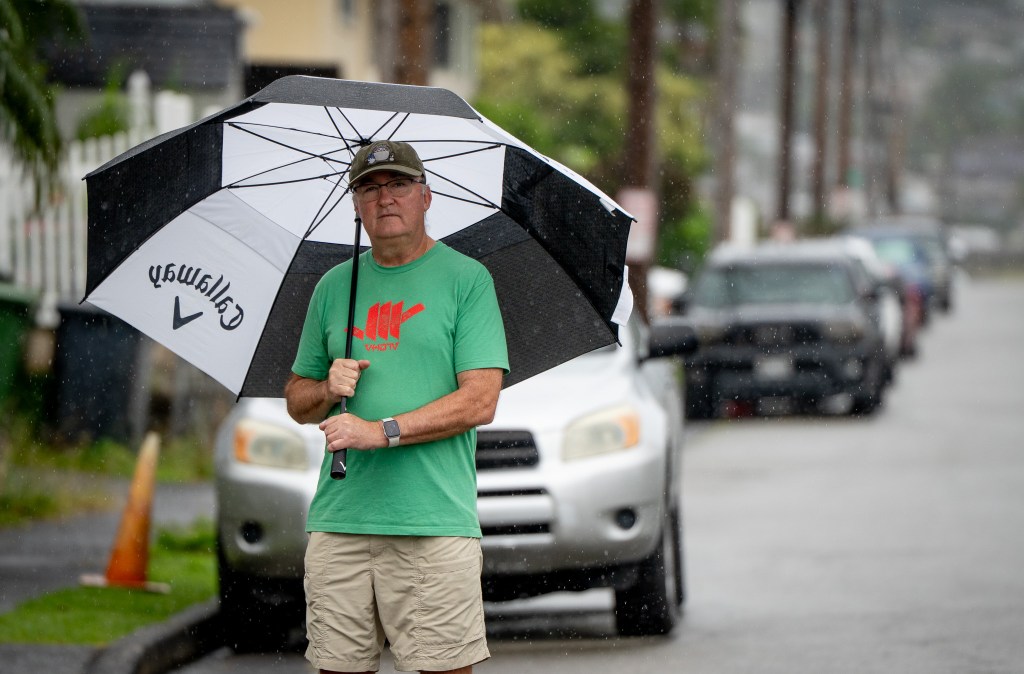
Parking can still be tight, with some people leaving orange cones out to hold their spots for the day, but the situation is far more manageable than it was a decade ago, Wilson Street homeowner Joseph Larnerd said.
Even though Larnerd led the push to restrict parking, he’s not fully happy with the outcome.
“It seems exorbitant,” Larnerd said of the cost. “They’re charging so much money.”
After Honolulu’s pilot program started, council member Carol Fukunaga passed a bill to create a framework for adding more restricted parking zones, but no neighborhood took advantage of it, with some calling the restrictions too onerous to be practical. Two related bills she introduced died.
A fourth bill by council members Radiant Cordero and Tyler Dos Santos-Tam — who each represent part of the Kalihi area — passed in 2023, but only after almost a dozen hearings as residents and lawmakers struggled to reconcile managing parking with preserving public access to beaches and trails.
The fee structure was a compromise, an effort to offset the cost of enforcement.
“I think during the hearings process, it’s an abstraction,” Dos Santos-Tam said. “But when you actually have to put in your credit card number, then it becomes real … So there was a little bit of sticker shock.”
Bringing Residents Up To Speed
More restricted parking zones could pop up in Oʻahu, although the city law has strict limits on where they can go.
They can’t be within half a mile of the shore, for example, and there must be some sort of traffic generator — such as a university — bringing in people who don’t live in the area.
Once those boxes are checked, the law allows zones to be added at a snail’s pace: one per year.
City officials know the zones are an adjustment for a neighborhood where parking once was free. Outcry from residents once the passes went on sale last fall led them to temporarily slash prices in half.
Clark, the planner, said the city will revisit that move at the end of 2026 and decide whether to stick with the discount or revert to the originally planned prices.
A lot of Clark’s focus has been educating residents about the changes and advising them to buy a permit or brace for tickets. This has meant going to neighborhood board meetings, putting up banners and holding pop-up events in community parks.
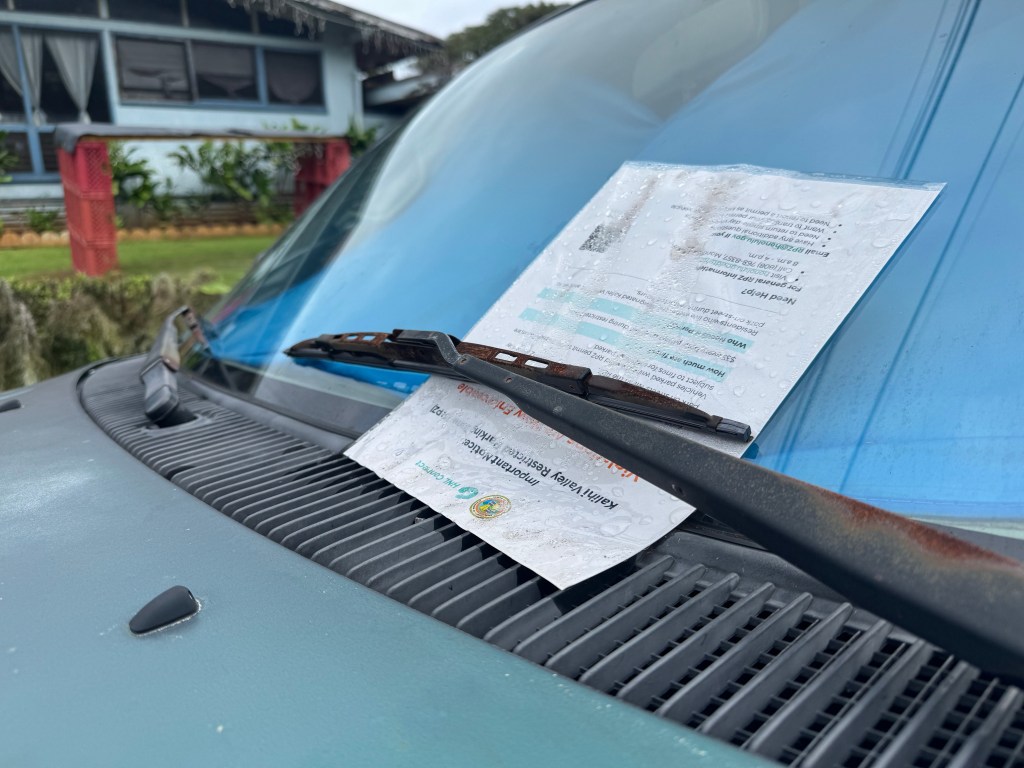
Last month, city workers fanned out early in the morning to tuck informational flyers under windshield wipers.
“The cars that weren’t displaying a valid permit, they got a little flyer,” Clark said. “And that subsequent week, a lot of people started calling in and making the purchase.”
Wilson Street resident Frankie Taitano said the availability of parking was “so sweet” when he moved to the area in 1999. Over time, that changed. People from outside the neighborhood would park there — and sometimes leave trash behind.
He credits the restricted parking zone program for making things better. Still, he said, it has led to some unforeseen consequences for him.
The law only says a vehicle must be registered in the state of Hawaiʻi, but Taitano said the city won’t register a vehicle if the applicant’s name isn’t on the registration. Taitano drives a company truck, which is not registered in his name.
So, his truck doesn’t have a permit, he said on a recent Tuesday afternoon, and “we got the warnings and all that.” In fact, he said, he had gotten cited that morning for not having one.