Maui Mayor’s $1.6 Billion Budget Focuses On Housing, Water, Fire Recovery
The proposed spending plan sets aside money to buy private water systems and wells. County will rely on emergency reserves for recent storm damage.
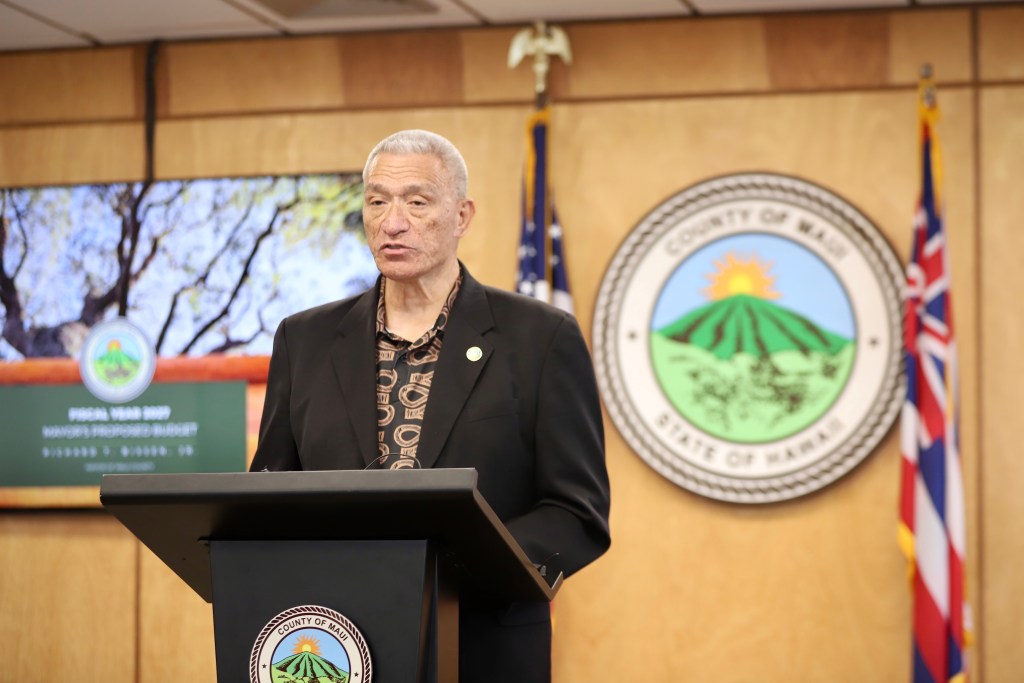
Maui Mayor Richard Bissen on Wednesday unveiled a $1.62 billion budget for next fiscal year that includes significant investments in affordable housing projects, post-wildfire recovery efforts and the acquisition of additional water systems.
“As we’ve seen over these past weeks, our community has been through a lot, and we are still walking that road together,” Bissen said at a press conference in Wailuku. “As we move forward, this budget reflects both the needs in front of us and the future we are building, keeping our residents home, continuing the work in Lahaina, strengthening our communities, protecting our natural and cultural resources, and creating opportunity through economic diversification.”
The proposed budget for the 2027 fiscal year, which begins July 1, is a nearly 4% increase over the current $1.56 billion budget. It does not include funding to address the extensive damage recently caused by back-to-back Kona low storms and severe flooding, but the county plans to tap into roughly $100 million in emergency reserves for those immediate needs, according to Maui budget director Lesley Milner.
Last week, the Maui County Council unanimously approved the administration’s request to use $12 million in emergency funds to address some of the destruction, and Milner said local officials were planning to make another request in the near future.
“The budget was finalized before the storms,” Milner said shortly after the mayor’s presentation. “So right now our plan is to fund it out of the emergency fund, and then any longer-term things that need to happen, those would become capital improvement projects in the future.”
County officials also expect to ask the federal government to reimburse costs that were paid for using emergency funds, she said.
The proposed budget takes into account a projected $58 million increase in county revenue, $402.2 million in grant funds and $174 million in revolving funds. The overall Capital Improvement Program budget totals $698.2 million across all funding sources, and just under 6% — or $73.7 million — allocated for debt service.
Over the next month, the council will dig into the mayor’s proposed spending plan. In addition to several daytime public meetings in the council chambers, the council plans to solicit feedback from residents at eight evening meetings held in communities across the county.
$44 Million For Water Systems And Wells
Bissen’s budget presentation built on the State of the County address that he delivered earlier this month, in which he outlined his plan to increase housing options for locals, expand public control over the county’s water supply and continue to rebuild Lahaina.
Under the mayor’s proposed budget, $79.5 million would be invested into the county’s affordable housing fund to support 10 affordable housing projects on Maui and Lānaʻi. Additional funding would go toward expanding the local rental assistance program, advancing workforce housing at Hale ʻO Lā‘ie in Kīhei, investing in infrastructure improvements that would allow for more residential development and supporting temporary housing options for those who have not yet transitioned into permanent homes.

Bissen’s budget also includes $44.5 million to acquire additional water systems and wells, reflecting the tension that has been mounting between private companies that have long owned water systems in West and East Maui and residents who want to see local control of a resource that’s considered a public trust in Hawaiʻi.
During his State of the County address, Bissen announced that the county was in negotiations with several companies to acquire key water system assets in West Maui, and once completed, public stewardship of drinking water systems would increase to 93% from 45%.
The budget also includes proposed changes to real property tax rates, also subject to council approval. Vacation rentals, non-owner-occupied homes and commercial residential would all see increases while long-term rental rates would slightly fall and most other categories would remain flat. Luxury homes worth more than $4.5 million would see a 13% decrease in property taxes.
The mayor proposes increasing wastewater user fees by 9% and a 5% increase in monthly service fees for water across all meter sizes.
Funding would continue to be prioritized for ongoing recovery efforts in Lahaina, Bissen said, including for water infrastructure hazard mitigation projects and economic initiatives through the LahainaTown Action Committee and the Lahaina Restoration Foundation. To strengthen long-term resilience, he said, the budget would establish a hazard mitigation section within the Maui Emergency Management Agency that would focus on wildfire risk reduction, flood and coastal resilience and infrastructure protection.
Other funding priorities outlined by Bissen include: a safe parking program intended to provide more options for locals living in their vehicles, improvements to local parks, workforce development programs and the creation of a centralized grants division within the county government to improve coordination, compliance and efficiency in grant management. A new Small Grants Program will provide awards of up to $25,000 with a simplified application process.
See the complete budget below.