

North Shore Oʻahu Farmers Search For Answers In The Kona Storm Wreckage
Farmers spent Saturday wading through their properties, trying to pick up the pieces from crops and livestock lost during torrential rains, flooding and high winds this week.
The chickens are either floating or under water by the time Gabe Sachter-Smith arrives at Green Monster Farms in Waialua on Saturday morning. The Kona low storm has subsided, leaving the chicken house surrounded by about 2 feet of chocolate brown water, plenty to drown the already sodden birds.
Friend and poultry farm owner Toni Green had asked Sachter-Smith to check in while she struggled to find a way back to her farm on flooded roads. He gathers plywood and pallets to build makeshift life rafts for the birds still in their coop.
By the time Green shows up, she can see that at least 25 of her 350 birds are gone. She knows more could die from hypothermia.
Green had been kept away from her flock since Friday by weather that also ended up shuttering the farmers markets where she sells many of the eggs. Now she has about 200 dozen – 2,400 – eggs without customers that she needs to offload.
“Unless you’re now on the hill,” Green said from her car, while delivering eggs to a local bakery. “To be frank, you’re fucked.”
Green was just one among many North Shore Oʻahu farmers fishing and foraging Saturday for what’s left of their farms after the Kona low storm gusted over 100 miles per hour while dumping more than a foot of rain on the island. Drowned birds, downed trees and destroyed crops are only the beginning of the lasting impacts they foresee, as many also contend with power outages, impassable roads and customer demand.
Farming is notoriously difficult in Hawaiʻi, leaving the North Shore one of the few places on Oʻahu where small, new and young farmers can set up shop. The area has become an 18,000-acre tapestry of agricultural operations as large landholders steadily sell off parcels of the rich, red dirt land.

Margins are thin, though. And in the wake of the storm, many of the farmers are left without much to fall back on, especially since insurance is almost impossible to get.
They’re already asking questions about why they were hit so hard. Some blame the rampant development of the North Shore, others blame the government for failing to mitigate the potential impacts of a major storm like this one.
The weather arrived on the day the state was due to sign off on its acquisition of Wahiawā Dam, its spillway and 30 miles of irrigation ditches feeding North Shore agriculture. It is arguably the most important piece of agricultural infrastructure on Oʻahu, built by the Dole Plantation in 1906 to nourish its pineapples.
After more than a century of water delivery, that system got dangerously close to failing on Friday evening, leaving the Waialua farmers to pick up the pieces.
Who’s To Blame
The region knows turbulent weather. In late February, community members cleared debris clogging the underside of Anahulu bridge near Haleʻiwa.
They feared rising waters would mirror flash flooding that beset the area in 2021, when more than 4,000 residents were forced to evacuate. The damage cost residents hundreds of thousands of dollars.
The changing landscape of the North Shore is to blame, according to most farmers, who list as culprits an ominous combination of changing land uses, invasive species and climate change. One change in land use is new housing developments which Green says do not acknowledge their place within the wider environment.
The poultry farmer has two plots of land. The inundated plot, where 350 hens live, is surrounded by new homes built on agricultural lands and roads put in without consideration for the flow of water.
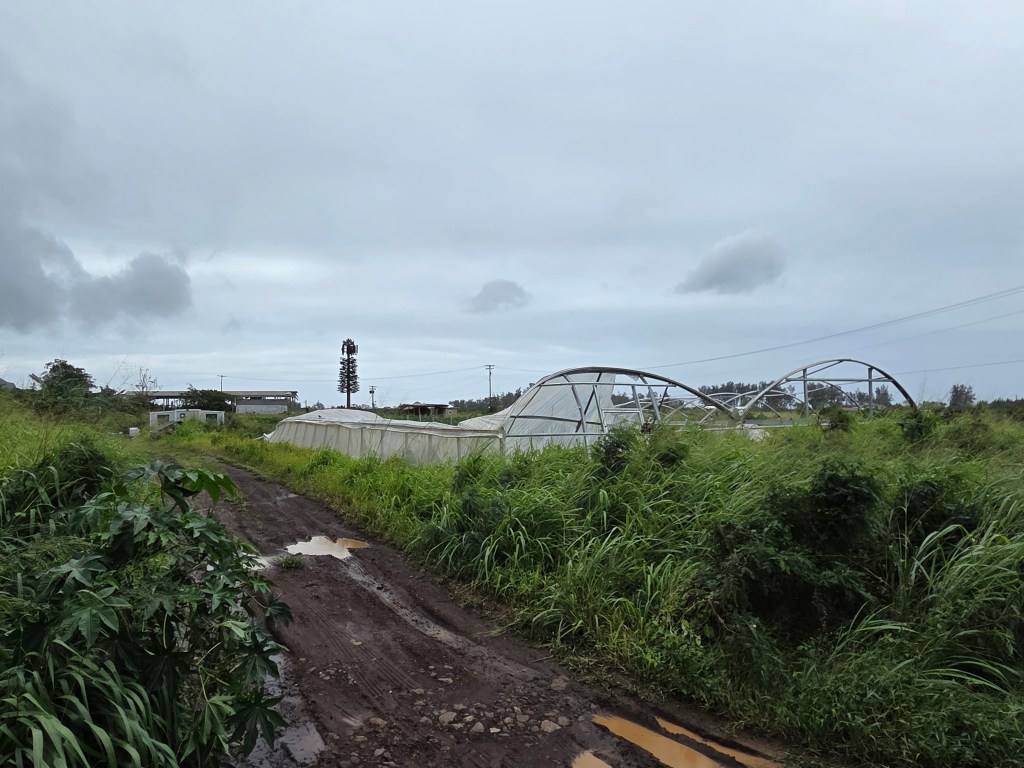
“They’re ‘homesteaders,’ multi-million dollar homesteaders, building a house for themselves. I’m the only farmer nearby,” Green says. “They’re fixing the road, but the road is stopping all the water from draining out from our land. So our land is collecting water.”
The spread of invasive trees in the inland areas, including species like albizia, which break in severe weather only to wash down streams, according to Dave Dutra Elliott, executive director at Hawaiʻi Agriculture Stewardship. That debris then clogs key drainage routes, such as Anahulu Bridge.
So what one landowner does upstream of others has ramifications, especially as climate change continues to exacerbate severe weather events, Dutra Elliott said. Holistic watershed management, he added, is crucial to mitigate future events.
“There are these larger drainage patterns that used to fit together,” he said. “As larger pieces of land are getting sold off and split up, they need to understand how what they do impacts their neighbors downstream.”
‘Canary In The Coal Mine’
As Friday’s pounding storm sent water rushing down from the Waiʻanae Mountains range and into the wind-whipped farmland below, it created rivers that tore into nurseries and through orchards, potentially costing farmers years of effort and investment.
Near the foot of the mountains, drainage ditches backed up, sending floodwaters sweeping through Growing Together, the farm India Clark started about four years ago with her partner, Drew Wilkinson.
The water ripped down a windbreak of milo and ‘a‘ali‘i trees they had just planted at a cost of more than $15,000, and tore across their nearly 6-acre farm. In the nursery and orchards, dozens of avocado trees were partially submerged, along with mango and citrus trees.
In her nursery, Clark righted one after another of potted avocado trees that had been knocked over. The Kona low storm had hurled plants to the floor in every direction. Panels of the shade cover overhead had been blown away, too.
“It’s heartbreaking, actually,” she said.
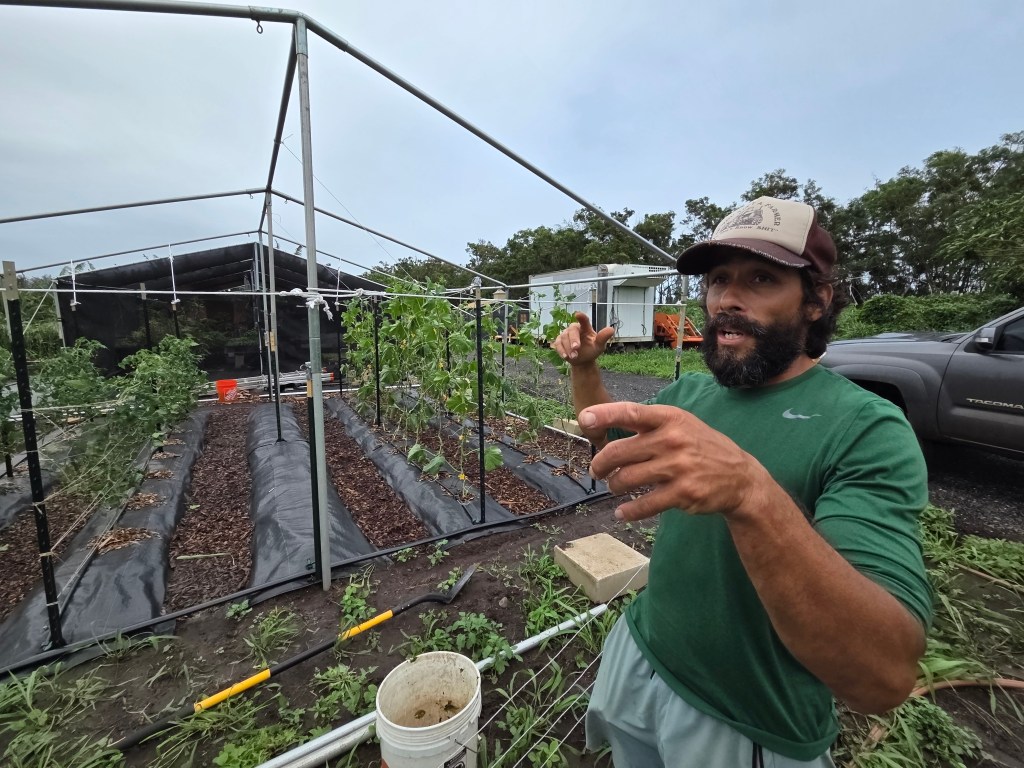
Like other farmers in the 100-acre Kaʻena Farm Lots community, Clark and Wilkinson aren’t certain yet how much they have lost. The mango and citrus are more resilient, Clark said, “but I’m kind of figuring the avocados are a wash.”
Calculating in the years it would take to regrow the trees, that could mean a budget hole in the neighborhood of $75,000 between trees and fruit they planned to sell over five years, Clark said.
She and other farmers said someone – they believe management at the neighboring Kawaihāpai Airfield, often called Dillingham Airfield – cut down a stand of Ironwood trees that lined a drainage ditch that runs parallel to the field and collects the runoff from three other ditches. Those ditches in turn bisect the 100 acres of farms, then funnel the water out to Polis Beach.
The downed trees were left on the forest floor, some in the drainage ditch and others hanging into it, backing up the rushing storm waters, said Eddie Oroyan, who farms about 6 acres of the Kaʻena Farm Lots with eggplant, beets, celery, tomatoes, cucumbers, cabbage and cauliflower.
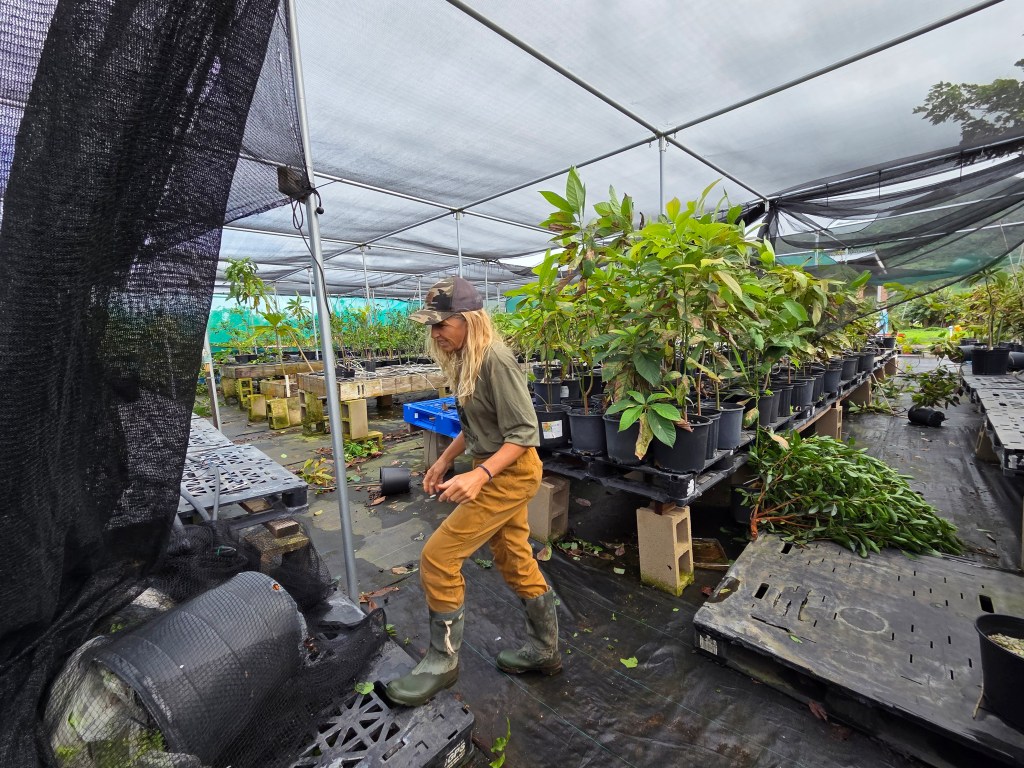
“I’m the canary in the coal mine,” Oroyan said, because the property’s drainage system converges on his Lewaterra Farm.
He stood in front of a nursery now missing its shade roof, the tomato and cucumber plants it had sheltered bedraggled and tattered inside, deep mud underfoot.
“Both my wife and I cried,” he said. Like Clark and Wilkinson, he and his wife, Jessica, are still assessing the extent of the damage. And like them, he has no insurance to cover it.
“There was like a moment where I was like, and I could tell with her too, ‘Is this worth it?’” he said. “Because it’s really hard. You put so much time and energy and then something like this happens.”
Giving A Dam
Even farmers left with little or no damage remain concerned about the prospect of Wahiawā Dam failing, after emergency services on Friday night considered evacuating the more than 2,500 people downstream.
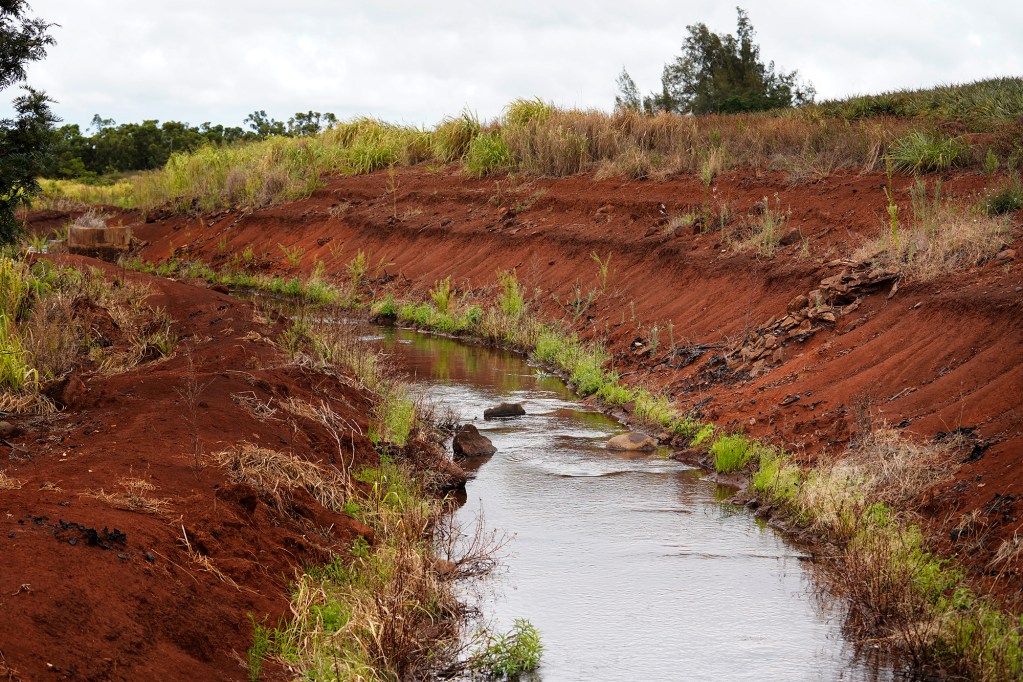
The state has been working on acquiring the dam, spillway and irrigation infrastructure for more than three years, after Dole said it would not pay for necessary safety improvements.
For Waialua farmer Sachter-Smith — recognized globally as “Banana Gabe” because of his extensive research into the fruit — Friday represented the first time an evacuation was considered because of the dam. He evacuated anyway.
“It’s a whole different set of possibilities happening,” he said.
Sachter-Smith, like Green and many other Hawaiʻi farmers, farms on more than one parcel. If the dam breached his smaller plot, in Haleʻiwa, would be “critically hit.” It would be a huge loss, destroying his processing facilities and his prized nursery of about 150 rare and prized banana species.
But because he has two parcels, earlier this week he was able to move machinery, vehicles and equipment to his upland plot in anticipation of flooding.
The dam’s failure would potentially send a deluge down the Kaukonahua Stream and Anahulu River system, thus putting the 2,500 lives at risk, according to the U.S. Army Corps of Engineers. The state has been negotiating its takeover of the dam for years since Dole said it could not afford to bring it up from the “poor” safety rating it was given by the Army Corps a decade ago.
The state is not paying for the dam, Dole is “gifting” it — although with that gift comes a price tag: officials have increased their restoration cost estimate since the first $26 million appraisal, to over $50 million.
“Hawai‘i Grown” is funded in part by grants from the Stupski Foundation, Ulupono Fund at the Hawai‘i Community Foundation and the Frost Family Foundation. Civil Beat’s coverage of climate change and the environment is supported by The Healy Foundation, the Marisla Fund of the Hawai‘i Community Foundation and the Frost Family Foundation.


