Mud, Mud And More Mud: Residents Of Oʻahu’s North Shore Start To Dig Out
Residents of Haleʻiwa and Waialua were allowed over the weekend to return to their neighborhoods, flooded in the second of two powerful Kona lows. The damage was sobering.
India Myerscough stood in about 2 inches of soupy red mud in her living room, taking stock of the damage. A layer of red dirt covered her kitchen island. Muddy water filled the sink. The delicate patterned tiles behind the stove were stained and her fridge had been dislodged and now jutted out, tilted over.
Stains on the white walls traced the rise of the floodwaters, reaching almost to Myerscough’s shoulders, roughly 4 feet. She took it in stride.
“We were shocked, we thought it would be up to the ceiling,” she said.
In the next room, her bed had been lifted up and now sat at an angle. Her nightstand had been chucked into the hall. Only a handful of things were untouched: a plant, two swimsuits hung up to dry, her Bible.
It had taken Myerscough a year to curate the cozy space just right. The light pink wallpaper with little yellow suns, the paintings on her walls, the large bookshelf her friend had found on Facebook Marketplace for $40 – now all strewn about and covered in thick clay.
The flood in the early hours of March 20 caught her and many others on the North Shore by surprise. The week before, heavy rain atop saturated soil and fears that Wahiawā Dam would fail forced people to flee. For many who fled again, this second storm proved even more catastrophic.

Across Waialua and Haleʻiwa, people are still reeling. Some escaped in the buckets of backhoes, in high-water military vehicles or in neighbors’ lifted trucks. Others were stuck for hours. Roughly 5,500 people lived in an evacuation zone at risk of flooding had the dam failed, and more knew they could be cut off if roads became impassable.
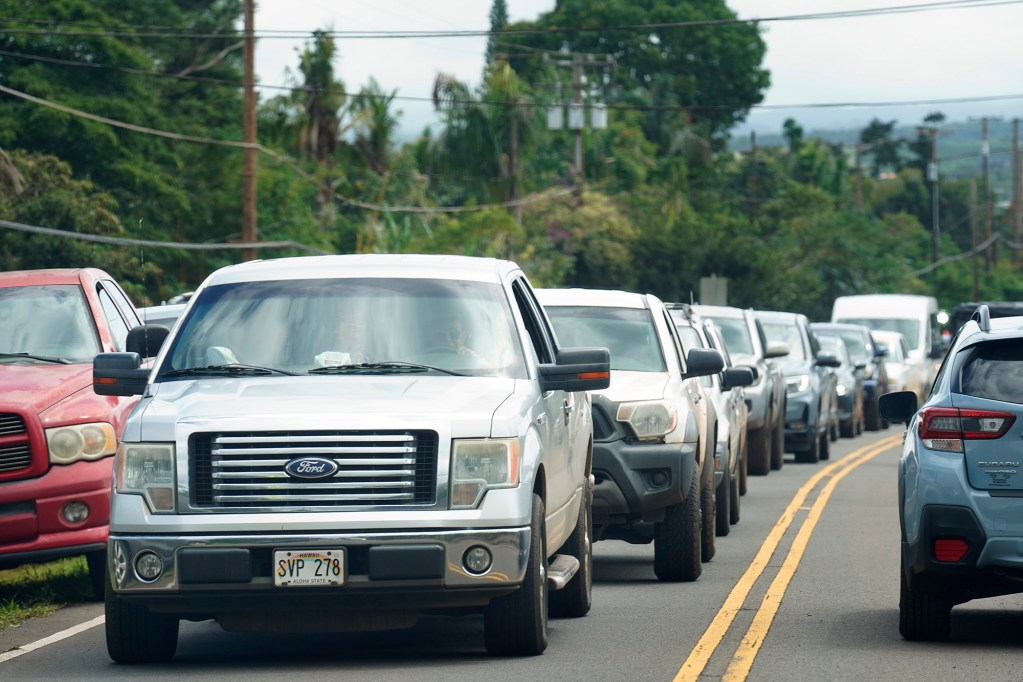
By midday on Saturday, police had taken down the roadblock on Waialua Beach Road, allowing a waiting line of cars to pass through. People let back in their homes for the first time found them water-logged and caked in mud. Even the insides of cars were covered in clay. The damage, many began discovering, is extensive.
Houses knocked off their foundations. Cars moved off the road into yards or pushed up against houses. Surfboards and even a motorcycle in trees. Garage doors mangled from the force of the flood.
The water had even picked up a roughly 12-foot stretch of sidewalk and tossed the pavement across the road. Red mud up the trunks of trees and sides of buildings measured how deep the floodwaters got.
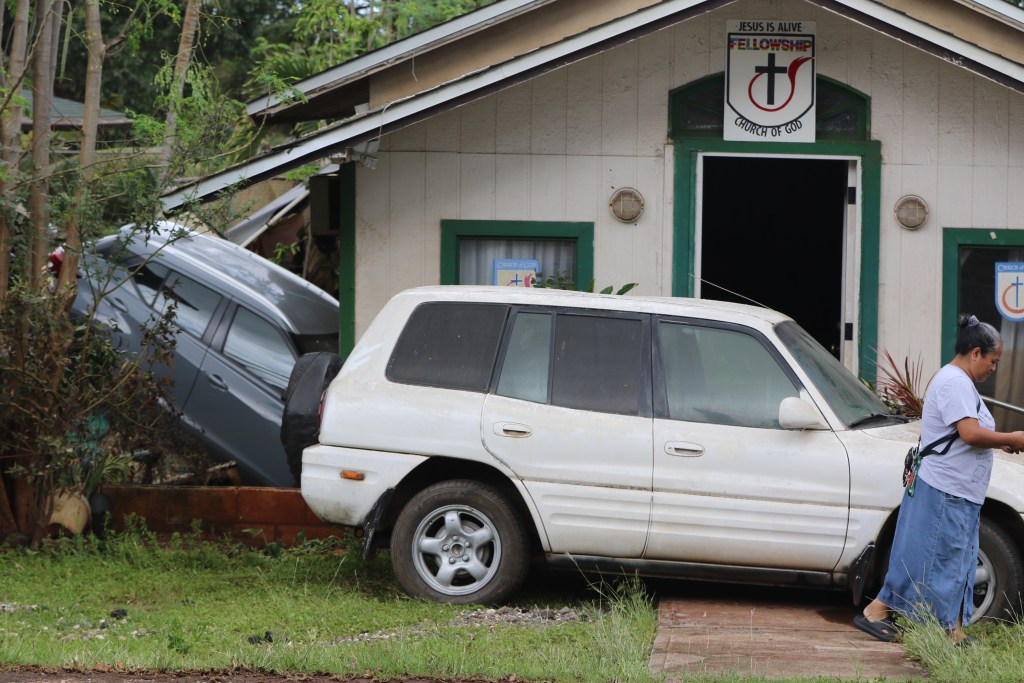
The chaotic scene of emergency vehicles, trucks with generators and residents trying to get home kept up for most of the weekend. Yellow emergency helicopters circled overhead as community members started on cleanup. Military vehicles and emergency crews were still rescuing people from flooded farms off Farrington Highway on Saturday afternoon.
At around 2:30 p.m., Honolulu Mayor Rick Blangiardi came to Waialua Beach Road to survey the damage, accompanied by Honolulu Interim Police Chief Rade Vanic and a host of government officials. As he paused to talk with Myerscough and her friends, the mayor’s neat, clean khakis stood in stark contrast to his constituents covered in mud.

Before Friday’s storm, Myerscough had just started cleaning up the damage from the previous Kona low, which had sent the 30-year-old, her brother and his girlfriend fleeing. They had just fixed their water heater and replaced their washer and dryer damaged in those rains. Myerscough’s sodden floor had just been demolished. She thought maybe her couch, which had been wrapped in plastic for the work, would make it through the new storm.
She had hoped this storm was going to be less severe. But when she woke up in the middle of the night on Friday, she quickly realized it was serious. Seconds later, a loud bang as the neighbor’s foundation cracked woke up her brother and his girlfriend upstairs.
Water rose four feet in 40 minutes. A camera a friend had set up in their yard to gauge the flood showed that later, after they had all left, it reached just under the eaves of the roof. Water rushing down the slope of the driveway created a wave.
“You could have full-on surfed that thing,” Myerscough’s brother Reed said. “That was wild.”

Surveying The Damage – And Getting To Work
The extent of the damage across Waialua and Haleʻiwa is still unknown, and assessment crews will be on the North Shore through at least Monday, according to Molly Pierce, a spokesperson for the Department of Emergency Services. Officials have created a webpage for people to self-report damage to their homes, which recommends they take photos to document the devastation before they dive in.
Block by block, neighbors began helping neighbors and crews of volunteers from other parts of the island showed up, too.
On Waialua Beach Road, the water had even gotten into the upstairs where Myerscough’s brother Reed lives with his girlfriend, Belle Younkam. The musty smell of mildew was already settling in on Saturday as Younkam surveyed the aftermath of the inundation just 24 hours before.
The flood had come gushing up the stairs in the early hours Friday, sending water swirling down the hall and around the bedrooms. Stains on the couch and the legs of the coffee table showed the second floor living room ended up with about an inch of standing water. Younkam and her friends said they didn’t hear the warning sirens until they were already at the evacuation shelter.
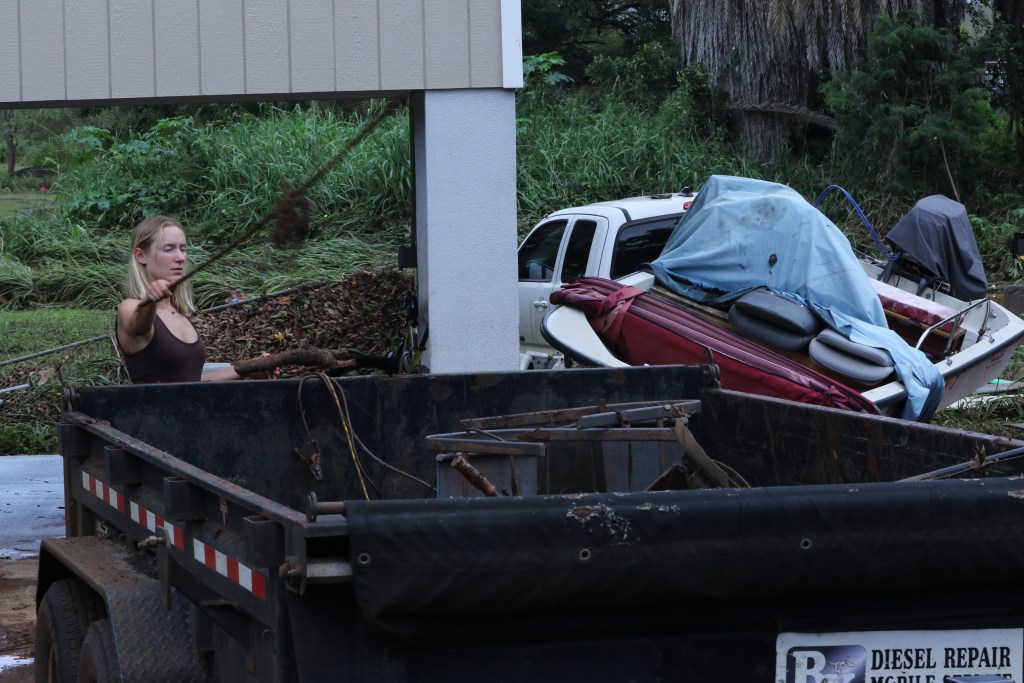
Holding a mask over her face, Younkam moved carefully from room to room picking through what could be saved. The carpet in the bedrooms squelched as she walked. Her mattress, she determined, might be salvageable. But the extra bed, where a friend displaced by the flood a week earlier had been sleeping, wasn’t. Even on this higher floor, the force of the water had shifted the bookshelf where the TV was sitting.
The yard behind their apartment is usually a wild expanse of grass and trees. But as the clouds cleared and the neighborhood returned, it had become a lake with floating debris and washed-up lawn chairs. Reed Myerscough picked around the edges, his shoes sticking in the mud, turning up belongings that had washed away. Younkam’s fin, a lure used to attract fish while diving, his sister’s beloved surfboard, made for her by a former partner.
“We got blessed, so we’re going to try to bless some other people and help.”
Brandon Rice
The force of the floodwaters was sinking in for the housemates as they surveyed the damage. Next door, their neighbor’s house had been shifted 180 degrees on its foundation. It was still standing, but visibly weakened.
In their yard, their mom’s small sedan was now sitting on top of an air-conditioning unit. The inside was caked in mud, ruining Younkam’s computer and headphones. A little to-go pack of salt balanced precariously in the steering wheel, set down gently as water receded.
Across the North Shore, an immense amount of cleanup needs to happen before residents can even start scrubbing dingy walls or tearing up soaked carpet. In some places, floodwaters are still receding. Wrecked chairs, destroyed lawnmowers, waterlogged air-conditioners – enough to fill truckloads – litter people’s yards. Stacks of trashed mattresses and couches are piling up in Waialua as people with heavy machinery haul away belongings too far gone to be salvaged.
Honolulu officials are asking people to separate debris into different piles for green waste, appliances, mud or rocks, and other debris because crews conducting curbside cleanup will be collecting one type of debris at a time.
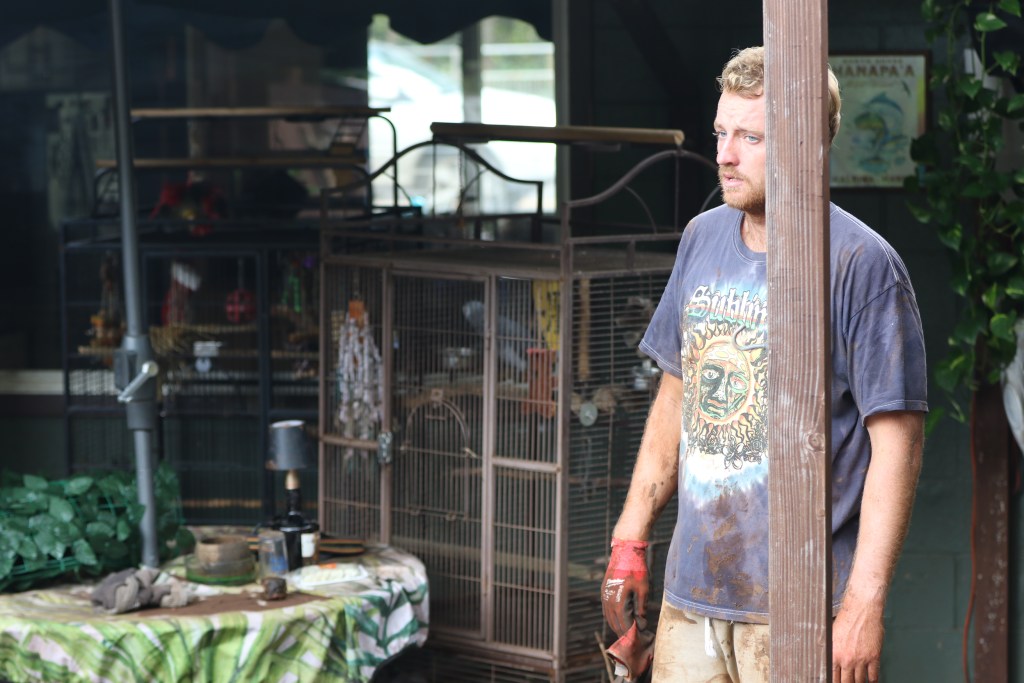
Reed Myerscough was perched in the bed of a truck, trying to figure out how to unhook a boat that had been washed up against his neighbor’s house when he heard a call from the road. He looked up to see someone he’d never met from a nearby neighborhood here to kickstart the cleanup.
Brandon Rice backed his flatbed truck and a trailer down the driveway. A mechanic with a diesel repair shop, Rice owns heavy machinery like excavators. He was rescuing people from the flood waters at 4 a.m. on Friday. When the road reopened, he returned to help clear debris.
“We got blessed, so we’re going to try to bless some other people and help,” he said as he picked his way through the mud in India Myerscough’s apartment.
“This is crazy, huh, brah,” Rice added, turning to his 11-year-old son who he’d brought to help. “Yeah!” said the kid, the watermarks on the white walls reaching his chin.
The group who moments ago had been strangers made quick work of the yard. Scraps of wood, a destroyed lawnmower and whatever else they could find in the mud – all thrown into the trailer. This would make Rice’s second trip back and forth between the flood zone and the dump since the roads reopened that morning. Yellow emergency helicopters circled overhead as they worked.
Rice is still thinking about one family he took to the shelter, a couple with their baby who couldn’t have been older than a year, tiny feet dipping into the water as the parents tried to get to Rice’s truck. Or the elderly lady standing in water up to her chest, holding her dog and begging her rescuers to get her neighbor first.
“I woke up this morning, I want to shed a tear, just the stuff I seen yesterday,” he said. “It was crazy.”
Kukea Circle, which runs parallel along a stretch of Waialua Beach Road, was hit hard.

Waialua resident Sharmaine Arial started a makeshift supply hub with her family at their flooded-out Kukea Circle property, collecting donated cleaning supplies, food, propane tanks, potable water – “pretty much anything anybody needs,” she said. She encouraged anyone who wants to donate food or supplies to bring them to her property at 67-367 Kukea Circle.
People from parts of the island who didn’t get hit as hard arrived in their personal pickup trucks Sunday, Arial and her neighbors said, to help haul muddy, rotten furniture and junked appliances to the landfill in Wahiawā.
“It’s all regular people,” Arial said. “It’s all the people. The community is doing everything.”
Arial’s neighbor, Les Romero, said they and other Waialua flood victims were taking care not to scratch or nick the trucks of the those who showed up to help them load all the bulky, muddy items.
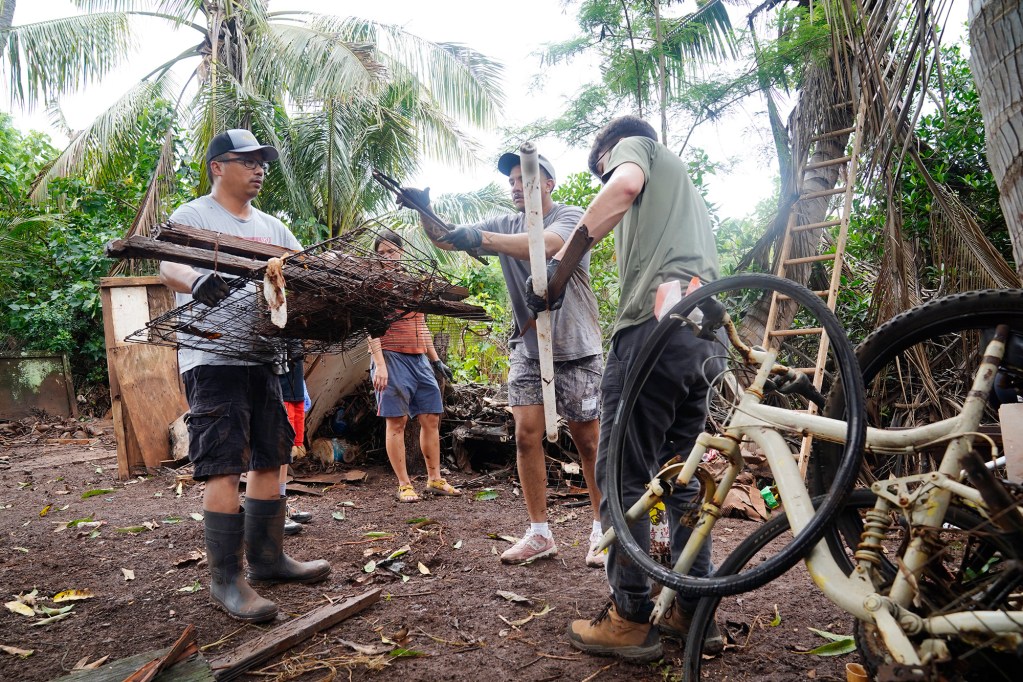
Romero also worked Sunday to remove debris from other homes upstream that landed in his family’s yard — gates, fishing poles, coolers — and, he said, chunks of other houses. Neither he nor Arial expected to have electricity for at least several days.
“It’s just been a lot,” Arial said. None of her family’s furniture was salvageable. “It stinks. It’s all mud and it’s just gross, so we’re just dumping everything.”
Picking Up The Pieces After A Harrowing Escape
Heather Nakahara and Michael McEwan returned to their North Shore home on Waialua Beach Road on Saturday afternoon to start piecing their lives together. The first order of business was finding his wallet and her purse.
“Cause walking around this earth without ID and credit cards, that sucks,” Nakahara said. “Luckily, he knew his was in the truck and I knew mine was in the living room.”
The sudden deluge of water and an evacuation order in the middle of the night forced people to flee on a moment’s notice, often without vital belongings. Everything from medication to cell phones was left behind in the panic, inaccessible to most until the roads reopened.
Once Nakahara and McEwan found their wallet and purse, they started pushing their way past broken furniture in pursuit of clean clothes and food for their pets. Soon, help arrived. After some initial cleanup at their house a few houses down, Younkam and the Myerscough siblings had quickly turned their attention to their neighbors.
They found Nakahara and McEwan trying to get into their bedroom through the double doors in the backyard. The task at hand: finding Nakahara’s glasses.
They’d been next to the bed, but the force of the flood waters had pinned the bedframe up against the door to the backyard. The shed had once held tools that would have been helpful to force open the door, but now everything was buried in lawn chairs and dismantled storage boxes.
Reed Myerscough picked up a hammer and started banging at the hinges. After a couple minutes of prying, the group celebrated as they broke down the door.
The neighbors found humor where they could – undergarments stuck in the fence, the long-forgotten sandal that had suddenly resurfaced.
“The Jager survived!” McEwan called out as he opened a mini fridge, holding up a green bottle of liquor in with a smile.

But other things that mattered much more hadn’t survived. McEwan’s vinyl Ska records and DJ equipment were destroyed. So was a little wooden box his father made before he passed away two weeks ago.
Nakahara and McEwan had been fast asleep when suddenly their pet bird flew off her perch shortly after midnight on Friday, jolting them awake. When McEwan opened the bedroom door, water poured in. Within seconds, it was ankle deep and quickly rising. Nakahara ventured out into the living room and saw the water pick up her couch and float it toward her.
The bottom of the barn door on their first floor rental had been blown clean off its hinges. Water was gushing into their living room, knocking their Instapot off the counter and hurling furniture across the room. The water sounded like a roaring river as it rushed through their house and yard.
“In my worst case scenario, that bed – and us and all our animals – was gonna float and go God knows where.”
Heather Nakahara
As Nakahara turned to go back into the bedroom to rescue her dogs and birds, she realized the door was stuck from the weight of the water forcing it closed. After much pushing and pulling, they managed to get it open the door, Nakahara scooped her pets onto the bed and called 911.
“They’re like, your road is not passable. We can’t come and get you. Stay safe. Do not go outside. You will be washed away,” she said.
It was 1:17 a.m, and by that point, officials had declared a flash flood warning for the North Shore with rain falling at 1 to 3 inches an hour, according to the alert from the National Weather Service. By about 1:30 a.m. the water was up to Nakahara’s belly button, almost three feet deep.
“In my worst case scenario, that bed – and us and all our animals – was gonna float and go God knows where,” she said. “People were going to drown.”
The couple locked themselves in the closet, hoping that the water wouldn’t be able to pry them out and wash them away. The water was up to Nakahara’s waist.
Around 2 a.m. they could hear heavy machinery driving down the street rescuing people stuck on rooftops. But their calls for help were drowned out by the roar of the water and the noise of the machines themselves. So they waited, in the dark.
“When I was in the closet and the water was rising, I was thinking about how much I cannot watch anyone die,” Nakahara said. “Mike or the animals – I’m not gonna be able to handle that. If somebody starts floating away or somebody starts drowning, I don’t know how I’m gonna do that.”
It took about seven hours for them to be rescued by firefighters, they said, at around 8:30 a.m. By then, the water had started receding.
“Once the water started going down, I started to think more about how all our stuff is gone,” Nakahara said. “What are we gonna do?”
Contributing: Marcel Honoré