

‘Godzilla’ El Niño And Recent Floods Bring Risky Fire Forecasts To Hawaiʻi
This year’s heavy rain has turbocharged the growth of vegetation statewide. When the inevitable dry months come, it will become extra fuel for wildfires.
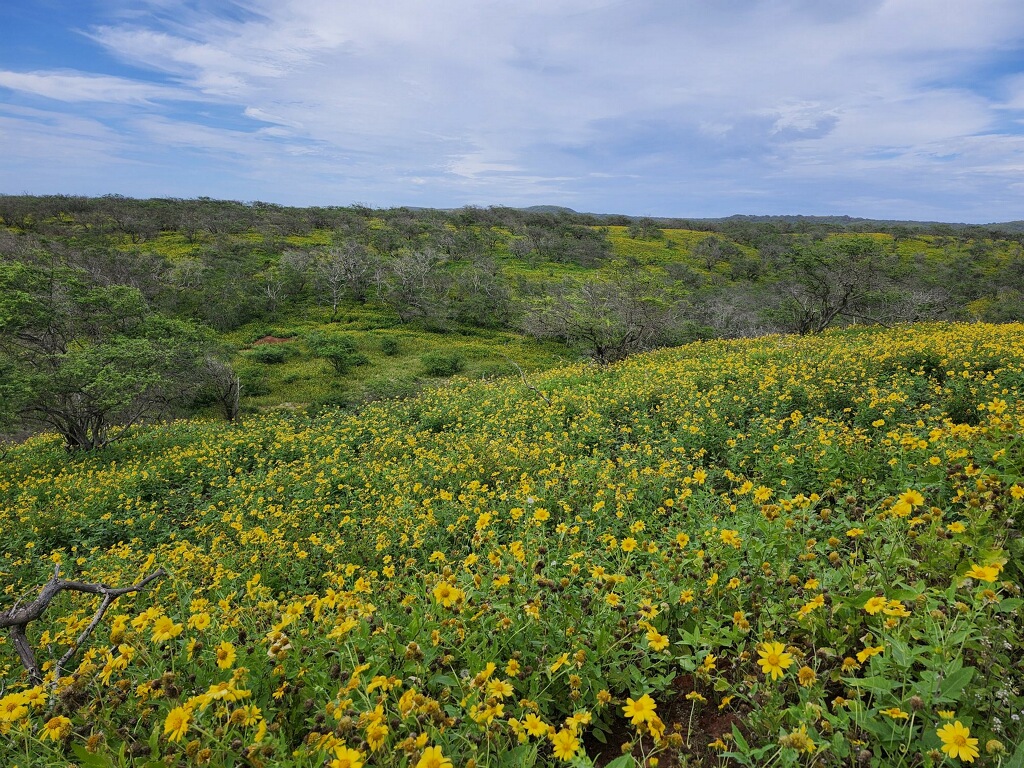
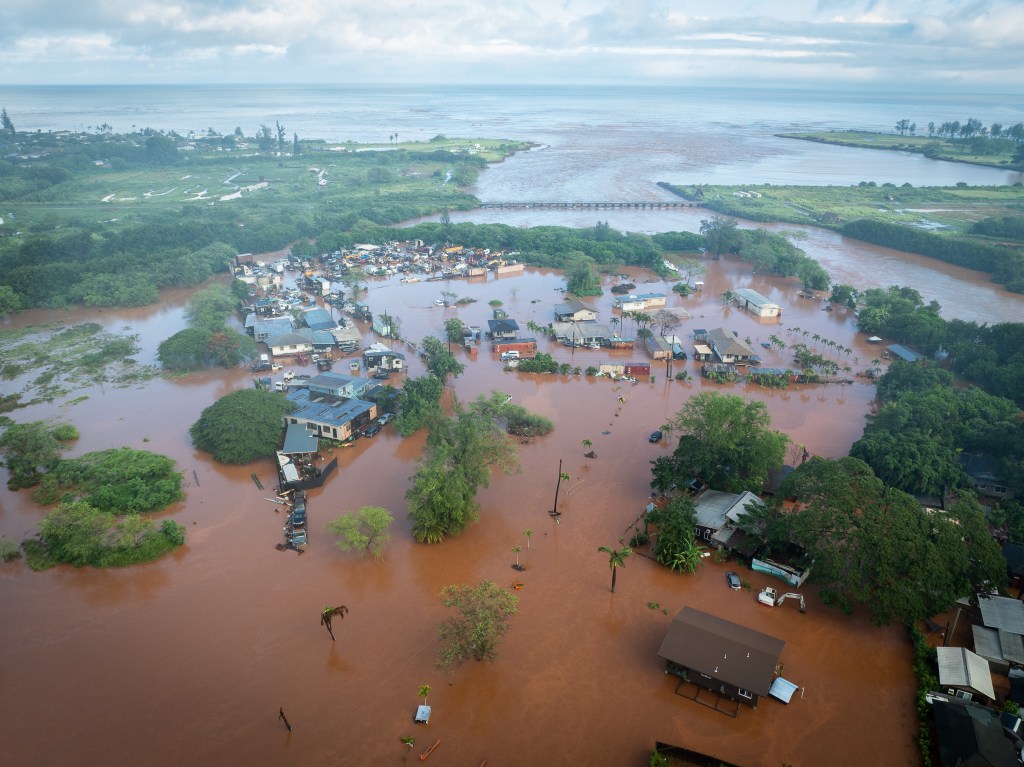
Severe weather on Molokaʻi has flooded homes, peeled roofs off buildings and torn up the island’s roads and infrastructure. It has also fueled an explosion in vegetation.
Erin Peyton, who lives on the island’s west side, said the area typically looks like an African savannah, characterized by red dirt, kiawe and haole koa trees. But record rains from March’s Kona low storms have the landscape looking like “a beautiful Monet painting” with daisies everywhere, and that has her worried.
“They die and dry,” Peyton said. “So that’s going to be a lot of fuel if a fire comes through here.”
Moloka‘i, much like the rest of the state, is still in the early stages of recovering from last month’s flooding. For people like Peyton, whose career revolves around mitigating wildfires, the end of the drought is unfortunately the beginning of another problem.
Meteorologists are forecasting a “super” or “Godzilla” El Niño season, with a more than 60% chance of starting in May. That system, fueled by ocean surface temperatures and winds, typically signifies an increased risk of tropical cyclones but less rainfall on the whole. That means what is green now will become yellow and, eventually, a brown tinderbox.
“It’s not good,” University of Hawaiʻi fire ecologist Clay Trauernicht said of the forecast. “The concern is totally valid.”
The combination of an abnormally wet winter followed by an abnormally dry summer means work needs to start sooner rather than later to cut back excess vegetation — among other preventative measures — so Hawaiʻi is ready, fire safety advocates say.
Paniolo Hale, the housing community where Peyton lives on Molokaʻi, has been enrolled in the Firewise USA program since 2019 to help residents protect their homes from wildfires. But right now, Peyton said, many of the island’s 7,000 residents are still too busy cleaning up the mess left from last month’s storms to think about reducing the risk of wildfires several months from now.
Harder To Predict
The El Niño-Southern Oscillation is a weather phenomenon with significant impacts in Hawaiʻi, feeding both drought and flooding that impact lives and livelihoods across the Pacific islands. The recent storms have given Hawaiʻi a brief respite from drought, but next winter could be especially dry.
State climatologist and UH professor Pao-Shin Chu said it’s clear that such a weather system is forming, likely beginning next month and lasting into 2027. The extremes of the system, known as ENSO, are called either La Niña or El Niño and are characterized by the cooling or warming of the ocean surfaces and winds. The resulting atmospheric patterns dictate seasonal rains and hurricanes. Hawaiʻi has only recently emerged from a mild La Niña.
“This coming winter and next spring are going to bring very low rainfall, just the opposite to what we are experiencing now,” Chu said. “It will be a sharp contrast.”
El Niño conditions helped feed the 2023 fires on Maui, which destroyed Lahaina and killed 102 people. A wet winter fueled the growth of invasive grasses that surround the town. A warm, dry summer then dried the vegetation out, creating ripe conditions for fire.
Chu cautioned that relying on the past to predict the future, meteorologically speaking, is getting harder to do as the climate changes.
“It’s becoming more difficult to predict,” he said. “Extreme events are going to become more common … It’s scary, even for me as a meteorologist.”
Requiring Land Management
An analysis of years of Hawai‘i’s fires and weather by UH fire ecologist Trauernicht has yielded a strong correlation between El Niño seasons and especially large annual footprints of wildfire.
Between the wet summers and especially dry winters, “you’re getting that one-two punch,” Trauernicht said. “It’s trapping us on both sides. It dries out super quick and carries fire super quick, but is also so sensitive to rainfall and it just grows like mad when it’s wet.”

Non-native savannah grasses grow quickly and disperse their seed when burned. But unlike African savannahs, where fire-friendly species abound, there are few species in Hawaiʻi that can compete to keep them in check.
The land management practices of large landowners and the state became a lightning rod for discussion in the wake of the 2023 wildfires, with many criticizing them for a lack of maintenance of invasive and fire-prone grasses.
“We need to be in a place where land ownership requires land management,” Hawaiʻi Wildfire Management Organization Co-Director Elizabeth Pickett said. “The system protects the right for people to do nothing, which has to change.”
For fire, roadside gulches were seen as especially problematic, as hot vehicles have been known to ignite fires in long, dry grasses. A stray cigarette butt and even glass bottles have also been blamed for ignitions. For flooding, the long dry grasses choking North Shore berms are stemming waters’ seaward flow.
In a wildfire’s aftermath, the loss of vegetation and soil – which also can burn – leaves the leftover earth unable to absorb water.
“It just sloughs it all off into major drains and it all ends up in our major waterways,” Pickett said. “When we see those big sediment plumes on the west sides – that’s not natural.”
Approximately 1,000 Molokaʻi residents celebrated Earth Day early on Friday at the Mitchell Pauole Center in Kaunakakai, where Peyton held a stall for the Hawaiʻi Wildfire Management Organization. Peyton, now the organization’s Molokaʻi Firewise and outreach coordinator, said island residents are coming to realize the importance of protecting their homes.
They are not alone. Before the 2023 Maui fires, just 16 communities were signed up for the Firewise program statewide. Now, 50 are nationally accredited and 10 are in the enrollment process.
It shows a recognition that managing the space around homes — from 0 to 5 feet — is paramount, Pickett said, and the importance of community efforts alongside state and county work to mitigate fire risks. That includes the disproportionately high number of fires started by people, and the miles of open, fallow land that covers Hawaiʻi.
It all starts at home, Peyton said, by clearing flammable material from a 5-foot radius of the building. She sees it becoming as routine as washing dishes and taking out the trash.
Civil Beat’s coverage of climate change and the environment is supported by The Healy Foundation, the Marisla Fund of the Hawai‘i Community Foundation and the Frost Family Foundation.

