

Hawaiʻi Banned Plastic Foam Food Containers. Are Bodyboards Next?
Critics say cheap boards harm the ocean and give people a false sense of safety.
On a recent patrol at Makapuʻu Beach Park, a teenage tourist paddled out on a polystyrene boogie board. No fins, no experience. A wave snapped the board in half, quickly pulling him into deeper water before he was rescued by a lifeguard.
“He got swept out very fast,” said Briscoe Beaton, the lifeguard who responded to the incident.
For lifeguards, it’s a familiar scenario, one that lawmakers across Hawaiʻi are now trying to address as attention turns to the disposable boards often at the root of these rescues.
Polystyrene, sometimes branded as Styrofoam, has long been a target for environmental advocacy groups. Each island has banned polystyrene food take-out containers that, combined with other local regulations, has created a statewide prohibition.
But, while it’s illegal to be served a plate lunch in a plastic foam container to take to the beach, there’s nothing wrong with taking a big chunk of plastic foam into the ocean to catch waves. Now, a similar effort is unfolding to ban the disposable polystyrene boogie boards, more formally known as bodyboards.

The push isn’t aimed at skilled bodyboarders or the high-performance boards they rely on. Instead, it targets the cheap, lightweight boards often sold at convenience stores and big-box retailers, the ones most likely to break in big surf, stranding swimmers and scattering debris in the ocean.
Counties have already begun to act. On Kauaʻi, a measure introduced by council members Fern Holland and KipuKai Kualiʻi was signed into law by Mayor Derek Kawakami in December, with a one-year phase-in period. Maui also has a ban on Styrofoam bodyboards, which was spearheaded by council member Tamara Paltin, a former county lifeguard.
Hawaiʻi Sen. Angus McKelvey this session introduced a bill to extend the prohibition statewide. The bill stalled despite some support from county officials.
“They’ll break apart and fall apart. … It gives people a false sense of security.”
Sen. Angus McKelvey
In the absence of statewide action, lawmakers are again turning to the counties. On March 10, Sen. Mike Gabbard introduced Senate Resolution 30, urging Hawaiʻi County and the City and County of Honolulu to adopt bans on the sale, rental and distribution of disposable bodyboards. The measure has a hearing Monday.
“There are stable, durable options to the Styrofoam boards, and it’s obviously going to help the environment by keeping those pieces from littering our beaches and killing our marine life,” Gabbard said.
For supporters, the issue is not just environmental. It’s also about safety.

People “go out in conditions and the waves, where they think, ‘Oh, I got a board, I’ll be able to float, I’ll be able to surf,’ and not realize that these things just completely, totally, can’t do either of those. They’ll break apart,” McKelvey said. “On the water safety side, it gives people a false sense of security.”
Local surf retailers say the price of higher-quality boards often pushes visitors toward cheaper options sold at retailers like ABC Stores. People staying in Hawai’i for vacation or a short stint “get scared of the prices of these high-performance boards and go to Walmart or ABC and buy the cheap ones,” Phillip Pellew, sales associate at Local Motion, said.
Additionally, workers say many tourists don’t know the difference between cheap boards and good ones they see people using to carve waves at places like Sandy Beach and Waikīkī.
“They think because we are on boards, that their same cheap board will work the same and they can ride these waves,” said Isiah Santos, sales associate at T&C Surf Designs.
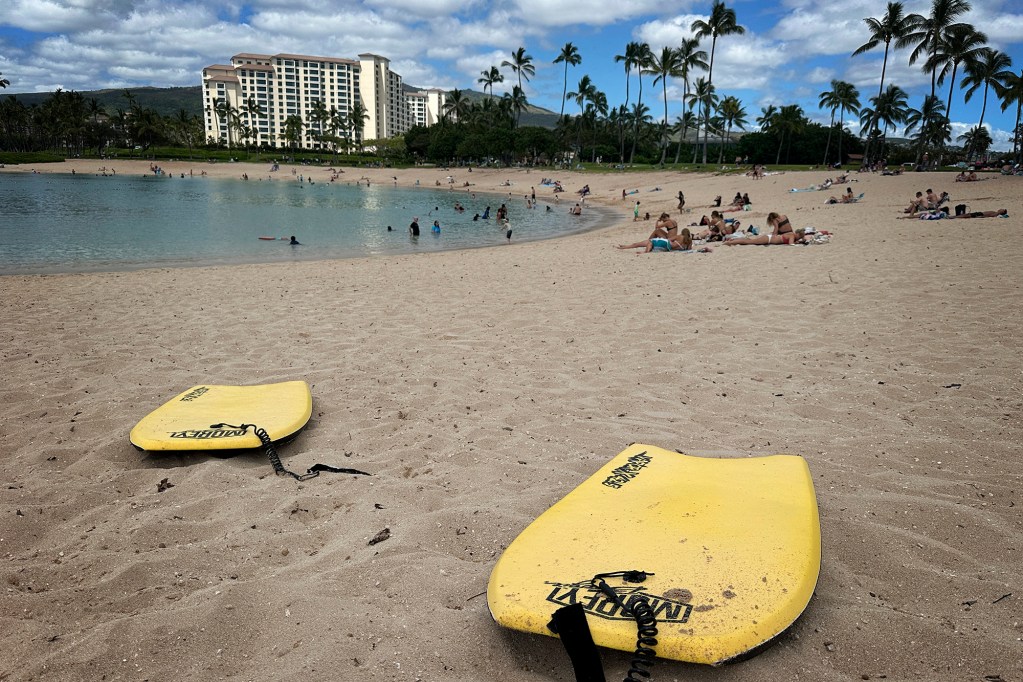
Unlike high-performance bodyboards with hard cores such as Science or Hubboards, many polystyrene boards are designed for short-term use. They can snap in half when under pressure, especially in strong shore breaks, leaving inexperienced swimmers without flotation in dangerous conditions.
“People that aren’t familiar with the power of the ocean aren’t familiar with the needs of a boogie to even ride a wave,” Paltin said.
“It’s just not sustainable or respectful to this place that we’ve been blessed with, to treat the island and treat our ocean as a dump, which unfortunately often happens when we have so many of these disposable plastic products,” Wayne Tanaka, the chapter director of Sierra Club of Hawaiʻi, said.

Polystyrene foam is a thermoplastic petrochemical material which disintegrates into tiny lightweight pieces, which can persist for several decades. The material can leach toxins which creates pollution problems for marine ecosystems.
“When they’re exposed to sunlight, they break down and decompose and break into smaller pieces and marine life, particularly turtles and others, mistake them as food and eat them,” McKelvey said.
According to the National Library of Medicine, as marine life consumes these particles, they can accumulate up the food chain, increasing the likelihood that humans ingest these microplastics as well.
Hawaiʻi’s geography makes the issue even more significant. Situated within the North Pacific Gyre, the islands are already exposed to high levels of marine debris because of its proximity to the Great Garbage Patch, also known as the Great Pacific Garbage Patch.
According to the Hawaii Wildlife Fund, an estimated 15 to 20 tons of marine trash are being washed up on the shores of Hawaiʻi every year, 96% of which is made from plastic material.
Despite that, much of the policy focus has historically been on items used on land. Products like plastic bags and foam containers have been targeted because they can end up in the ocean.
But policymakers have given less attention to eliminating items used in the water, such as disposable bodyboards.

On Maui, Paltin said the county’s earlier action was driven by the visible impacts of plastic waste on local beaches.
“From my former life working at the beach, during tourist season, the rubbish can areas would be piled up almost every day with these Styrofoam boogie boards,” she said. “Then, going through the county budget process and learning about solid waste, you realize the cost.”
On Kauaʻi, Kawakami framed the ordinance as part of a broader push toward responsible tourism and protecting the environment.
“We’ve come to a point in time, a far overdue point, where every one of us has a responsibility to be very conscious of our environmental impact,” he said. With both safety and environmental concerns, “all of these components coming together really made it a common sense policy that should be passed by other counties. If they haven’t taken a look at it, they should be looking at it.”
The Senate resolution is scheduled to go before the Agriculture and Environment Committee at 3 p.m., Monday. For now, the future of a statewide ban still remains uncertain, but the proposal nudging the remaining counties in that direction is in motion. If Hawaiʻi and Honolulu counties take action, it could set a precedent for a uniform policy across the islands, as it did with polystyrene food containers.
Back at Makapuʻu, Beaton said the rescue was a reminder of how quickly things can go wrong.
Civil Beat’s coverage of climate change and the environment is supported by The Healy Foundation, the Marisla Fund of the Hawai‘i Community Foundation and the Frost Family Foundation.

