

Hawaiʻi Legislature Moves To Guard Against Federal Immigration Enforcement
Bills are advancing to prohibit face coverings, protect the right to record police and limit state cooperation.
Motivated by the deadly federal immigration operations in Minneapolis and other cities, Hawaiʻi lawmakers are close to approving a wide range of bills intended to protect people in the islands from similar incidents.
Those include four bills that passed a key deadline Tuesday, most notably House Bill 1886. Described by advocates as perhaps the most consequential immigration measure this session, it would limit state and federal cooperation with U.S. Immigration and Customs Enforcement and establish identification and facial covering standards for law enforcement officers.
Improper facial coverings and lack of visible identification when unauthorized civil immigration interrogation, detention and arrests occur could result in a criminal offense.

HB 1886 easily passed the Senate Tuesday with only the chamber’s three Republicans voting against it. More than a dozen related measures are still alive as the Legislature works toward a May 8 adjournment.
Not all bills made the cut Tuesday. A measure intended to make it easier to obtain pretrial bail was killed, continuing a pattern seen over the past few sessions.
But dozens of other bills passed, including an amendment to an emergency funding bill that will appropriate $175 million to help the state recover from the recent Kona low storms. Sen. Donovan Dela Cruz said the figure is based on a projected damage estimate from the Green administration. Total damages, he said, are reported to be over $1 billion.
But Dela Cruz said the state must also follow through on the 2024 tax cuts passed by the Legislature, something that can be accomplished by tapping underutilized funds and adjusting deduction standards and tax brackets.
“With national and global instability, we must deliver on our promise for tax relief for our working families,” he said.
The Senate subsequently passed the state budget bill on a unanimous vote.
‘A Crime Is A Crime’
Members of the ACLU of Hawaiʻi and other groups gathered in the Capitol Rotunda and in the Senate gallery on Tuesday to show support for pro-immigrant and anti-ICE bills, wearing yellow T-shirts that expressed support for due process.
Liza Ryan-Gill of the Hawaiʻi Coalition for Immigrant Rights said extensive lobbying efforts, especially with county law enforcement officials, had helped break down resistance to the bills they are championing. But several lawmakers are still uneasy about some of them.
Sen. Kurt Fevella, a Republican, voted against House Bill 1839, which requires state and county law enforcement agencies to notify an individual in custody of their rights before any interview with ICE. He said he represented a district with a large Filipino community that came to Hawaiʻi legally.
“If the job needs to be done because you came in illegally, not legally, then you need to be detained, because, again, a crime is a crime,” he said.
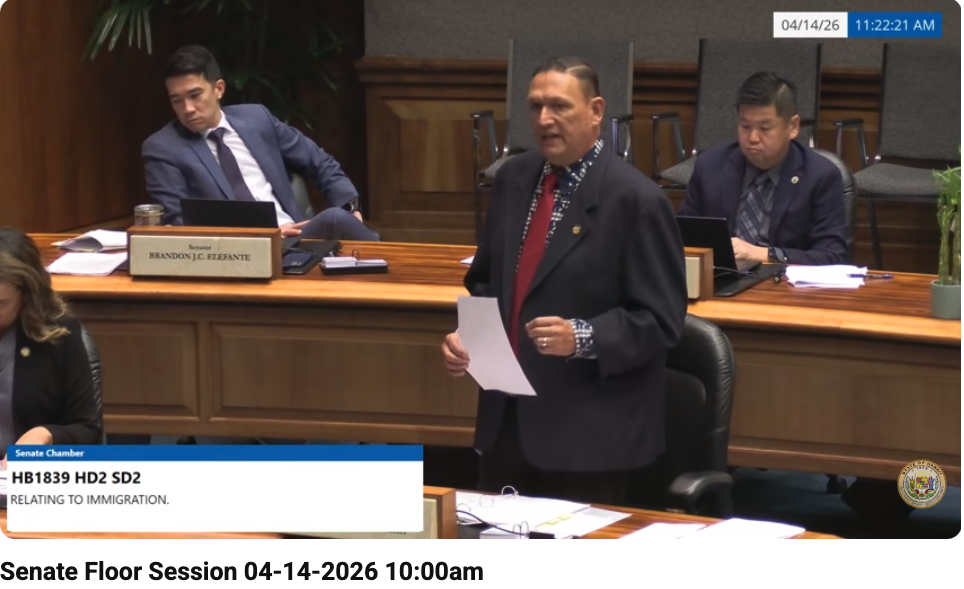
Sen. Joy San Buenaventura disagreed.
“This bill merely requires agencies to inform immigrants of their rights,” she said during floor debate. “I don’t think we should oppose anything that merely requires the agencies to inform them of their rights for interview process or before any kind of detention. In fact, the Supreme Court has done that for actual criminals.”
Another anti-ICE bill, House Bill 1768, also passed the Democrat-dominated Senate with the three GOP members again voting no. It would prohibit any law enforcement agency or official from entering into an agreement under federal law that permits state or county agencies to engage in immigration enforcement.
House lawmakers on Tuesday also gave tentative approval to Senate Bill 3322 to limit the ability of local law enforcement to cooperate with federal immigration enforcement operations. That measure passed in a 42-9 vote over the objections of most of the House Republicans.
The House also approved Senate Bill 2203, which would prohibit most law enforcement officers from wearing a mask during their official interactions with the public. That measure would make it a misdemeanor offense for an officer to do so.
Pretrial Release Bill Dies
Another bill that some lawmakers worried appeared to be soft on crime was soundly rejected. House Bill 2413 would require pretrial bail for defendants charged with violations, traffic offenses, nonviolent petty misdemeanors, nonviolent misdemeanors and nonviolent class C felonies.
Sen. Karl Rhoads sought to tamp down any notion that criminals would be freed to roam the streets should the bill become law.
“In an age where we have these incredibly accurate algorithms, what we really need to be looking at are the factors that can indicate more accurately,” he said. “They’ll never work 100% correctly, but they more accurately predict who should be left in in jail before trial and who should be let go. The present system isn’t working in that regard. And so we need to move in a direction to a system that does work.”
But other Democrats disagreed.
“I think the idea of bail reform is to help in terms of the public safety, as well as looking at the financial circumstances of a person,” said Sen. Sharon Moriwaki. “But it really should be left to judicial discretion — the whole idea of judges looking at the whole circumstance of a person in each case by case, rather than categorical assessment of whether a person has petty misdemeanor or misdemeanor, and now felony C has been included.”
Other bills passing the Senate by healthy votes included measures to increase regulations for e-bikes, to direct more resources to aid Molokaʻi in combatting invasive species and to help homeowners convert cesspools.
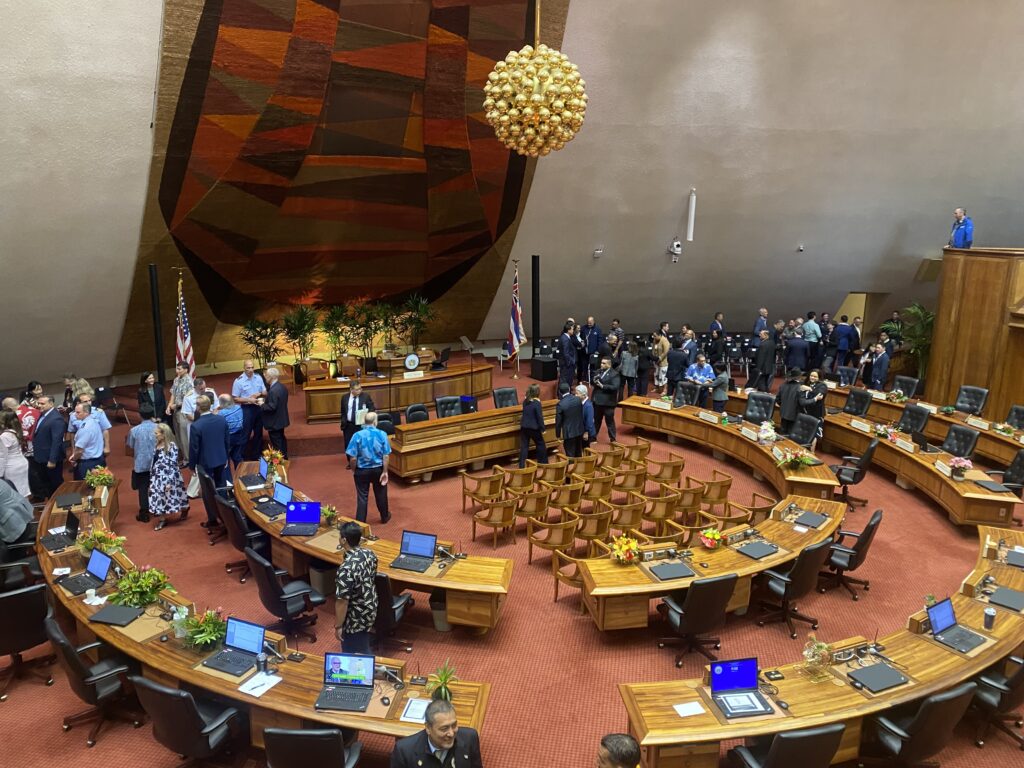
The Senate and House will meet again Thursday to address any final bills that are up for consideration this session. Then begins a two-week period where both sides work to reach compromises on bills that still have major differences between the chambers.
Tax Cuts Debated
Republicans in the House, meanwhile, used the Tuesday crossover floor debate to try to goad the ruling Democrats into doing more to preserve the income tax cuts that lawmakers approved in 2024.
Hawaiʻi lawmakers passed the largest tax cut in state history two years ago by approving a series of changes in tax brackets and standard deductions that were supposed to roll out over eight years. Gov. Josh Green signed that tax cut bill into law as Act 46, but then proposed a “pause” in the tax cuts last fall.
The tax cuts would cost the state more than $740 million lost revenue next fiscal year year and billions of dollars more in the years ahead, and Green has said the state needs that money to fund state operations in the face of federal budget cuts.
The House and Senate have each proposed compromise bills this year designed to continue the tax cuts for lower income state residents while ending the tax breaks for wealthier taxpayers.
But the tax proposal in Senate Bill 3125 prompted a scolding from House Republican Minority Leader Diamond Garcia in a Tuesday floor speech.
“We told the people of Hawaiʻi that help was on the way, that we understood the cost-of-living crisis, that we were going to give them some breathing room,” Garcia said, “and now at the first sign of pressure, we turn around and say ‘Never mind, we’re taking all that back.’ ”
The Republicans proposed a floor amendment that would adopt the Senate’ version of the bill, which House Minority Leader Lauren Matsumoto said would leave the full tax relief in place for 90% of state residents. She said that would mean an average savings of about $4,000 per year by 2031.
House Finance Chair Chris Todd said the Republicans’ arguments and the Senate bill both have merit, and he plans to meld the best parts of the various proposals together during House-Senate conference committee negotiations in the weeks ahead.
The Democrats, who control 41 of the 51 House seats, then rejected the Republicans’ floor amendment in a voice vote, and adopted the Democrats’ draft of SB 3125 in a 40-10 vote.
The House also adopted a proposal to increase the state conveyance tax to raise an estimated $150 million a year for the state general fund. It passed without any floor discussion or debate, with eight Republicans and two Democrats voting against the measure.


