Maui Resort’s Plastic Barrier To Save Beachwalk Faces Public Pushback
State land officials are waiting for more information from the Hyatt before taking further action after meeting with community members, hotel representatives and local officials.
Plans to install a 360-foot long plastic “erosion protection skirt” on Kāʻanapali Beach are in limbo following pushback from community members and environmental advocates who say the barrier could accelerate erosion and harm a neighboring beach that is beloved by locals.
“Hanaka‘ō‘ō Beach Park is special because it’s where everyone has baby showers and birthday parties and retirement parties — everything. It’s the last beach where folks really feel at home, where they’re not pushed out by tourism,” said Kai Nishiki, executive director of Maui Nui Resiliency Hui. “It’s a living cultural space that local people are using every single day, so any potential negative impacts due to a neighboring parcel installing de facto shoreline hardening is very concerning.”
Heavy rains during the first of two Kona low storms that swept across the state last month caused erosion that undermined the beachwalk fronting The Hyatt Regency Maui Resort and Spa. Contractors hired by the resort were granted an emergency permit shortly thereafter allowing them to push sand under the southernmost section of the paved walking path and place a plastic, geotextile fabric skirt to prevent further damage.

Workers began moving sand earlier this month, but Hyatt representatives agreed to delay installing the skirt to provide more time for state officials to review their proposal and to further discuss the project with the community in response to a wave of criticism led by Nishiki.
The permit stipulates that the barrier would need to be removed no later than Sept. 20. But Maui residents such as Hanna Lilley, the Hawaiʻi regional manager for the Surfrider Foundation, said the storm’s damage wasn’t severe enough to justify even temporary shoreline hardening, and they feared the skirt would ultimately remain in place for years to come.
“There’s just a very clear pattern — especially in West Maui — of all of these ‘temporary measures’ that were supposed to be there for six months, but now they’ve been there for years,” Lilley said, referencing an existing temporary plastic erosion skirt that was installed in front of the Hyatt more than a decade ago. “They’ve bypassed any kind of community input or environmental review, and that’s the main concern.”
The existing barrier was authorized in 2015, and even though it was originally supposed to be removed after 180 days, state officials have since granted nearly a dozen extensions that have allowed it to remain in place.
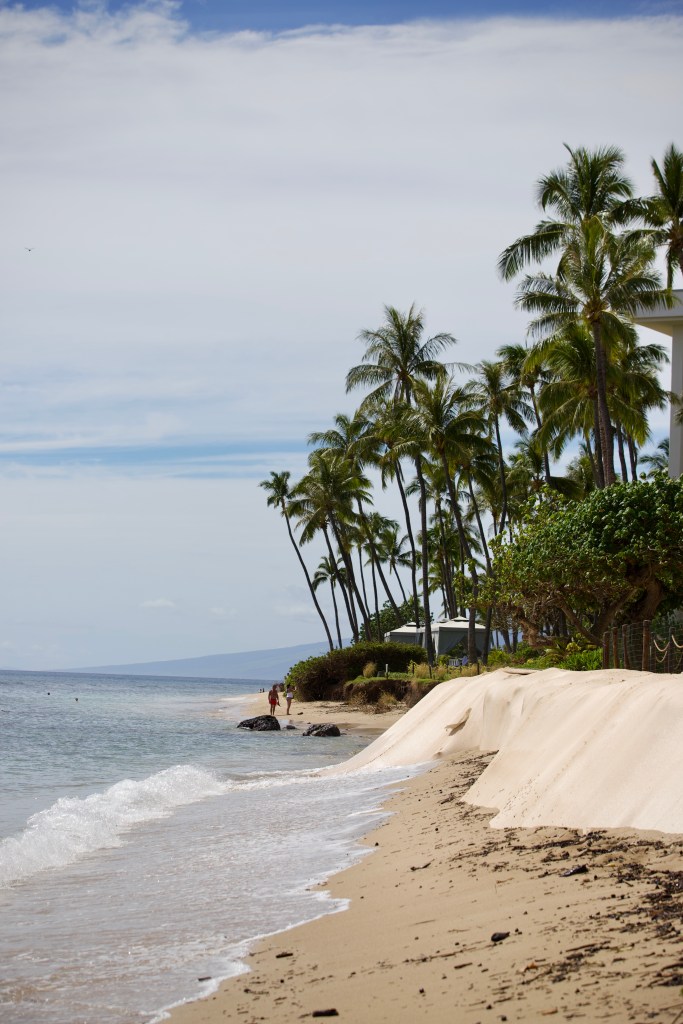
Residents’ concerns are valid, but the beach conditions where the plastic sheet would be placed are not comparable to those near the existing barrier just up the coast, said Chris Conger, vice president of Sea Engineering, the firm hired by Hyatt to handle the project. The beach along the years-old skirt is chronically narrow, and waves are constantly lapping against the bottom of the revetment, he said.
The new skirt would be farther from the water, on a beach that is known to vary in size and naturally replenish itself — or reinflate — following periods of erosion, Conger said.
“This event that we’re dealing with was one specific extreme event, and the beach is already starting the recovery process, which is what we expected,” he said. “If the beach recovers and continues to inflate, then four to six months from now, we see a healthy beach and we’ve got enough protection to take stuff out and go back to life as normal.”
On Friday, Conger and other Hyatt representatives met with local and state officials, environmental advocates and community members on the beach in front of the resort.
“We wanted everybody to see that conditions had definitely changed from right after the storm to when that site visit occurred, that there had already been significant beach inflation so the level of the emergency wasn’t what it was, and to ask DLNR to please reconsider,” Nishiki said.
Shortly after the meeting, Ryan Kanaka‘ole, acting chair of the Department of Land and Natural Resources, said he thought the conversation had gone well and that he was glad the parties were able to come together to discuss the issue.
Andrew Laurence, a DLNR spokesperson, provided a statement Tuesday that said state officials were expecting additional information from Hyatt representatives and had not made any further determinations.
Local officials from the Maui County Planning Department also attended the meeting on Friday to monitor discussions and note any potential impact the barrier might have on public shoreline access, said Collette Cardoza, an environmental planning supervisor with the department. Department representatives noted during the discussion that the project may require a special management area permit from the county in addition to the emergency permit from the state because, while the state has jurisdiction over the beach up to the highest wash of the waves, the county oversees the area farther inland where the skirt would likely be fastened.
Conger said he should have sought an SMA permit from the county sooner, and his team has started working on an application since discussing the situation with Cardoza last week.

Planning officials also informed Hyatt staff on Friday that wooden walls obstructing a beach entrance next to the affected beachwalk needed to be taken down to comply with laws guaranteeing public shoreline access, Cardoza said. The barriers have since been taken down.
A Dynamic Shoreline Environment
Kāʻanapali Beach — like many other beaches across Hawaiʻi — was ravaged by last month’s back-to-back Kona low storms. Raging floodwaters and violent waves dragged massive amounts of sand into the ocean, exposed utility lines and eroded away the earth beneath parts of the famed beachwalk that snakes between the beach and several resorts including the Hyatt.
“This moved a lot of sand offshore, and that left as much as a 4-foot drop from the beachwalk down to the beach, with significant undermining that threatened the stability of the beachwalk,” Conger said. “We saw an emergency that evolved out of this event.”
Viewing the project as necessary for public safety, Conger applied for an emergency permit on behalf of Hyatt’s leadership team to push sand under the beachwalk and install the skirt to protect the pathway until beach conditions improved.
“We were looking for a non-invasive way, or as non-invasive a way as possible, to stabilize that beachwalk,” Conger said.
In his March 21 letter to Conger authorizing the project, Kanaka‘ole said the department issues emergency permits “only in truly urgent circumstances” because they bypass public and environmental review, but state officials understood “the historic nature” of the March storms and the extent of the erosion damage.
“We also recognize that shorelines are dynamic environments, and that the shoreline in this area should naturally reinflate,” he said, explaining his rationale for approving a 6-month permit.

Lilley said she worried installing a skirt could impede the beach’s natural restoration process.
“We’re talking about installing a football field-length plastic skirt along hundreds of feet of really high-value public beach that’s already showing recovery,” she said. “It makes no sense.”
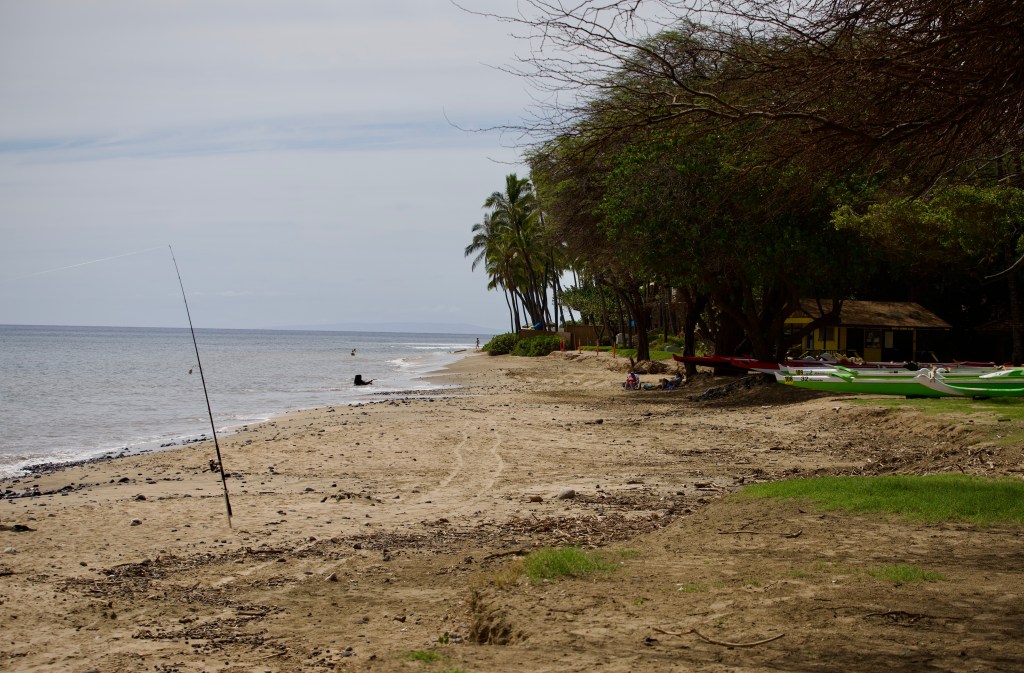
Pointing to research showing that certain shoreline hardening measures can increase erosion in nearby areas and leach microplastics into the environment, Lilley added that she feared the proposed barrier could potentially harm and eventually alter access to neighboring Hanakaʻōʻō, which serves as the home base for three local canoe clubs, the site of state paddling championships and a cherished community community gathering space.
“This is one of the most pivotal, high-value community spaces,” she said. “It’s just too much to risk.”
Conger said he was unfamiliar with any research linking revetments made from the permeable geotextile fabric that would be used for the proposed skirt to increase erosion.
“I have not seen it, and it doesn’t match any of the documentation that we’ve done,” he said.
The new skirt would also be further inland than the existing barrier and in an area rarely reached by waves, making it even less likely to contribute to increased erosion, he added.
A Wave Of Community Backlash
In the weeks since state officials approved the proposed erosion protection skirt, community members, the interim CEO of the Office of Hawaiian Affairs and elected officials including Maui County Council member Tamara Paltin and state Sen. Angus McKelvey contacted Kanaka‘ole to express their apprehension about the project and request that state officials reconsider their decision after taking public comments into account.
In one letter to Kanaka’ole, Kahana Canoe Club leadership said the organization has been forced to relocate multiple times due to erosion and reduced shoreline access over the course of its 50-year history.
“The impacts of shoreline management decisions are not abstract to us, they are lived and experienced,” the letter says.
For some people who grew up visiting Hanakaʻōʻō, it was painful to learn that a new plastic barrier could be built just north of what locals colloquially refer to as canoe beach, said Theresa Marzan, the president of the Nāpili Canoe Club.
“It’s a place where we don’t just go to the beach. It’s a place of cultural gathering for our people, for our community here in Lahaina and whoever else comes to the beach. It’s just a place of togetherness,” she said. “It’s something that we want to protect and pass forward to more generations to come.”
Lilley said Hyatt leadership’s response to recent storm damage was unnecessarily heavy-handed, and she hoped Friday’s meeting would ultimately lead to a more thoughtful, collaborative approach.
“We’re really hoping that the Hyatt has taken into consideration all of the community concerns that were brought up,” she said. “The outcome that we’re really hoping for is that the Hyatt goes back to the drawing board and comes back with something showing that they’ve really paused and reassessed the situation and are responding appropriately.”
Civil Beat’s coverage of climate change and the environment is supported by The Healy Foundation, the Marisla Fund of the Hawai‘i Community Foundation and the Frost Family Foundation.