Hawaiʻi County Is Taxing Homes Of The Rich, But Others Get A Break
Council chair flexes to keep a more aggressive proposal off the agenda.
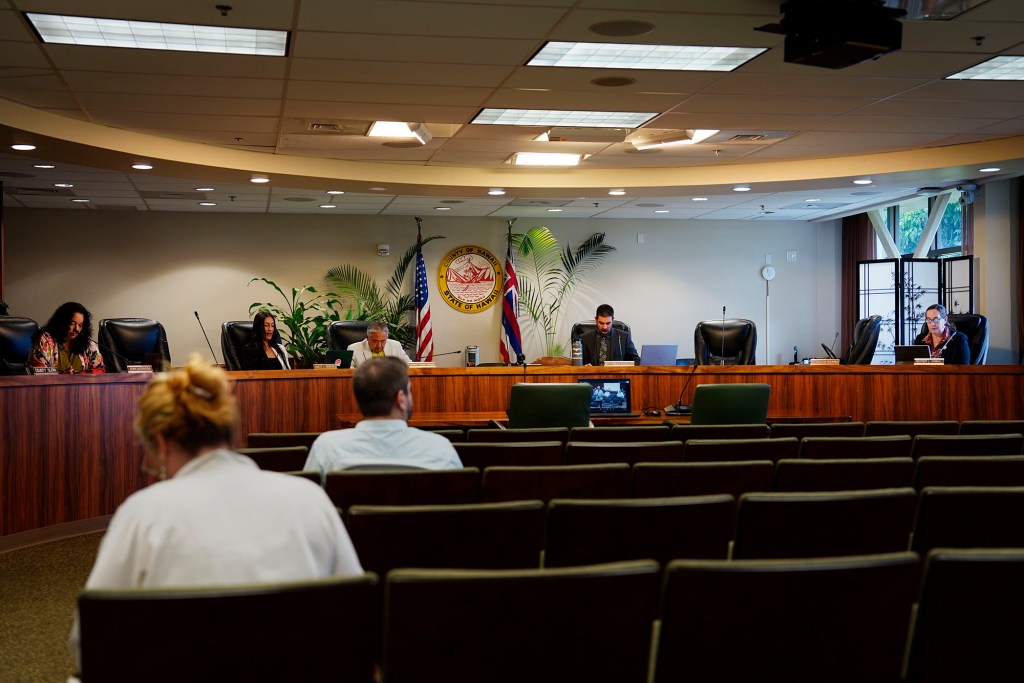
The Hawaiʻi County Council passed a progressive new property tax rate on Thursday as the county takes on significant debt to repair and replace its wastewater facilities and faces a budget shortfall of $15 million for 2028.
The resolution, introduced by Council Chair Holeka Inaba, lowers property taxes for homeowners and affordable housing, raises the rate for second homes and sets rates for two new tax classes — one for long-term rental housing and another for people who own second homes on Big Island worth more than $4 million. The new rates are projected to increase revenue by about $17 million.
The increase in revenue is sorely needed. The county’s debt services are projected to increase over the next 10 years, Finance Director Diane Nakagawa said at Thursday’s meeting.
The increase in debt is largely due to upgrades to the county’s derelict wastewater systems, which the county is required by the U.S Environmental Protection Agency to complete. Nakagawa added that the new tax rates would cover the $15 million shortfall.
The council also passed the first reading of the mayor’s $975 million operating and $375 million capital improvement budget. The budget will undergo one more reading by the council before its adopted.
Mayor Kimo Alameda submitted testimony in support of the new tax rates, saying they help protect local families and add needed revenue to support essential public services and facilities.
The county “faces rising operational costs and substantial wastewater infrastructure and regulatory obligations,” he wrote. “Adjusting rates for non-owner-occupied and investor-owned properties is a fair and balanced approach to help meet those needs.”
New Tax Classes
Inaba’s resolution also sets the rate for tier three residential properties, a class created by the council in March for second homes valued at more than $4 million, and the long-term rental class created by the council last year. Inaba notably was the only council member to vote against the measures to create the new classes.
The long-term rental class allows owners of second homes valued under $2 million to enter into the cheaper long-term rental rate if they rent that housing to residents for at least 180 days.
Council member Jennifer Kagiwada, who introduced the bills to create the new tax classes, says her intention was to open up more housing to residents as the county struggles to build new homes and faces a housing shortage.

“It would be a mistake not to use our real property taxation authority to incentivize the behaviors we want to see and disincentivize those that we don’t,” she said during Thursday’s meeting.
The county has already received over 800 applications to move into the long-term rental class, council member Michelle Galimba told the council. She said she expects more as word gets out about the program.
“This can be a very effective way to start incentivizing long-term rentals,” Galimba said. “There’s a number of people who want to help solve our housing issues and this (long-term rental class) is really helping people to make that decision.”
Kagiwada said creating a third tier in the residential class — which includes non-owner-occupied homes valued greater than $4 million — was also an attempt to create a tax rate that put residents first.
“It’s really a kind of a progressive tax strategy,” she said, “really trying to focus on our residents and their needs and their struggle with affordability here.”
People who testified at a public hearing on Tuesday for the new tax rates were largely in support of the tiered system. Jane Tellisford said as a senior and renter, she fears what may happen in her future as local residents are priced out of affordable housing.
“I support taxes being tiered to prioritize local homeowners and renters over nonresident high value investment developers and properties,” Tellisford said Tuesday. “Tax the rich, help the poor.”
The Grassroot Institute of Hawaiʻi’s policy analyst Jonathan Helton told the council that it supported the rate reductions for the homeowner and affordable rental classes, which could amount to $20 to $30 in savings on average for their annual tax bill. But the group was concerned that higher rates for the middle and upper residential tax classes could have the “unintended consequence of increasing costs for local renters” because thousands of those properties are likely long-term rentals and the cost could just get passed on to them.
Blocked Proposal
Inaba’s tax rate measure was the only proposal to be heard Thursday, but there were actually two new tax rate proposals. The other, introduced by Kagiwada, would have generated approximately $30 million for the county annually. But her resolution was missing from Thursday’s agenda.
Kagiwada told Civil Beat she was disappointed her proposal won’t be heard and felt that it had been blocked by Inaba. She attempted to discuss her rates during Thursday’s meeting but was stymied by other council members because her legislation was not on the agenda.

She introduced a motion to table Inaba’s resolution until hers could be heard but she only received one vote in support, from Galimba.
“I always think of our council as being kind of above using the little tricks and stuff to make policy,” she told Civil Beat. “Maybe some of that was at play at this time.”
Inaba told Civil Beat he denied Kagiwada’s request to push the deadline to decide on new tax rates because it would be “too confusing” for the council to take on two resolutions of similar nature at the same time. So he only approved a hearing for his own legislation.
The two proposals are mostly similar. Both would have lowered taxes for homeowners and affordable rental owners and raised it for second homes. The biggest difference is Inaba’s proposal doesn’t increase the tier one rate for second homes valued at under $2 million and for those in the apartment class.
Kagiwada’s proposal would have increased both and aligned the rates for tier one homes and apartments. She said based on how those homes are used, they should be taxed at the same rate.
“They basically are the same thing, except one’s a multifamily setting like a condo, and one is a standalone home,” she said.
Both could also apply to move into the long-term rental category. Without increases in the tax rate, she said, they are less incentivized to rent out to residents.
“If they’re not able to move into long-term rental or affordable rental, it’s because they are doing short-term vacation rentals or having a vacant home,” she said.
Inaba said he didn’t see increasing the tier one rate as a necessity with the new tier three class. He also noted that local families often own second homes in the tier one category.
Inaba said the $17 million that his proposal would raise will be enough to cover the looming deficit. Whether the council would pursue further tax hikes as the county takes on more debt, he said, is yet to be determined.
“Every individual has a budget that they live within. They don’t have the opportunity to just increase their own revenue or their income easily,” Inaba said. He added the county shouldn’t be treated any differently.
“Working within our means is something that I definitely emphasize and support when we’re talking about property tax rates,” he said.
Kagiwada said the county needs to look further ahead. Her rates would have given the county nearly double what Inaba’s will, and that’s critical as debt services increase over time.
“Some of the council members were just really focused on this next year and what the shortfall is,” Kagiwada said. “I was trying to get ahead of it.”