

High Housing Costs Force Hawaiʻi Residents Into ‘Impossible Choices’
The latest housing report from the University of Hawaiʻi notes some improvements in the market but authors say they are small and slow.
The first sentence of the 2026 Hawaiʻi Housing Factbook lands with a distressing thud familiar to readers of last year’s Factbook: “Hawai‘i residents face the highest housing costs in the nation.”
That and a lack of options confront residents with impossible choices, the latest report said, of “leaving the state, making do with substandard or overcrowded homes, or, in some cases, falling into homelessness.”
As in 2025, the latest Factbook said the state’s housing landscape faces enormous challenges with some signs the housing market is moving toward improved affordability.
Those improvements include home prices leveling off after climbing for the past decade. And for the second year running, more households can afford a mortgage on a median-priced home — currently nearly $2 million on Maui for a single-family home, $1.1 million for a single-family home on Oʻahu and Kauaʻi and $465,000 on Hawaiʻi island.

On Maui, Bill 9 – which passed in December and promises to phase out more than 6,000 short-term vacation rentals — has wide implications for both the economy and the housing market, the report said.
Though a UHERO analysis of Bill 9 found it could reduce tax revenue by $75 million, it also concluded that the phase-out could add more than 6,000 units to Maui’s long-term housing stock, ultimately bringing down condo prices.
Notably, last year’s Factbook cited opposition to Bill 9 as an example of how initiatives aimed at creating more housing can sometimes be discouraged.
The number of active vacation rentals statewide has continued to climb after declining during the Covid-19 pandemic, the report said, with approximately 34,500 advertised vacation rental properties statewide last year, up about 2,000 from 2024.
Most of the growth in those units was on Maui and Kauaʻi. Vacation rentals were 20% of the Garden Isle’s total housing stock, compared to 15% on Maui, 9% on Hawaiʻi and 2.5% in Honolulu, where they are restricted to resort areas.
Demand And Supply
The state’s housing challenges come down to demand for housing far outstripping supply, and the report said the primary solution is to build more of it. It suggests that can be a matter of political and public will, noting: “If demand for housing continues to outpace our ability and willingness to build, high prices and unattainable housing will persist.”
Also central to the 2026 report’s findings is that any “improvements have been small and slow,” said Justin Tyndall, an associate professor of economics at the University of Hawaiʻi Mānoa and one of the report’s authors.
“We live in a housing market that’s incredibly unaffordable for the vast majority of people, and we haven’t made a lot of progress in building housing,” he said.
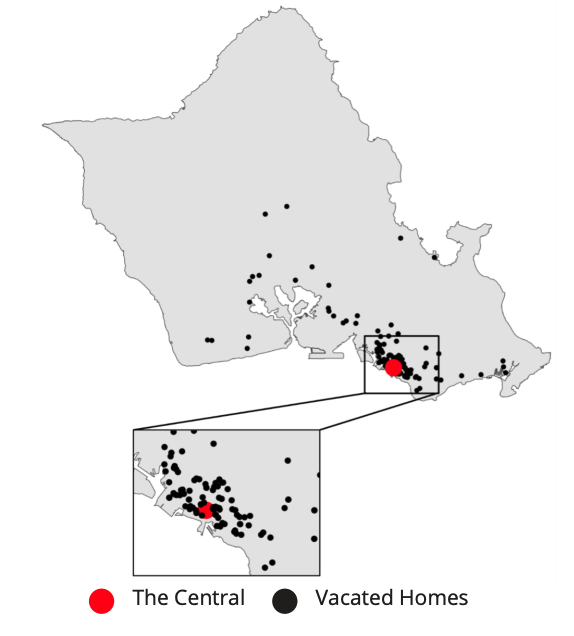
The report highlights another UHERO study, which found that the construction of a 512-unit mixed-income condominium tower in Kakaʻako, The Central, started a chain reaction that led to more than 500 other units on O‘ahu becoming vacant. Those units were 40% more affordable than The Central’s, the report found, and of the people who moved into the tower and the other units that became vacant, 88% were already Hawaiʻi residents.
“When a local family moves into a newly constructed unit, they typically vacate their old home, freeing it up for someone else,” the authors wrote. “When a new family moves into that vacancy, they in turn vacate their prior home, and so on.”
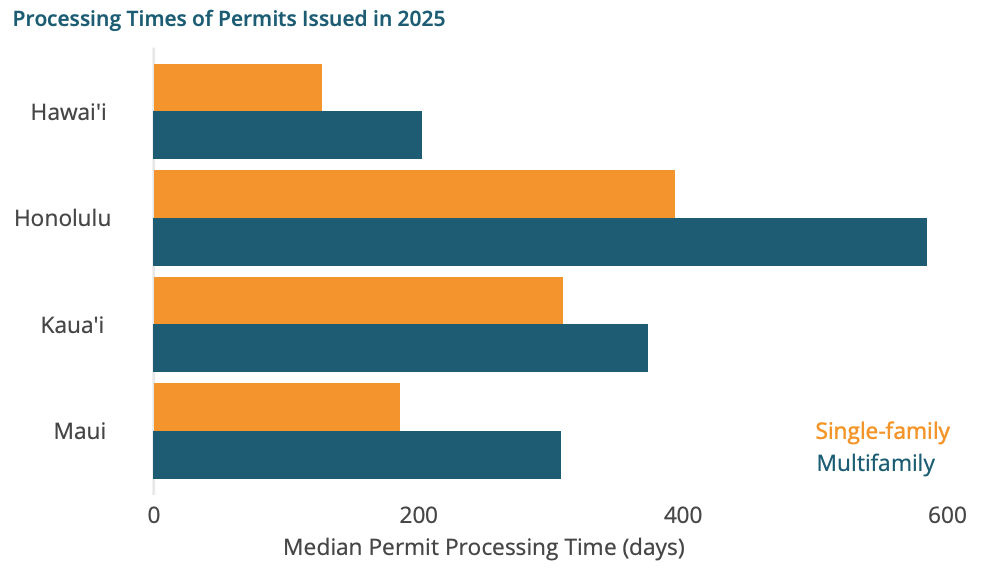
As in past Factbooks, the authors noted that regulatory barriers are a major obstacle to new housing development. In Honolulu over the first half of 2025, median processing times for new permits were 394 days for single-family homes and nearly two years for multi-family projects.
That was before the department put a tech upgrade into place meant to speed the turnaround time for permits. Initially, the number of permits issued actually slowed, which officials said was due to adjusting to the new system. In December, the department had to close its front counter services for a week to process a backlog of permits, though it continued to accept applications.
Current data on the department’s permit processing times was not immediately available.
Hawaiʻi County recorded the fastest permit processing times for single-family homes, a median of 127 days in 2025, down 27% from the year before.
Among Nation’s Highest Fees
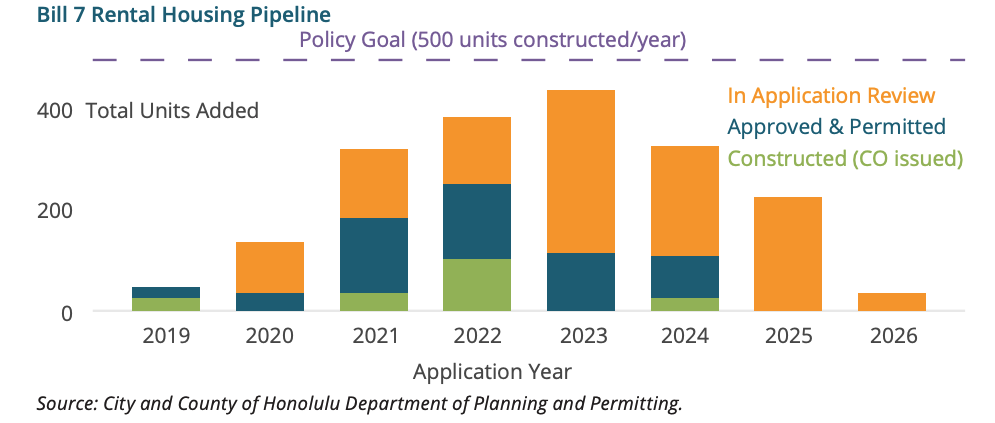
The report pointed out that a Honolulu program to create affordable rental housing known as Bill 7 has succeeded to some extent, but that production has slowed as interest rates rise, developers face difficulties securing land and financing, permitting delays persist, and neighbors oppose some projects.
While the program, launched in 2019, has created 189 units, with another 550 under construction, the report said it has fallen far short of the 500 new units annually envisioned. It is due to expire in 2030.
The highest median rent in the state was in Honolulu, at $2,083, while Hawai’i County had the lowest at $1,510. The top three most expensive zip codes for renters were all on Oʻahu, in Hawai’i Kai, Kailua and Salt Lake, at, respectively, $3,501, $3,316 and $3,190.
The report found that 57% of renters in the state are rent burdened, meaning more than 30% of their income goes to rent. Slightly more than a quarter of renters pay more than half their income toward rent.
New census data also “confirms what many have suspected,” the report said: Homeowner association fees are more common in Hawaiʻi and those fees are among the nation’s highest.
In Hawaiʻi, among all owner-occupied housing units, 42% of homeowners pay HOA fees, compared to 25% nationwide. And Hawaiʻi ranks behind only New York State in median monthly fees, which clock in at $470 here.
However, homes for sale often advertise much higher fees, the report noted. For instance: an analysis of O’ahu real estate listings in February 2026 found the median listing had an advertised fee of $882.
There are other headwinds, too, the report noted.
The Iran war has pushed interest rates back up, making mortgages less affordable. Rising rates make it more costly for developers to borrow money, making it more expensive to build housing projects, “which could discourage new development.”

Civil Beat’s reporting on economic inequality is supported by the Hawaiʻi Community Foundation as part of its work to build equity for all through the CHANGE Framework; and by the Cooke Foundation.
“Data Dive” is supported in part by the Will J. Reid Foundation.

