Maui’s Speed Bump Bonanza Is Driving Some Locals Crazy
The county has installed dozens of traffic-calming devices to improve public safety. Some residents say it has gone too far.
The Kula 200 neighborhood, a quiet Pukalani community that borders Kula and Makawao, has for years been an ideal location for Cliff Hauser and his wife. It offers a peaceful and temperate Upcountry climate and is not too far from Haʻikū, where the couple likes to eat out, hit the gym and visit their son.
They have always driven over a few speed humps on their route to Haʻikū, but they’ve recently noticed an explosion in the number they encounter every day.
“Of course, safety comes first,” Hauser said, particularly near schools or in areas with a lot of pedestrians. “But I think that they’re just so overdone now, and it’s getting to the point where you’re driving down the street and looking more for the speed bumps than you are for people on either side. It’s getting a little crazy.”
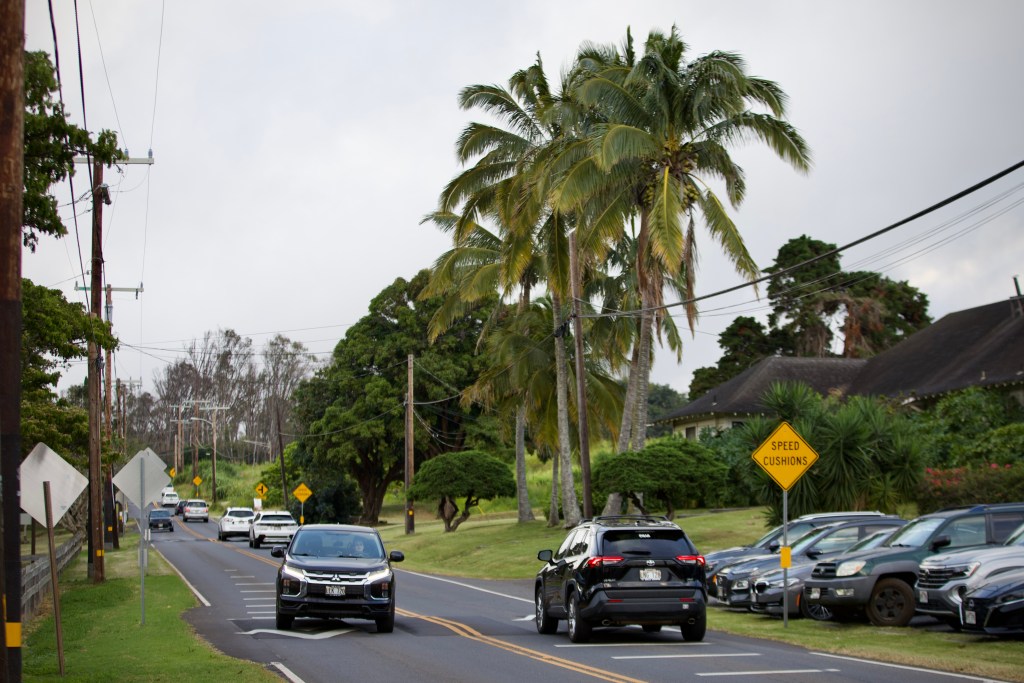
In the past year, county workers have installed at least 69 traffic-calming devices — including speed humps, speed bumps, speed cushions and speed tables — on county roads across Maui, public records show. Nearly half of those were in Haʻikū, where there are now at least 37 speed humps on main throughroads connecting the community to other parts of the island. Another 10 traffic-calming devices were installed on nearby Haliʻimaile Road, and 28 were installed on streets in Kahului, Kīhei, Wailuku, Kahana, Kula and ʻUlupalakua.
Several Maui residents told Civil Beat that they have been growing increasingly frustrated with the relatively sudden increase in traffic-calming devices across the island. The issue has become especially heated in Haʻikū, where residents’ concerns recently prompted Mayor Richard Bissen to announce a temporary pause on plans to design and construct new traffic-calming devices on county roads in the community.
“While the intent of these traffic-calming measures was to improve safety, we recognize that the recent installations have also created challenges for some residents,” Bissen said in a press release last month. “This is exactly why it’s important that we listen, reassess and adjust when needed.”
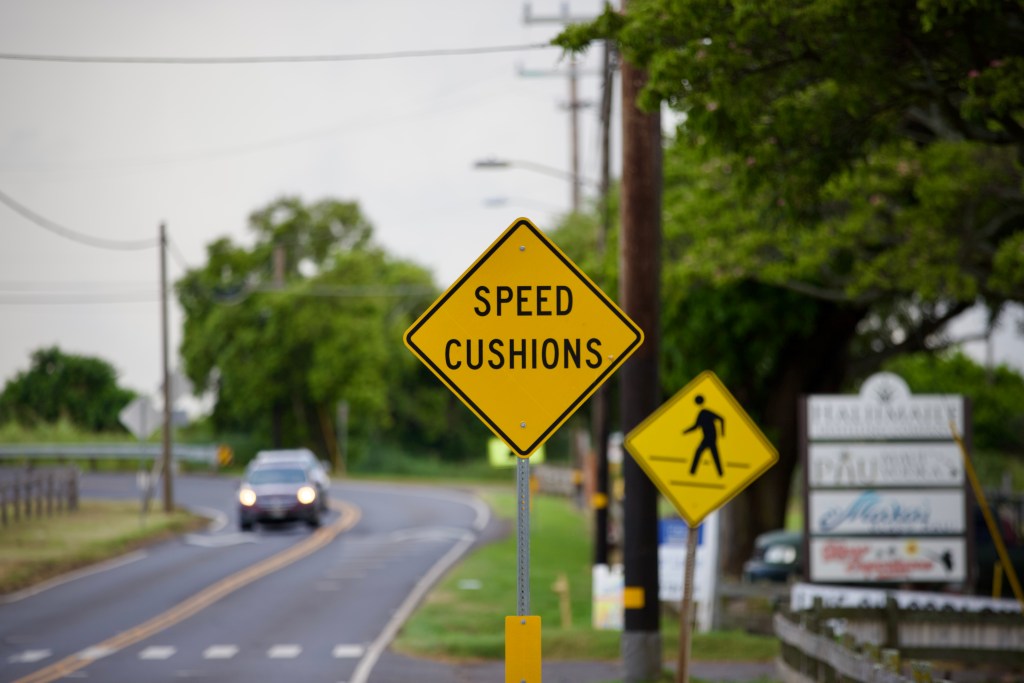
Speed humps, speed bumps, speed cushions and speed tables are all raised areas of the roadway intended to reduce or manage the speed of vehicles driving through the area — differentiated by their design and impact on vehicles.
Speed humps are generally more gradual than speed bumps, typically allowing drivers to pass over them at about 20 mph, according to the Institute of Transportation Engineers. A speed bump, on the other hand, is much more rigid and abrupt, usually forcing drivers to reduce their speed to 5 mph or less. Speed tables are essentially flat-topped speed humps, and speed cushions are speed tables that have wheel cutouts that allow certain emergency vehicles like ambulances and fire trucks to pass through the area without significantly reducing their speed and response time, according to the U.S. Federal Highway Administration.
Slowing Things Down
Despite the recent outcry, some community members said they have wanted to see traffic-calming measures in their neighborhoods for years, and that their communities are safer since new speed humps have been installed.
Tracy Stice said some residents have pushed to get speed bumps installed on Ulumalu Road and in other areas in Haʻikū for more than a decade.
“It’s just an extremely dangerous road,” he said, pointing to fatal crashes over the years. “I can’t tell you how many times as I’ve been trying to get in and out of my driveway, or going into the street to get my mail or take my trash cans in and out, I’ve had people scream by me at 50 miles per hour in a 20 miles per hour zone.”
There are now seven speed bumps on Ulumalu Road, according to Stice.

Dean Stelow, who drives from Kīhei to Haʻikū almost daily to visit his grandchildren, said most of the new speed humps appear to be well-thought-out. Some are more abrupt than others, but in general, Stelow said he wasn’t bothered by them.
“These new speed bumps I think are really nice for slowing things down, but not too much to the point where you just spill your coffee all the time,” he said. “I do think safety has increased in Haliʻimaile and Haʻikū, specifically.”
Frequently, speed humps and tables are initiated by residents concerned about speeding in their neighborhoods, according to the county’s April press release. The Department of Public Works investigates requests by installing temporary traffic-counting devices to determine if traffic and speed data show that new traffic-calming measures are warranted, and then begins planning and designing new speed humps.
Maui County had 13 traffic fatalities in 2025, records show, the same year O‘ahu had a spate of deadly crashes that led to Gov. Josh Green issuing an executive order to increase safety.
According to the county’s official procedures for installing speed humps, requests for a new speed hump on a minor street should not be considered “unless 80% of the property owners are in favor of the installation,” and location plans should be reviewed by the neighborhood and emergency services. A minor street is typically defined as no more than 24 feet wide and as one that provides direct lot access, offers the lowest level of mobility, and generally does not serve through-traffic.
Many community members feel like they have been left out of conversations about new speed humps, according to Gregg Blue and Jonathan Lane, critics of the new speed humps in Haʻikū.
“When speed bumps are getting installed, residents are not getting proper notification on the location of speed bumps, and they’re not getting proper notification on when they’re going to be put in and how long that’s going to take,” Lane said, adding that the issue is particularly egregious in neighborhoods where multiple speed bumps have been added in relatively quick succession. “That’s been stated several times in the Haʻikū community.”
Blue said he encounters 42 speed bumps every time he makes the roughly 10-minute drive to Makawao from his home in Haʻikū. Many of them are poorly constructed and unusually jarring to travel over, he said, and several are already deteriorating.
“Every 30 seconds I’ve got to stop,” he said. “I’ve already counted 78 speed bumps in Haʻikū. I mean, they’re out of control. They didn’t realize what they were doing. They didn’t realize the unintended consequences, and now it’s a mess.”
Lane said he and others in the community were also concerned that the new humps could negatively affect emergency response times because fire engines and ambulances must significantly reduce their speed to travel over each hump. According to studies cited by the Federal Highway Administration, emergency vehicles are delayed anywhere between 1 and 10 seconds per speed hump.
“I have direct letters from fire response drivers, fire apparatus drivers, stating that they have to slow down much below normal speed levels, and it causes a direct delay in emergency services response time, and that emergency services are taking alternative routes to avoid the speed bumps, and those alternative routes tend to be longer,” he said.
The Haliʻimaile speed cushions were installed earlier this year by Maui Kupono Builders, also known as Manu Builders, as part of a $343,847 contract awarded by the Department of Public Works.
Maui Kupono Builders was also paid $656,775 to install dozens of other speed humps across the island as part of a nearly $2 million roadway safety improvement project that was approved by the previous administration and council in the fiscal year 2022 budget. The company has been paid tens of millions of dollars in recent years for various other paving and resurfacing projects, but it is unclear how many of those projects included the construction of new traffic-calming devices.
A person who answered the phone for Maui Kupono Builders on Monday afternoon said he was unable to speak with media.
County officials are scheduled to attend a Haʻikū Community Association meeting on May 27 to continue the discussion on traffic-calming devices and determine next steps.