‘Slush Fund’? Honolulu Council Wants Control Of $41 Million
The provisional account would be used for covering disaster relief and routine operations.
The Honolulu City Council already controls the purse strings for the $5 billion city budget, but now key members of the council want greater control over a $41 million slice of the pie.
Council Chair Tommy Waters and Budget Chair Val Okimoto are proposing the formation of a new fund through which the city administration would have to ask the council’s permission to spend money.
The proposed Provision for Operations and Emergency Recovery could be used for emergency purposes like responding to the recent Kona low storms, they said, but also regular operating expenses as departments brace for a tight upcoming fiscal year.
Waters and Okimoto say the fund would promote transparency by making these council-controlled expenditures the subject of public hearings. But Mike Formby, the city’s managing director, told council members last week the new structure would gum up city operations, which he called “unacceptable.”
“You have put us in a position where we will be coming back to council for essential, existing government operations,” he said at a council meeting last Friday.

The money for the fund would come from existing city resources dedicated to lawsuit settlement payouts, adjusting salaries, supplementing fuel costs and preparing and responding to disasters. These pots of money would be brought under the council’s control.
The administration would access this money through council-initiated resolutions that would have public hearings to authorize the funding transfers.
Transparency Or ‘Slush Fund’?
Each side professes wanting to improve transparency in a tight budget year. Departments lapse and reallocate millions of dollars every year toward other expenses, Okimoto and Waters said, and the new provision ensures city departments ask the council’s permission to do so through public hearings.
Budget director Andy Kawano said this information is already public through quarterly reports made to the council.
“So they have all of that information already,” he said.
Waters shot back in a written statement to Civil Beat. He said the proposed provisional account means members of the public can testify upfront on decisions about funding transfers.
“The current reporting structure is largely after-the-fact,” Waters said. “It tells people and the council what happened once the decision has already been made.”
He also stressed that the new pot of money would be a provisional account, which is legally different from a fund when it comes to the city’s budget.
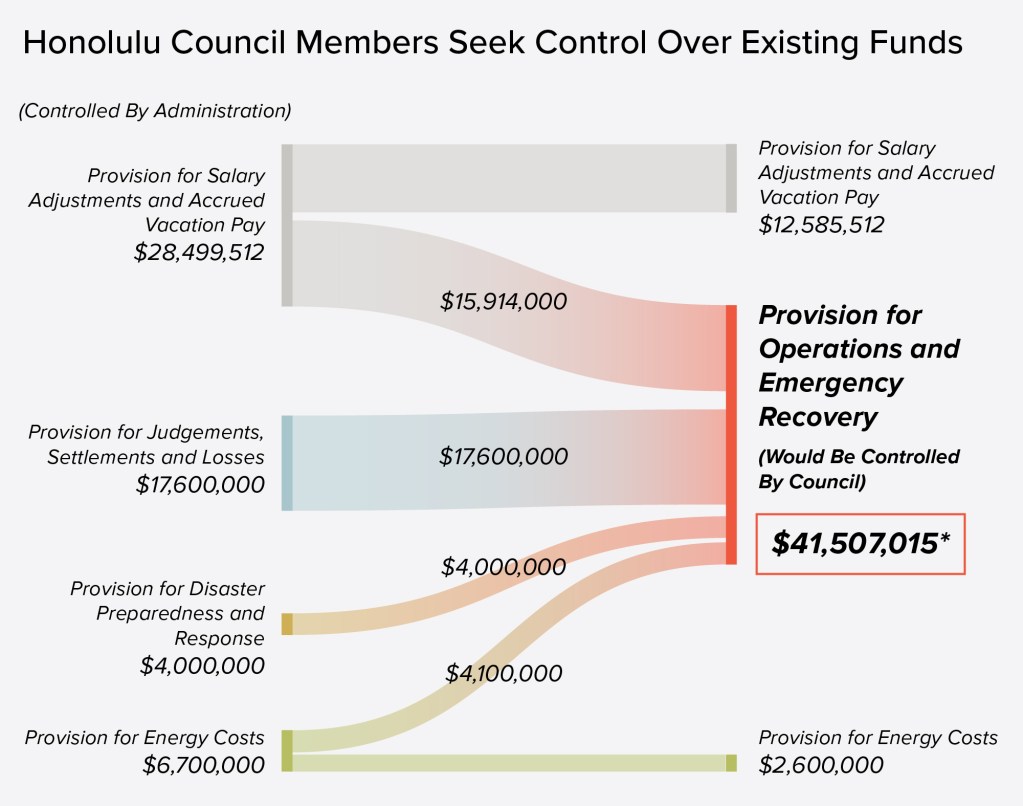
Kawano said the council’s idea of putting money previously designated for different purposes into one big pot is worse for transparency, not better. He also said it’s possible that rising costs of fuel and collective bargaining agreements would take most of the money out of the provision, for example, leaving little left for lawsuit settlements.
Hypothetically, Kawano said, the administration’s ability to respond to an oncoming hurricane could be hampered by the money being locked up by the council. Rather than being able to quickly spend money on preparation, he said, the administration would need to go through a lengthier public hearing process that requires that an agenda be posted at least six days before a meeting.
At the meeting, Council Member Tyler Dos Santos-Tam called the proposed provision a “slush fund.”
Debate over whether department expenses are worthwhile is usually settled during the annual budget process. With the new provision, Dos Santos-Tam said, departments would be more incentivized to cater to the nine council members throughout the year to secure needed money rather than carrying out the administration’s own projects.

“If this is going to be a fund that the council deigns to give out based on whether we like a certain expenditure or not,” he said in an interview, “it certainly seems very slushy.”
Waters and Okimoto disputed that characterization. A slush fund implies money can be spent without oversight, Okimoto said. This would require more oversight, not less.
Formby said the provision would violate the separation of powers laid out in the City Charter, which gives the administration the power to spend budgeted money without additional permission from the council.
Power Struggle Over Budget
Colin Moore, a political science professor at the University of Hawaiʻi Mānoa, said it is the nature of councils and administrations to wrestle over control of the budget.
“I don’t think it’s some kind of separation of powers crisis,” he said, “but I think Formby has a point.”
Budget chairs have switched out almost yearly under Waters’ leadership, as he uplifts and grooms members of his shifting faction by placing them in this position of power. By creating this provision, Moore said, it yanks more of the power back to the council while still allowing Waters to use the position to politically reward his members.
“If you think of who is ultimately the winner in this,” he said, “seems like it is the Council chair.”
Waters did not respond to a request for comment about his shifting budget chairs.
In a way, Moore said, the provision’s control over emergency response money makes for good optics when situations such as the devastating Kona low storms.
“If this fund makes it look like the council is more directly involved or coming to the rescue of the administration,” he said, “that’s a good look for them.”

Council member Matt Weyer, whose North Shore constituency bore the brunt of the storms, opposes the provision’s creation. He said if his colleagues cared about disaster recovery, they wouldn’t be trying to cut positions from the Office of Economic Revitalization as it assists with the North Shore’s recovery.
Okimoto, however, said that office has strayed from its mission of helping economic development, pointing to an audit from January that said it hadn’t achieved some of its goals.
During the council hearing, Formby said that the mayor wanted to avoid any kind of veto to this year’s budget, which is up for a final vote on June 3. Asked if the mayor would veto this provision, spokesperson Ian Scheuring said that he reserves the right to line-item veto specific provisions in the budget bill.
Waters and Okimoto said the proposed provision could be a temporary measure for no more than a few years and emphasized that its mission is to ensure more oversight.
“This fund is really designed for us to be more transparent,” Okimoto said. “It really is. And I wouldn’t be saying that if I didn’t believe this.”
CORRECTION: A previous version of this story included an incorrect date for the final vote on the budget.