Student-Run Stock Portfolio Could Fund Scholarships
University of Hawai‘i students were given a $1,000 donation in 1978 and told to invest it. The returns — in student experience and real-world stock holdings — have been significant.
Students in a finance club at the University of Hawai‘i Mānoa logged into the club’s investment account in January and saw something remarkable: Their holdings were worth more than $100,000 — a hundredfold increase since the portfolio began with a donation more than 40 years ago.
Kaui Keaunui, the club’s current portfolio manager, was in awe when he saw the six-figure milestone.
“I was sitting at my desk when I saw it — I actually had to do a double take,” Keaunui said. “That 100 times growth is incredible. It’s not just my work, it’s every student who contributed ideas over the years.”
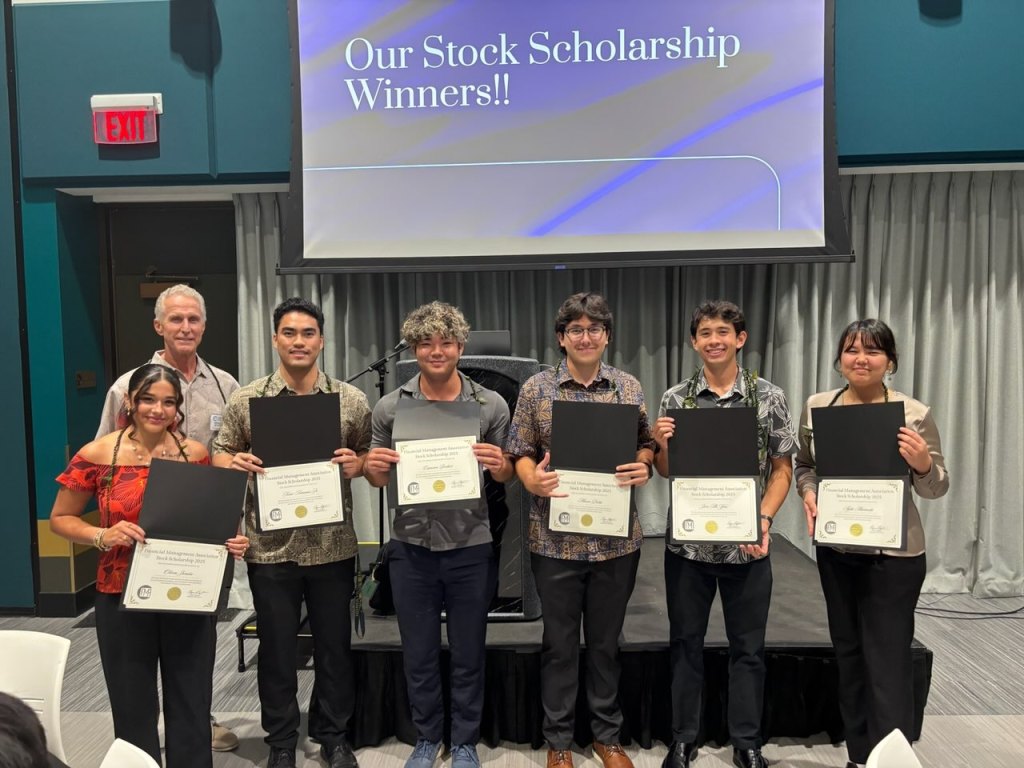
The account is a teaching tool first, and an investment tool second, faculty advisor Benjamin Bystrom said. But there is real money on the line. The Financial Management Association at UH Mānoa, the finance club, plans to use investment gains to fund scholarships for UH students studying finance.

The portfolio is almost entirely managed by UH students, who pitch investment strategies in the hopes of growing the portfolio over time. The program’s success goes beyond profits: Wall Street analysts and local bank executives are among UH finance alumni.
They’ve seen their share of losses, but Bystrom says that is part of the education.
“It’s important for students to see that investing is about understanding risk, research, and patience rather than making money,” he said.

Keaunui said the $100,000 milestone was never an explicit target. The club sees constant turnover as students come and go, each bringing their own priorities and ideas for the growing portfolio.
Managing the portfolio, Keaunui said, has taught him that investing isn’t just about chasing big gains, but about patient decisions and research.
“Money does talk,” he said. “But real wealth whispers.”
Taking Stock
The fund began in 1978 with a donation from an executive at Castle & Cooke, one of the “Big Five” companies that controlled Hawai‘i’s business and political landscape for decades. Then-company President Henry Clark gave $1,000 to UH finance students in the hopes it could jumpstart a new generation of executives steeped in the high-stakes world of corporate finance.
Clark envisioned the fund as a way for students to invest in local companies. In the early years of the portfolio, more than half of its holdings were in locally based stocks.
That focus on local companies and higher trading costs at the time didn’t yield large gains, Bystrom said. For its first three decades, the portfolio grew slowly, reaching just over $10,000 by 2009, an average annual return of 7.97%.
The focus on local companies became harder to sustain as many Hawaiʻi-based firms went private, taking their stocks off the market.
Today, Hawaiian Electric Industries. remains the portfolio’s only local holding, while the club has expanded into foreign and S&P 500 companies such as Apple Inc., Google, and Costco Wholesale Corp.

Those changes since 2009 have led to much larger growth in the portfolio. Since then, the portfolio has posted an average annualized return of 14.45%, nearly double the anticipated annualized returns for the state’s pension system of around 7.7%
As of Feb. 17, 2026, the portfolio was valued at $106,868.60. Much of that growth in the last 17 years was due to high returns from investments in companies like semiconductor manufacturer KLA Corp., manufacturing company Deere & Co., and VISA Inc.
In the last three years, growth has also been driven by high demand for semiconductors and other tech required for generative artificial intelligence programs.
Bystrom said the goal is not just to grow the fund, but to expand its impact. In recent years, he’s personally funded $1,000 scholarships for students who made successful pitches, allowing them to start their own portfolios. The finance club aims to use the portfolio returns to fund the scholarships in the future.
“It expands the impact,” he said. “You start with $1,000, grow it to $100,000, and then branch off. Those accounts can grow over time too.”
Real Stakes
The club’s student board and roughly 30 students gather in a classroom at UH Mānoa about four times per semester to present stock ideas. The group walks through financial models and potential risks. Other members challenge those ideas before the group votes.
Individual students research stocks on their own, utilizing company data and projections to present a case for why a stock should be bought or sold, and in what quantity.
Students discuss company news and management, stock value and projections before the group as a whole votes on whether to move forward.
The process is designed to mirror real-world investment decision making.
But there are guardrails. The portfolio focuses primarily on buying and selling shares in companies and generally avoids stock options — which can carry a higher risk — and highly volatile cryptocurrency. There are also informal restrictions on industries such as tobacco and gaming.
While students drive the decisions, Bystrom maintains oversight. He can adjust the size of investments or step in if a proposal poses excessive risk, though he said that has never been necessary since he became the club’s adviser in 2009.
If they’re wrong, the consequences are real.
“The actual stakes is that FMA loses money and becomes poor,” Bystrom said.
Real Money
For many students, the experience extends far beyond the classroom.
Kyle Bischoff, now a vice president at Bank of Hawaiʻi, said in a written statement that joining the club’s Investment Committee helped shape his career path after graduating in 2014.
“This is where class lessons meet real stakes with real money on the line,” Bischoff said.
He said pitching stocks and serving on the committee helped him develop both technical skills and confidence, ultimately leading to his first job as a commercial banking analyst. Bischoff said participation in the club helped him land his first job out of college. Bystrom also recommended him for the role.
“That’s the best return on investment I could have asked for,” Bischoff said.
Johnathan Fung, who helped manage the portfolio from 2010 to 2012, recalled weekly meetings where students debated ideas in small groups.

“We didn’t know what we didn’t know, ” Fung wrote in an email, adding that his colleagues had to be quick on their feet when presented with new information.
After graduating from UH, Fung worked at Deloitte, attended the University of Chicago Booth School of Business and now works in investment banking at Evercore in New York. Fung’s experience at UH helped build the foundation for his career.
“We probably made more intellectual mistakes than good investments,” he wrote. “But we did our best with real money on the line.”
Fung recalled a trip to San Francisco where UH competed in a global equity research competition.
Among the team’s pitches were investments in a Chinese solar panel manufacturer and the electronics company known at the time as KLA-Tencor.
Looking back, the KLA stock pick didn’t turn out as planned. It took years for the stock to reach their target, but the experience taught patience, research, and collaboration.
“It showed me how real-world investing often unfolds differently than expected,” Fung said. “It wasn’t a great pick and our thesis didn’t play out. We had a laugh about it years later when the stock finally crawled up to our target price.”
That’s part of the ups and downs with the portfolio.
The club eventually sold its stock in the solar manufacturer before the company went bankrupt. But the KLA investment, which was a slow grower, is now one of the club’s standout performers.