

Charity Program for Housing Homeless People Broke Promises, Landlord Says
Small landlord now has doubts about renting to tenants from housing assistance programs; tenant says his story is off base.
It wasn’t the first time landlord Bradford Yamamoto had rented his Nānākuli condo to someone whose rent was paid through government or nonprofit housing programs such as Section 8 vouchers.
For years, in fact, since not long after he first bought the two-bedroom, one-bathroom unit in 1998 — the only rental property he owns — he had sought out such tenants.
Not for only altruistic reasons: It was good to have the rent guaranteed. And if it came to having to evict someone, he said, the programs were easier to deal with and the proceedings less likely to end up in court.
But he also wanted to help.

Having lived for years near Sheridan Street in Honolulu, Yamamoto was used to seeing — and troubled by — people who were homeless crowding the sidewalks and wandering the streets, sheltering in bushes, in yards and in cars packed with belongings.
“That’s what also put me in the mindset that, you know, if I offer my property to these homeless people, then I’m helping the situation,” said Yamamoto, 67, who was born and raised on Oʻahu.
Still, he vetted prospective tenants from housing subsidy programs more carefully, doing multiple interviews and background checks. And for the most part, such arrangements had gone well.
Then he ended up in a dispute that has Yamamoto wondering whether he can stick with his good intentions: A tenant referred to him by a Catholic Charities housing program caused thousands of dollars damage, he said, and the nonprofit has refused to compensate him what he thinks is fair.
“I just wanted to help,” Yamamoto said.
The tenant, who was eventually evicted by the building’s homeowners association, mostly disputed Yamamoto’s version of events, saying the apartment was in poor condition when she moved in.
“He better rethink his evaluation of things,” said the former tenant, Marquita Pimental.
Catholic Charities acknowledged in a statement that damage was done to the apartment during Pimental’s tenancy but said they couldn’t agree with Yamamoto on how much and that they did what they could to resolve the disagreement.
Being Convinced
In 2022, after a Section 8 tenant moved out, Yamamoto advertised the Nānākuli condo for rent. He received a call from Garrett Koshiba, a staffer with a housing program run by the nonprofit social services agency Catholic Charities for chronically homeless individuals and families.
Koshiba, who did not respond to Civil Beat’s requests for comment, asked Yamamoto if he would consider renting the apartment to a Catholic Charities program client, Pimental, and her mother.
Pimental had no credit rating and a spotty rental history, but she was pleasant and, he said, Koshiba did a good job persuading him to take her in.
“He basically convinced me that she’s a good tenant. You know, nice and quiet, and he assured me that they’re going to be good tenants,” he said.
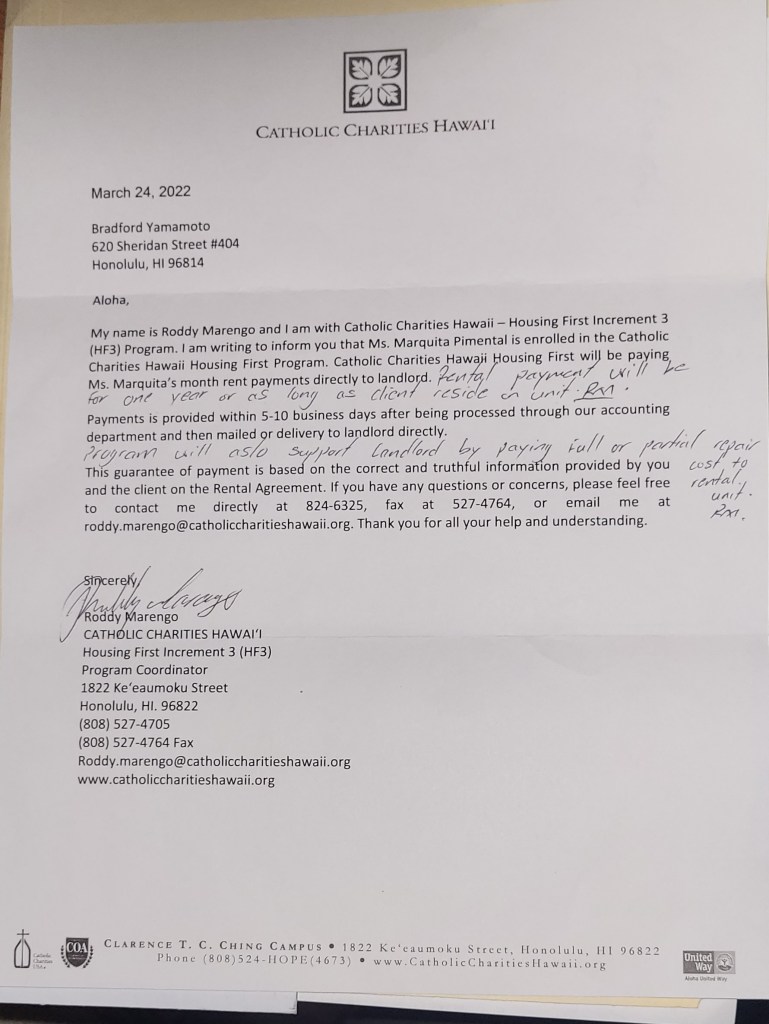
Mindful of a previous tenant who had damaged the apartment, Yamamoto pressed Koshiba for assurances that Catholic Charities would compensate him if that happened again. The agency added language — in a handwritten sentence — to a letter about the rental agreement, saying it would “support landlord by paying full or partial repair cost to rental unit.”
Koshiba said the agency’s staff would check in weekly with the tenant in addition to paying her monthly visits, as required by the program’s rules, to make sure everything was going smoothly.
That was good enough for Yamamoto, and in March 2022, Pimental moved in. She says the apartment was not in the best shape but she was grateful for the opportunity the housing program offered her.
“Catholic Charities is amazing,” she said, “Got me through life when it was hard.”
Yamamoto says problems began soon after. He and Pimental had a dispute over who was to pay the electric bill. And complaints from the condominium owners’ association piled up, documented in text and email exchanges and legal correspondence between Yamamoto, Pimental, building management and their attorneys.

The new tenant left garbage in the hallway outside her third-floor apartment, HOA directors said. She parked incorrectly, taking up other residents’ spaces or blocking them in. Blasted music from inside her unit. Invited friends over and disturbed neighbors. Her dog allegedly caused a disturbance, too, running around and scratching at the floor.
“It was just so constant, you know, we would enforce the rules. You think she was complying, but then they would violate the same rules over and over again,” Mark Aki, the onsite building manager, told Civil Beat.
With each new complaint, Yamamoto would ask Pimental to make things right and also ask Catholic Charities for help. At least twice he threatened eviction, Yamamoto said. Each time, Koshiba persuaded him that the agency would work with her to fix the problems.
Eviction. Then It Got Worse
Ultimately, the HOA acted, evicting Pimental in August 2024. That’s when Yamamoto said his problems came into full focus: Inside, he found the apartment trashed.
He said Pimental’s dog had scratched a hole in a bedroom floor that extended to the downstairs neighbor’s ceiling, and Pimental acknowledged in an email to Civil Beat that her dog damaged the floor.
Photographs provided by Yamamoto show ripped up carpets and flooring, water damage in the bathroom, missing closet doors, a hole in a wall — conditions far removed from the apartment’s appearance in photographs Yamamoto emailed to Koshiba and Pimental in March 2022, before she moved in. In that email, Yamamoto noted that Pimental’s father would be doing final touch-ups with some minor painting.
While insurance covered the water damage and carpeting, a contractor estimated the remaining repairs would cost just shy of $17,000, according to a scope of work order. Completing the repairs took two months, during which Yamamoto lost two months of rent, he said, nearly $4,000. The HOA fines reached about $9,000, with Yamamoto liable for them because he owns the unit.

Months of negotiations over what he said was a total loss of about $30,000 followed.
Yamamoto reminded Koshiba of the letter in which Catholic Charities said it would pay partial or full costs toward repairs. “The minimum I will accept is 50% of my itemized estimate submitted to you,” he said in an email exchange with Koshiba.
Half would have been $8,400. Koshiba offered $3,700.
“We know it’s a small percentage to the overall repair bill, but this is what we can provide to support with the turnover for the unit,” Koshiba wrote.
Yamamoto declined the offer, adding that had the agency made the promised regular visits, none of it would have happened.
Case workers had called weekly and visited monthly, Koshiba replied, and “with the visits and phone calls that we provided … the discussions regarding her violations and fines were conducted and noted on her case file.”
In the email, Koshiba also said: “Our program emphasizes support for clients but also holding them accountable for their decisions and what consequences follow. Marquita will have to be held accountable as well for costs of the damages and fines accrued during her tenancy with your property. “
A June 2025 mediation went nowhere, Yamamoto said, because Catholic Charities’ representatives were not authorized to negotiate, which Catholic Charities disputed in its statement to Civil Beat. The executive director of Mediation Center of the Pacific, Tracey Wiltgen, confirmed the session took place but said she could not comment further on it because of client privacy rules.
Dispute Over Unit Condition
Pimental dismissed Yamamoto’s account of events, saying the apartment was damaged, dirty and missing kitchen cabinets when she moved in.
“I don’t know what damages he is claiming but he lost so he should get over it,” she wrote to Civil Beat, adding that the HOA fines were “a joke.”
She is still in the Catholic Charities housing program, she said, but is “about to be discharged, discharged on good terms because I have met the end of the program” and found permanent housing.
After Civil Beat left messages for Koshiba inquiring about Yamamoto’s concerns, Catholic Charities responded through statements from Stella Wong, the nonprofit’s vice president of programs, issued via email from public relations firm Becker Communications.
Wong said “questions arose regarding the extent of certain damages and the supporting documentation available” — triggered partly by a pre-move-in inspection that Catholic Charities conducted. That inspection showed that some cabinet doors were missing before Pimental moved in, Wong wrote.
“We still want to resolve this issue and are willing to work towards a settlement.”
Stella Wong, vice president of programs, Catholic Charities
Also, Yamamoto did not provide documents seeking reimbursement in the form Catholic Charities had requested, Wong said: as a licensed contractor’s estimate of repair costs listed by line item. She added that the estimate didn’t match his earlier and later versions.
“We still want to resolve this issue and are willing to work towards a settlement if Mr. Yamamoto can provide the requested documentation to see what we can cover within the program limits and not considered normal wear and tear,” Wong wrote.
These days, Yamamoto said he is “verging on bankruptcy.”
He had to plow his life savings into getting the apartment restored to a condition where he could rent it again, paying fines and covering months of missed rent, he said. Then the small business he runs selling ‘Ōpae’ula — the Hawaiʻi state shrimp — was hit hard by tariffs imposed last year by President Donald Trump.
“I think I have about two more months before I have to reorganize or file,” he said.
He hasn’t sworn off renting again to a tenant from a housing assistance program. But he’s wavering.
“I would love to help. I loved to help,” he said. “But after this experience with Catholic Charities and the BS behind this letter, I don’t know.”
Civil Beat’s reporting on economic inequality is supported by the Hawaiʻi Community Foundation as part of its work to build equity for all through the CHANGE Framework; and by the Cooke Foundation.

