Where, Oh Where, Have The Bikis Gone? Oʻahu Is Missing 800 Bikes
Only 478 bikes remained as of the end of April, down from a peak of roughly 1,300 bikes soon after its start.
When Honolulu’s bike-share system Biki launched in nearly a decade ago, it promised to bring Hawaiʻi a transportation method that had seen success in places like New York City, Boston and Miami.
Residents and tourists could get around urban Honolulu by renting a bike for cheap from one of over a hundred stations and returning it somewhere else. In its first year, Biki was such a success that operating company Secure Bike Share added another 300 bikes to its original fleet of 1,000.
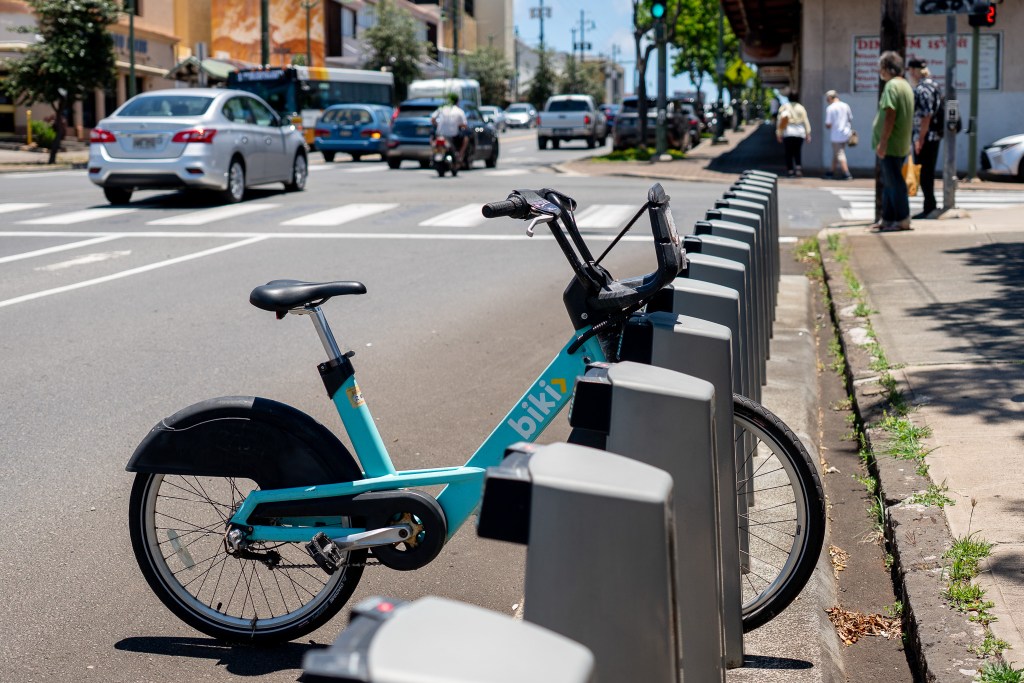
But time has not been kind to Biki. Vandalism along with normal wear and tear has depleted the fleet to less than half its original size. Only 478 bikes remained by the end of April, according to city spokesperson Travis Ota, a 60% drop.
People who want to use bikes often can’t find one, making it harder to generate needed revenue and trapping the system in a sort of doom spiral.
“It’s really frustrating that it’s not a reliable form of transportation,” frequent Honolulu visitor Josiah Ryan said.
Officials at the Department of Transportation Services declined an interview, saying they are working on pending contracts and therefore limited in what they can say. In a written statement, Director of Transit Jon Nouchi said the city’s goal is to eventually restore Biki’s fleet to its former heights.
“We also remain interested in expanding Biki service beyond its current service area into additional parts of urban Honolulu,” he said, “helping connect more residents and visitors to jobs, transit, and other destinations.”
Council member Tyler Dos Santos-Tam submitted a budget amendment in early May to direct $800,000 toward the Office of Climate Change, Sustainability and Resiliency for Biki, though he said Tuesday he doesn’t know whether council budget chair Val Okimoto plans to approve it. Okimoto did not respond to a call and text for comment. A final vote on the budget is scheduled for Wednesday.
‘The Poorest-Working System That I’ve Used’
Biki’s most recent ridership report says roughly 800,000 Biki rides were taken in 2023, 62% of which were taken by residents. At the time, it said, the fleet boasted 1,184 bikes. Biki hasn’t published a ridership report since.
But Ryan noticed a drop in reliability in January 2025, he said, “and then it got much, much worse when I was here two months ago.”
Compared to other cities he’s traveled to for work – like Los Angeles, San Francisco, Mexico City, Milan, and Washington, D.C., he said, “the Biki system is the poorest-working system that I’ve used.”
It probably works more often than not, Ryan said, but too often it’s a tossup. Bikes sometimes display on the city’s online map as available when the station they’re at turns out to be out of order, he said. Other times, the diminished fleet means no bikes are available in the immediate vicinity at all.
Some systems like New York’s CitiBike invest in redistribution programs to prevent some stations from emptying out while others overflow. But Biki lacks that option.

Within a 15-minute walk of the University of Hawaiʻi Mānoa Campus Center, for example, six Biki stations contain a total of 117 slots for bikes. On a recent Tuesday morning, however, only one bike was available.
“It’s not really a system,” Ryan said, explaining that he once rode a Biki to Kaimukī but when he wanted to leave, there were no bikes in sight. “There’s no other stations around. So if you bike up there, and you only brought one bike and someone else took it, that bike is gone, you’re stranded.”
Paying is another issue, he said. The station kiosks don’t have tap-to-pay, and swiping your credit card so the system recognizes it sometimes takes a special touch that he had to practice. Another option is to use the app – which is called PBSC, not Biki – though Ryan said he struggled to find it in the app store the last time he tried.
“That’s another reason that they’re losing revenue,” he said. “They don’t even know how to take money from people.”
‘An Essential Part Of Our Transportation Network’
This isn’t the first time Biki has teetered on the brink of failure. Like other bike-share systems around the country, Biki’s revenue plummeted during the pandemic. That, combined with supply chain woes and a spate of vandalism, brought its local fleet down to only 600 bikes in the spring of 2021.
Todd Boulanger, executive director of Biki’s then-parent organization Bikeshare Hawaii, said at the time that Biki might lose half its stations, though that was avoided after a subsequent rebound in ridership.
Two and a half years later, however, it hit another dip from which it still hasn’t recovered.
By 2024, insurance prices were going up for Biki’s for-profit partner, Secure Bike Share LLC, Boulanger said at the time. He wanted to purchase almost 300 additional bikes and to raise money, Biki increased fares starting that June.
Prices when it launched were $15 per month for unlimited 30-minute rides, $25 for unlimited 60-minute rides or $20 for a “Free Spirit” plan for 300 minutes worth of rides. Monthly costs went up to $25 and $35, respectively, with the more expensive option shortening its unlimited rides to 45 minutes. The popular Free Spirit plan went up to $55.
The cost of a single 30-minute ride, which had already gone from $3.50 to $4.50, rose to $5.

The company wanted to replenish its fleet with more bikes, including some with electric pedal assist to make biking less strenuous, though as of June 2026 that still hasn’t happened.
“They’ve got to be like the only big system in the world in a big city that doesn’t have electric bikes now,” Ryan said.
The city announced in late June 2024 it would take on oversight of Biki from Bikeshare Hawaii, leaving Secure Bike Share LLC in charge of operations and maintenance.
The takeover was via a one-year concessions contract that was supposed to last until the end of June 2025, and a city press release at the time said “riders will not notice any changes in system availability, operations, Biki accounts or customer support.”
In August 2025, council members approved a $1 million transfer from the new Climate Resiliency Fund to the Department of Transportation Services to boost Biki. Roger Morton, who heads the department, laid out his priorities in a letter to the council, in which he said he envisioned integrating bike-share with public transit, including by positioning stations closer to rail and bus stops and by allowing riders to use their Holo cards for Biki.
“Without public support, Biki faces the very real threat of shut down,” Morton said in his letter. “This appropriation is not about creating a luxury; it is about preserving an essential part of our transportation network.”
Morton told Hawaiʻi News Now in April that he thought Biki had about a 50% chance of survival.
Hawaiʻi Bicycling League executive director Travis Counsell said his group supports Biki, but he too declined an interview because contract negotiations are ongoing.
In a recent interview, City Council Chair Tommy Waters said he thinks the city’s transportation department should not operate Biki.
“I don’t think they have the staff to do it,” he said, saying it should go back to being operated by a nonprofit.
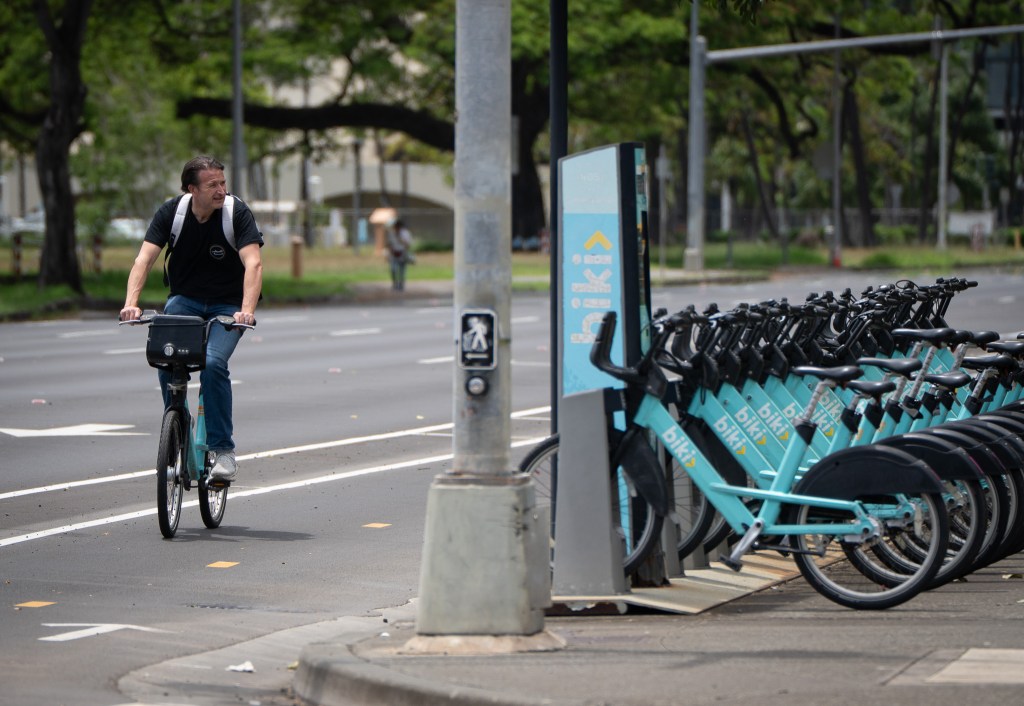
Kakaʻako resident Drew Buchanan likes Biki because it’s a fun way to commute downtown and because the system means he doesn’t have to lug a bike in and out of his apartment building to go places.
But he too has noticed Biki’s dwindling performance. In an ideal world, he said Biki should be financially successful, given how many tourists use them and those tourists’ increased likelihood to spend big.
If it fails, Buchanan said, “that’s one less thing for folks that need equitable access to transportation.”