Accused Puna Killer Faces Mental Health Evaluation. Here’s What That Means
Jacob Baker’s case has been suspended while examiners determine whether he is fit to stand trial for the murders of three people on the Big Island that sparked a manhunt. The process has proven to be controversial.
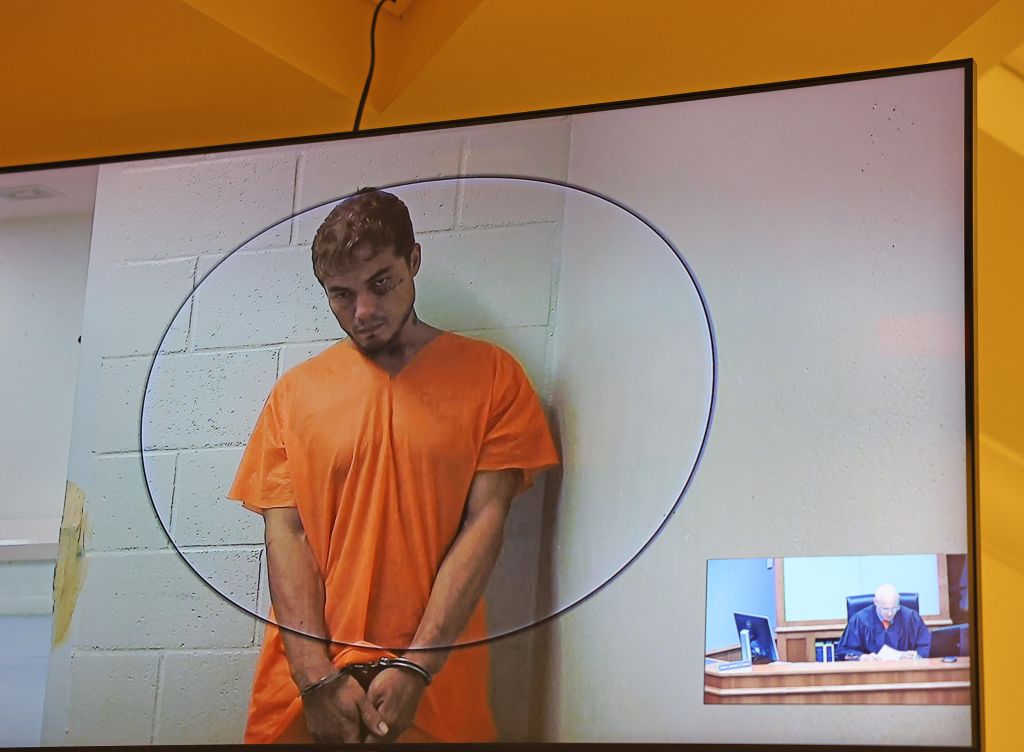
The defendant stared without blinking, his face gaunt and bruised, his eyes lifeless, his head tilted down and to the side. His lips moved as though he were talking to himself, but his muttering was inaudible in the courtroom where he appeared via video conference from jail.
Days earlier, police officers had pulled Jacob Baker shirtless from the woods in Puna after leading state and federal officials on a days-long manhunt. Now he stood in an orange jumpsuit facing charges for multiple homicides and a host of other alleged crimes.
“It is alleged that you have killed three people, all over the age of 60,” 3rd Circuit Judge Jeffrey Hawk said at the June 1 hearing. “These murders were committed in a particularly brutal and heinous manner.”
But there were questions about Baker’s mental state. Media reports said he had refused to engage with his defense attorney, prompting his attorney to ask for a mental health evaluation. His case, the judge announced, would be suspended while a panel of three experts established whether he was competent to stand trial.
It’s known as the 704 process, named for the section of Hawaiʻi law that governs mental health evaluations for people facing criminal charges. These evaluations are ordered in hundreds of cases across the state every year. But the complicated process is plagued by a lack of examiners, which can drag out cases and strain the psychiatrists and licensed psychologists who do this vital work.
Other recent high-profile cases have been slow to move through the courts because of delays in evaluations. Frank Bright sat at Oʻahu Community Correctional Center for more than seven months waiting for the court to rule whether he was fit to proceed after he was charged with killing his estranged wife, a teacher at a Honolulu charter school, in September. He was found fit in April but in May, his defense attorneys asked the court for another evaluation to determine his criminal responsibility. Two months later, it still hasn’t been completed.
Some cases drag on much longer. Henrietta Stone was in jail in Hilo for more than six years while doctors evaluated her mental health. One doctor found Stone fit to proceed while another disagreed. On other occasions, doctors couldn’t get records. She was found guilty last February – more than seven years after she was charged with manslaughter in the death of her 9-year-old granddaughter.
What Is Competency?
In felony cases, three experts conduct independent evaluations of the defendant’s mental state at the time of the legal proceedings and, often, at the time of the offense. The panel is made up of psychiatrists, licensed psychologists or qualified physicians, one of whom is an employee of the Court Evaluations Branch in the Department of Health’s Adult Mental Health Division. The others are private clinicians who are on the state’s list of approved evaluators.
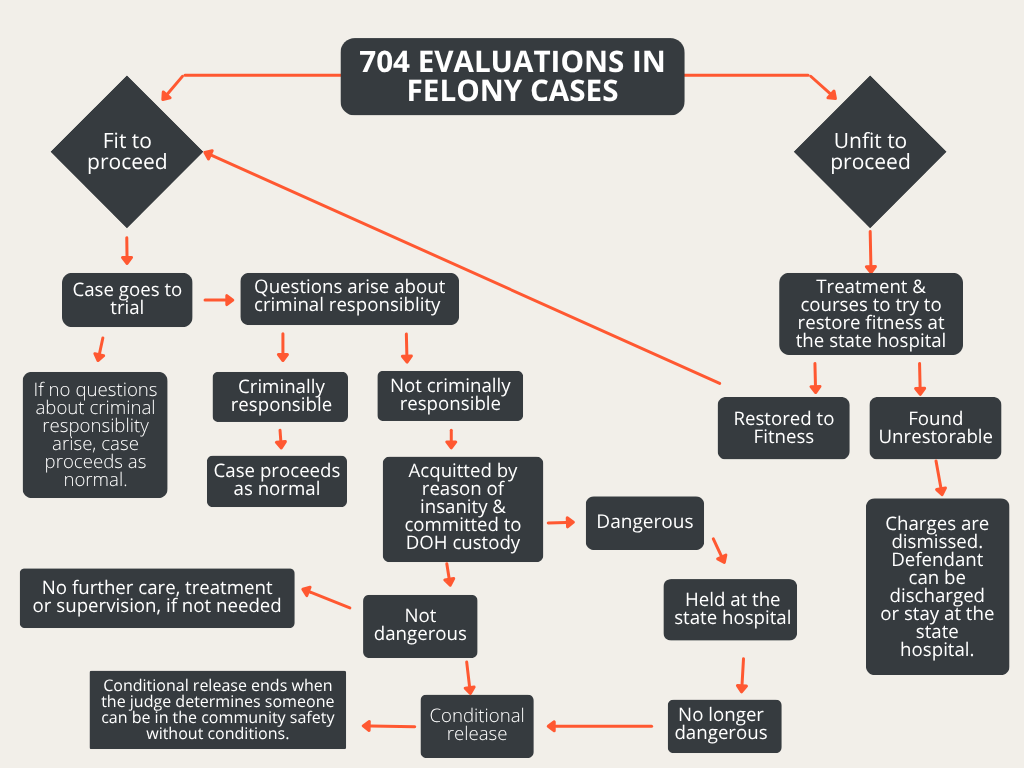
Their first task: determine whether the person understands the court process so they can aid in their own defense, a requirement known as fitness to proceed with trial. Evaluators are looking at whether the defendant understands the nature of the charges, what happens in court and potential penalties, according to Sheila Wendler, a clinical and forensic psychiatrist in Hawaiʻi who has performed dozens of evaluations.
It comes from the right to a fair trial established by the Sixth Amendment. “To be fair, the defendant needs to understand what’s going on,” Wendler said.
In addition to a conversation with the defendant, examiners review documentation, including the person’s medical and mental health records, police records and any records related to time they spent in the custody of the criminal justice system or the Department of Health.
In establishing someone’s fitness to proceed, evaluators test what defendants understand about the players involved in the legal process.
“Do they know that the judge is neutral? Do they know that the prosecutor is a lawyer representing the government that will try to prove them guilty, so the prosecutor is adversarial?” she said. “Is the defendant able to understand that their defense attorney is there to help them? Sometimes mistakenly they believe that the defense attorney is against them.”
Examiners present their findings to a judge, along with a diagnosis of the defendant and a determination of whether the person is too dangerous to release from jail. If the defendant is found fit, the case can go to trial. A defendant determined to be unfit is often moved to the Hawaiʻi State Hospital to undergo mental health treatment and classes to try to get them fit to stand trial.
The public often misunderstands this outcome as a “get out of jail free” card, Wendler said. In felony cases, being found unfit doesn’t mean the charge is dropped, she said.
The process played out this year in the high-profile case of BJ Penn, the former UFC fighter. Penn is accused of assaulting his mother in 2025. The court ordered a mental health evaluation after he claimed imposters replaced his family members. Penn was found fit to stand trial in May. His case is ongoing.
For those found fit to proceed, the next step is to establish criminal responsibility. Evaluators diagnose defendants to determine whether any mental illness or developmental disabilities impacted their state of mind at the time of the offense.
The goal is to answer two questions. Did the person have the cognitive capacity to understand that what they were doing was wrong? And did they have the ability to control their behavior to conform to the law?
Patients might be delusional or struggle to control their impulses, Wendler said. One patient at the Women’s Community Correctional Center, where Wendler was working with inmates, grew agitated in court. In front of the judge, the patient grabbed the psychiatrist by the hair and slammed her head into the table several times.
“This is a person that can’t control her behavior,” Wendler said. “If you cannot control in front of a judge, you cannot control in front of anybody.”
Drugs complicate the question of criminal responsibility. Under Hawaiʻi law, intoxication at the time of the alleged crime prevents defendants from arguing they were not criminally responsible. But drugs like meth can permanently alter someone’s brain.
If the defendant is found to be criminally responsible, the case goes to trial. If not, the defendant is acquitted.
Not guilty by reason of insanity doesn’t necessarily mean the person returns to the community. If they are considered dangerous, they are taken to the Hawaiʻi State Hospital until they can be safely released.
Six years ago, 27 people were admitted to the state hospital after being found not guilty by reason of insanity. That number dropped to 12 – a 56% decline – between July 2024 and June 2025, according to data from the Department of Health. That number doesn’t include people who were brought to the state hospital before their competency was determined.
Some patients are later released under the condition that they get treatment and stay out of trouble. Ten people were discharged from the state hospital on conditional release from July 2024 to June 2025, according to the most recent annual report by the health department.
But some can be held at the hospital for years, or even decades. According to the most recent single-day count on June 30, 2025, 49 patients were admitted to the state hospital after they were found not guilty by reason of insanity. On average, they had been at the hospital for more than eight years. Those patients made up 13% of the overall census at the state hospital.
In the Big Island triple homicide, Baker was interviewed by evaluators on June 19 by telephone while he was in custody, according to court records. The three experts are set to file their reports by Aug. 4, and he is due back in court on Aug. 11.
Too Few Examiners Slows Down Cases
The 704 process has historically posed a challenge for the courts, in large part because there aren’t enough medical professionals. As the number of cases requiring an evaluation has ballooned, the number of psychiatrists and psychologists willing to do them has dwindled. Statewide, just 16 people take on these evaluations, according to the state health department. Roughly 1,400 evaluations are ordered statewide each year.
In the 2010 fiscal year, 15 examiners handled 142 evaluations in the First Circuit on Oʻahu, Judge Ronald Johnson wrote lawmakers on behalf of the Judiciary last year. By 2025, the number of examiners had dropped by more than half to six.
The number of evaluations reached 169 between July and December 2024, surpassing the annual total of 15 years earlier in just six months at an average of 28 new orders a month. That meant each of the six examiners was juggling nine evaluations per month.
Statewide, the health department’s seven examiners handled an average of 51 evaluations a month between July 2025 and June 2026, according to the department.
The Legislature has for years considered decreasing the required number of examiners on each panel. Hawaiʻi is unique in requiring three examiners in felony cases, according to Marvin Acklin, a clinical and forensic psychologist who has handled hundreds of 704 evaluations in the state.
A bill last year faced significant opposition. Public defenders argued that because examiners don’t always agree, having multiple opinions is important to getting things right. The Judiciary pointed out that the statute allows for defense attorneys to call their own experts, which could create a stalemate and drag out the case.
Acklin’s research found that the three-panel system is key to fair outcomes.
“They try to dismantle it every year, but the reality is that when you have three examiners, you likely generate highly reliable forensic opinions where the court can then weigh the evidence across the three examiners,” he said. “You get higher reliability. It’s a higher quality of justice.”
Lawmakers also doubled the pay to $2,000 per examination. The rate for 704 competency evaluations had been stuck at $1,000 since 2008, significantly lower than what a forensic examiner would make in child custody, workers’ comp or civil tort cases.
Despite the change, the number of private examiners statewide willing to take these cases hasn’t budged, according to the Department of Health.
Each competency examination takes about nine hours, according to written testimony to lawmakers last year from Alex Lichton, the president of the Hawaiʻi Psychological Association.
“Many have taken their name off the list due to low payments. Others have capped the number of cases they are willing to accept each month and have restricted their practice to just one or two counties,” Lichton wrote.
The shortage of examiners causes cases to drag on. In 2010, court-ordered exams on Oʻahu were typically completed within eight weeks, according to Johnson, compared to 12, 16 or even 24 weeks in recent years.
Examiners, including those from the Department of Health, often ask for extensions.
“The extensions requested are in degrees of months and weeks, not days,” Johnson wrote in testimony to lawmakers last year.
That means defendants are held at the state hospital or in jail “for far longer than they would be if examinations were timely,” he said.
Wendler had handled dozens of cases as a forensic psychiatrist before she took her name off the list several years ago. Pay aside, the whole ordeal was frustrating, she said. Sometimes, the jail would turn her away even though she had an appointment to interview a defendant. She wasn’t allowed to make copies of documents and had to write hundreds of pages by hand. If the defendant wasn’t in custody, she’d have to do evaluations in her office, which didn’t always feel safe.
“I will not go back. There is no way,” she said. “I know there is a lack of psychiatrists, but I have my limits, I couldn’t do it.”
Others have limited their practice to just certain islands. Acklin, for example, takes cases from the Big Island, but not Oʻahu. Still, he sees the importance of the work.
“It’s an awesome system,” he said. “It’s very expensive. But it guarantees people’s constitutional rights.”
Civil Beat’s health access reporting is supported in part by the Atherton Family Foundation.