Another Delay For Honolulu Rail? The Timeline Appears To Be Slipping Again
A consultant that monitors the project for the Federal Transit Administration reports the entire rail line will probably open a year later than the city planned.
An assortment of design and construction problems on the Honolulu rail project may push back the opening date for the last segment of the 18.9-mile Skyline system by more than a year, to April of 2032, according to a report by an outside consultant that oversees the project for the Federal Transit Administration.
The Honolulu Authority for Rapid Transportation is still aiming for an opening date of March 31, 2031 for the entire Skyline system, but HART Executive Director Lori Kahikina acknowledged in a board of directors meeting Friday it will be a challenge to stick to that schedule.
Kahikina described the latest estimate of the rail construction timeline as “our no float schedule,” with only 100 days of flexibility left in the schedule as a cushion in the event something does not go as planned.
“You folks understand how construction is,” she told the board. “With no float, that means everything has to be perfect — no glitches — to reach our revenue service date of 2031. Right now if you look at our schedule we still are on to meet that 2031, but again, that’s with no float.”
The HART board on Friday also approved a $53 million change order with Hitachi Rail Honolulu JV to compensate the contractor for costs associated with years of delays and for changes to the scope of the original contract.
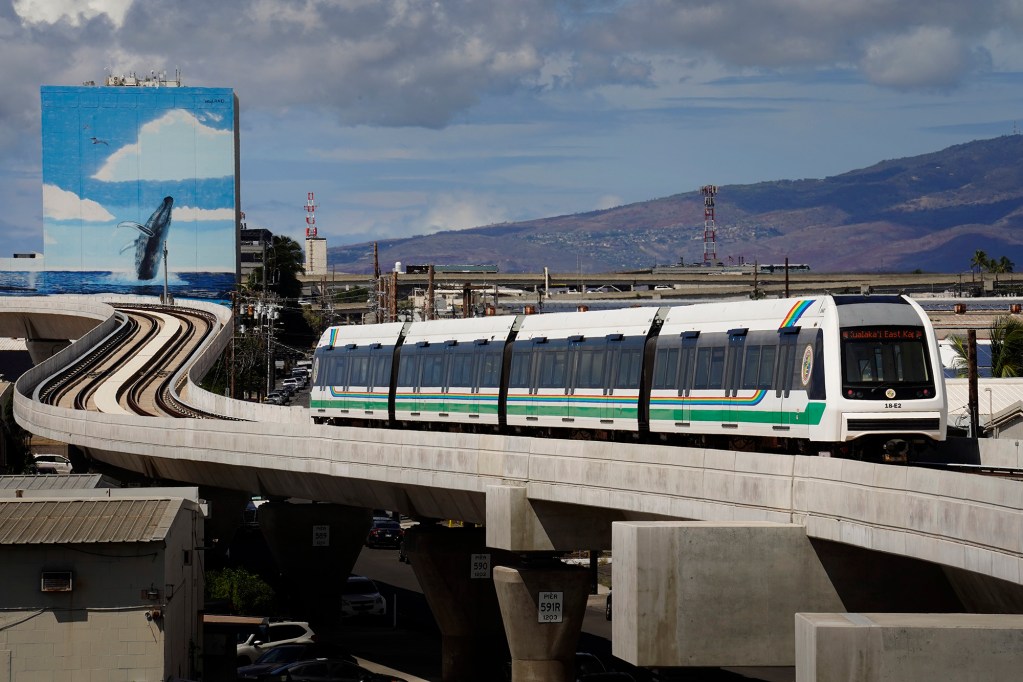
The Honolulu rail project was budgeted at about $5 billion when construction began in 2011 but the price has ballooned to about $10 billion, in large part because of costly delays. The line was originally supposed to run from East Kapolei to Ala Moana Center, but the city finally decided to shorten the rail line to end it in Kakaʻako to try to cut costs.
Rail was originally supposed to be completed by 2020, but FTA consultant Hill International Inc. indicated in its latest report there is now a 65% probability the city center rail segment from Middle Street to Kakaʻako won’t actually open to the public until the spring of 2032.
Corey Ellis, HART’s director of project controls, said much has changed since 2022 when HART and the FTA settled on the March 31, 2031 opening date. For example, contractor Tutor Perini was hired later than HART had expected to build the city center segment, which includes three miles of elevated rail line and six stations through the city center.
The Hill report notes utility relocation contracts in the downtown area were also delayed, and Tutor Perini has had some problems drilling shafts for the rail supports. Kahikina said Tutor is drilling into material that has presented difficulties, and drilling casings got stuck during work on both Dillingham Boulevard and Nimitz Highway.
A key variable that affects the schedule, Ellis said, will be when HART can to turn over the finished city center guideway and stations to rail contractor Hitachi so Hitachi can install the rail operating system, communications and other electronic components.
“That’s going to be the driver ultimately of our operational readiness date,” Ellis told the board.
He told the board that HART does not expect that a delay would increase the cost of the project. “We believe we can absorb some schedule slip and it’s still within our same costs,” he said. He said HART is trying to confirm that with the FTA.
Kahikina declined a request for an interview Friday, but HART issued a written statement noting there have been no official changes to the project schedule.
“Any potential schedule delays discussed were theoretical in nature and would be years away from realization,” according to the statement. “Evaluating risks and developing mitigation strategies well in advance is a best practice for projects of this magnitude and is critical to safeguarding both the schedule and budget.”
A Hefty Change Order
The change order approved by the HART board Friday increases Hitachi’s contract from $1.726 billion to $1.779 billion, which includes designing, installing and maintaining the Skyline operating system as well as providing the rail cars and running the trains.
Vance Tsuda, project director for HART, said the change order is necessary to compensate Hitachi for design changes the company had to make when the rail alignment was changed along Dillingham Boulevard, and when the city opted to end the rail line in Kakaʻako instead of continuing to Ala Moana Center.
The change order also covers costs associated with delays to the project including price escalations, the cost of storing equipment and materials, and payment for extending the contract, Tsuda said. Hitachi was originally supposed to have completed its work designing and building the system in 2024, and the change order extends its contract to 2029.
Tsuda said the change order also includes funding for an “obsolescence study” by Hitachi of rail system components that have already been installed. Some of the equipment installed in the rail segments that extend from East Kapolei to Middle Street may be considered “end of life,” he said, because it is no longer manufactured or supported for maintenance purposes.
“Because time has gone for so long, a lot of the equipment and material that was installed in segment 1 and segment 2 was designed a long time ago,” Tsuda told the board, “and we need to verify whether or not that equipment will be compatible with equipment that’s available on the market today.”
Hitachi sued HART in 2024 over previous rail project delays in a lawsuit that seeks $324 million in damages, and HART filed a counterclaim late last year accusing Hitachi of breach of contract and violations of Hawaiʻi’s False Claims Act. The change order approved by the HART board Friday does not resolve that litigation, which is still pending.