Facing A Competitive Reelection, Honolulu Council Chair Pitches Tax Breaks
The Blangiardi administration is concerned about a significant hit to city revenue.
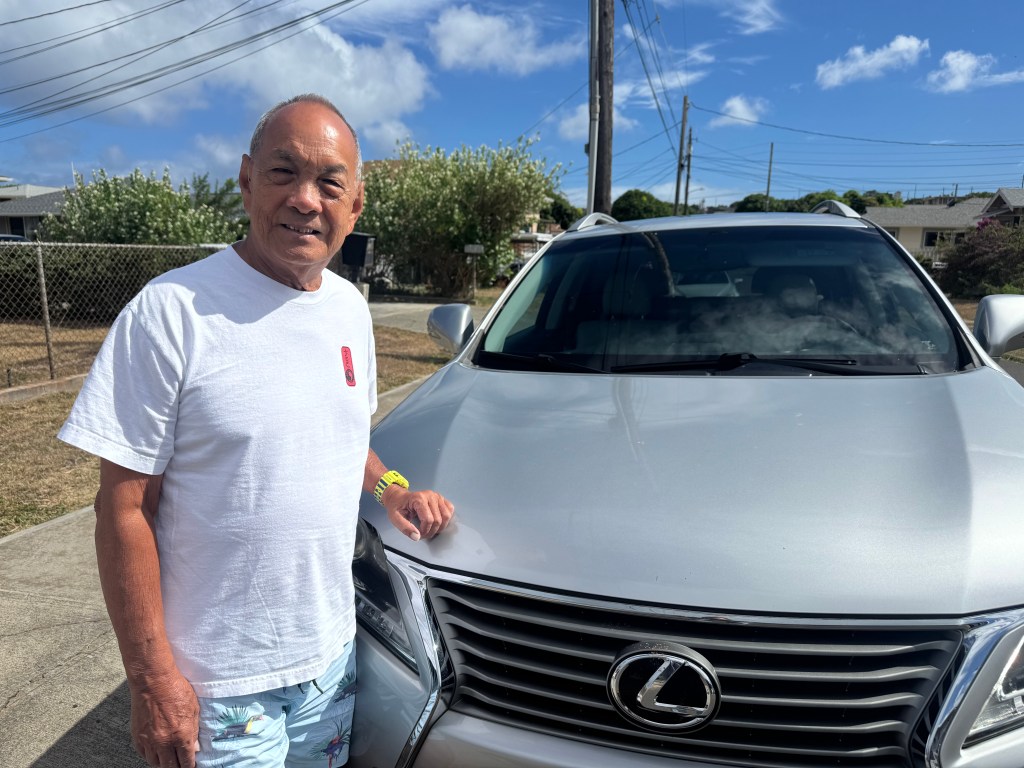
For Kaimukī resident Creig Lam, 82, a lower tax on his vehicle would come as welcome news.
“I would love it,” said Lam, who said he paid about $400 this year for the annual tax on his Lexus SUV.
That may come soon. As Honolulu City Council Chair Tommy Waters campaigns for a third term, he is floating the idea of tax breaks for island homeowners and drivers that would save residents money but could reduce city revenue by too much for the city administration’s liking.
The cost savings for residents would be modest — about $65 per year for drivers of Toyota Tacomas, $70 per year for homeowners — but Waters is arguing it would help people drowning under rising costs.
Honolulu Mayor Rick Blangiardi’s department heads oppose the bills. They say the lost revenue would prevent them from completing crucial services like road repair and streetlight maintenance.
“I do understand Council’s intent,” Department of Customer Services Director Kim Hashiro said at a budget committee meeting last week. “But I have not supported any kind of reduction in fees.”
Waters is running for reelection in what is shaping up to be a competitive race against former council member Trevor Ozawa along with political newcomers Jason Liang and Tara Malia Gregory. In the race, Waters is selling himself as a candidate who cares about making everyday life more affordable.
“We don’t have control over the cost of food, or medicine, or other expenses,” Waters said at last week’s meeting when discussing one of the bills. “But we do have control over your property taxes, and that’s what this bill does.”
He added: “That way you have more money in your pocket to support your family and take care of daily needs.”
Waters declined interview requests for this story.
These kinds of proposals tend to crop up during election time, said Honolulu Budget and Fiscal Services Director Andy Kawano.
“He’s campaigning,” Kawano said of Waters.
Waters’ affordability message is the most effective issue to highlight during his reelection campaign, according to a Tulchin Research poll commissioned by the political action committee For A Better Tomorrow, Hawaiʻi’s biggest super PAC that is funded by the Hawaiʻi Carpenters Market Recovery Fund.
The poll says Waters maintains a strong lead against Ozawa, the runner-up in the poll, but that about one in three voters remain undecided. Introducing bills to tackle the cost of living helps Waters’ campaign, University of Hawaiʻi political scientist Colin Moore said.
“They’re measures that will marginally reduce people’s tax burdens,” he said. “That’s a great message to campaign on when affordability is at the top of mind of most voters.”
Savings For Drivers
The bills would reduce property taxes and vehicle weight taxes.
Driving a personal vehicle is not a choice for many Oʻahu residents, Waters said in a written statement, and it’s the government’s responsibility to help struggling residents when it can.
“After a careful review of the City’s budget and special funds, I believe we can use resources already collected and set aside to provide meaningful relief without compromising essential public services,” he said.
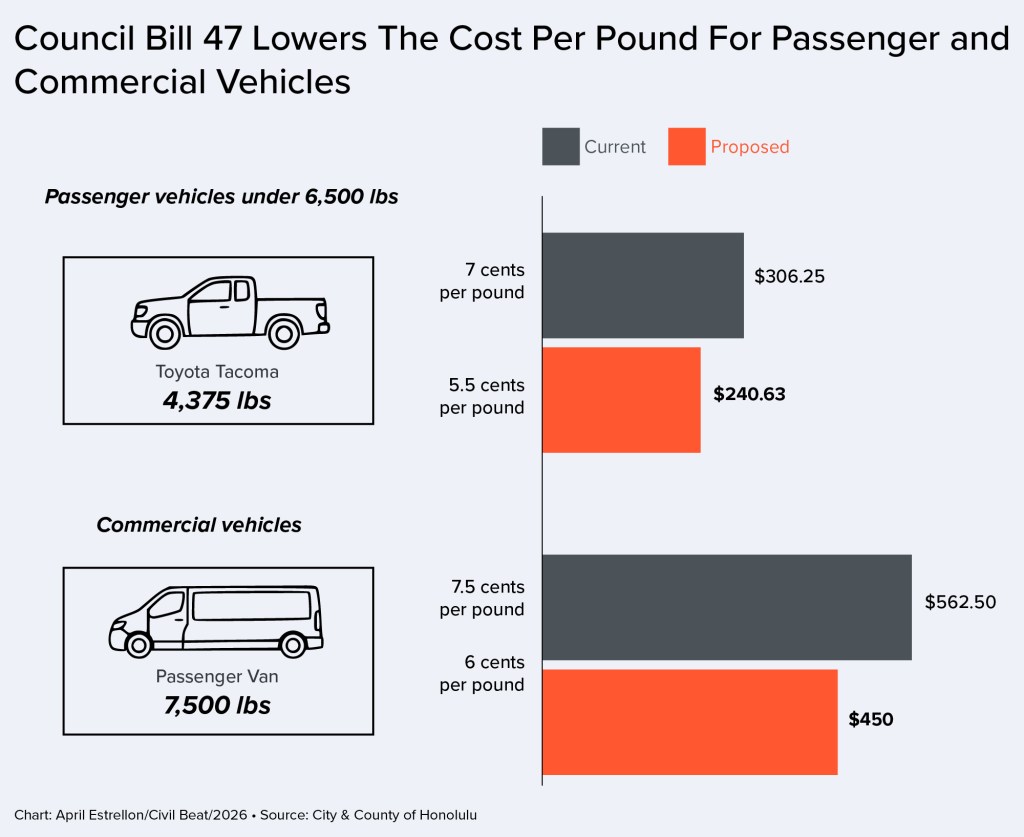
Currently, the city taxes ordinary passenger vehicles at $0.07 per pound, meaning the owner of a Toyota Tacoma that weighs 4,375 pounds pays $306.25 each year in vehicle weight taxes.
Waters’ Bill 47, which would lower the charge by more than 20% to $0.055 per pound, would reduce that tax to $240.63 —about a $65 savings.
Similarly, the tax on commercial vehicles would fall from $0.075 per pound down to $0.06 per pound. For a 10,000-pound truck, that would be a $150 savings.
“It’s not insignificant, right?” Waters said at last week’s meeting. “It’d be major savings for people.”
Hashiro, whose department includes the Division of Motor Vehicles that collects vehicle weight taxes, told council members the lost revenue of $20 million to $30 million would strain the city’s ability to maintain roads, streetlights, bikeways and mass transit.
Vehicle weight taxes contribute roughly $190 million to the city each year, according to recent budget documents.
There could be a ripple effect, Hashiro said, since federal transportation funding for city projects often mirrors how much funding the city can commit by itself.
“For transportation funding,” Hashiro said, “that’s significant.”
Lam, the Kaimukī resident, was initially concerned the reduced revenue might mean less road maintenance, a topic that has recently been on his mind.
“Potholes are just part of life here,” he said. “But after the Kona lows, it was just really miserable.”
But he agrees with Waters that the city can make up the lost revenue from elsewhere.
“Just take the money from rail,” he said.
Fellow Kaimukī resident Rochelle Arruda, 34, said she also welcomes lower vehicle weight taxes.
The red Tesla SUV she and her husband own has a heavy battery, adding to the weight that’s used to calculate their annual tax of roughly $300 on the car. She said she understands heavier cars cause more wear and tear, but she too agrees with Waters’ idea that the city can be more efficient with how it spends money.
“If we know we don’t have a lot of wiggle room,” she said, “let’s make sure we spend that money wisely.”
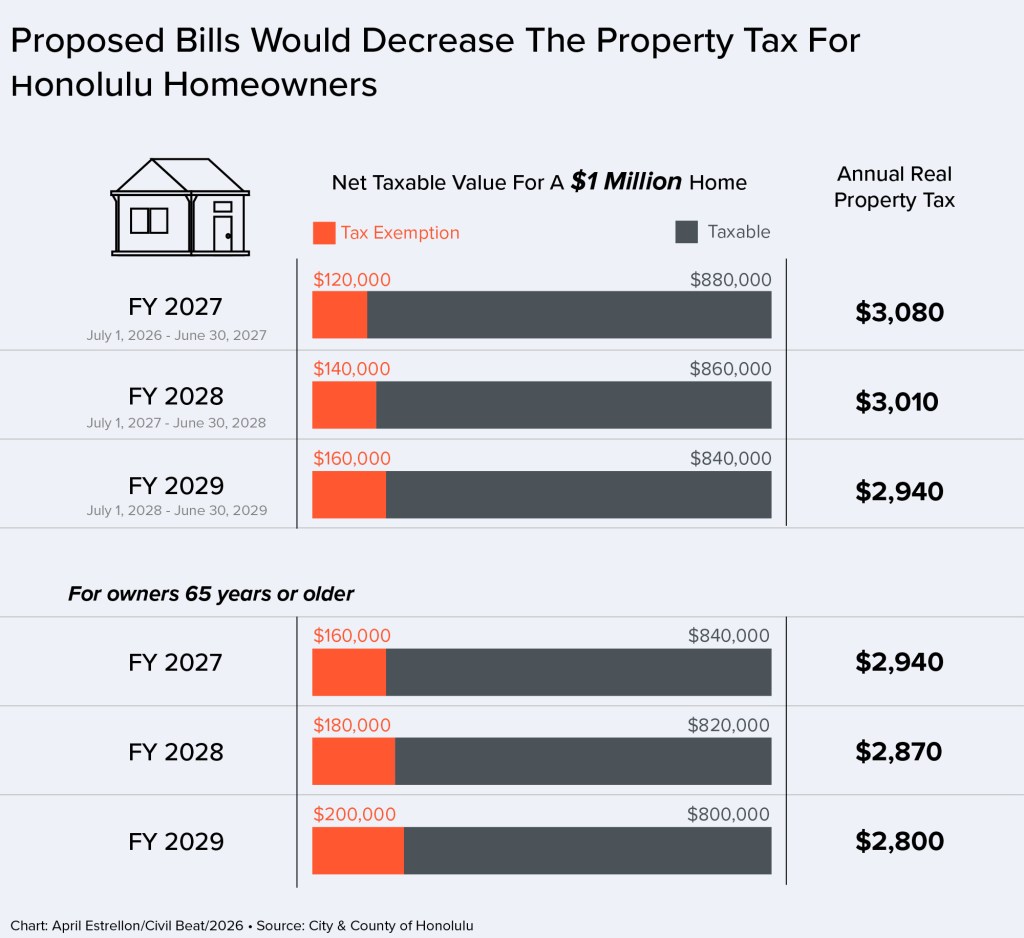
Home exemptions are somewhat more technical, but their goal is simple: lower property taxes for people who live in their homes. Waters’ bills aim to increase the amount of a home’s value that is exempt from taxes, thereby saving owners money.
“Homeowners should not be priced out of the communities they have spent their lives building simply because the value of their property has increased,” Waters said in his written statement. “We have held property tax rates steady, but that alone is not enough when higher assessments continue to drive up tax bills. These bills provide direct relief to homeowners and greater protection for our kūpuna.”
Homeowners under the age of 65 currently receive a property tax exemption of $120,000, which will increase to $140,000 by next year. Homeowners over the age of 65, who often are on fixed incomes, receive a home exemption of $160,000, which is set to increase to $180,000 by next year.
Under Bills 45 and 46, property tax exemptions would increase by another $20,000 in 2028.
Every $20,000 increase to the home exemption translates to $70 per year in savings for homeowners, or about $5.83 per month. And taxpayers would appreciate that, city budget director Andy Kawano acknowledged at last week’s meeting.
“At the same time,” he said, “our responsibility at BFS is to balance things and ensure we’re able to fund programs.”
Those exemptions would translate to about $11 million in lost annual revenue, according to Kawano.
All three bills have passed the first of three readings at the City Council. They would need five votes to pass, or six votes to have a veto-proof majority.
Lower City Revenue
Waters thinks the administration can find a way to make up for lost revenue.
“We lapsed $200 million last year,” he said at the meeting. “Two hundred million dollars that could go back into taxpayers’ hands – if we pass Bill 45 and 46.”
Kawano, however, warned Waters and other council members that part of the reason the city lapsed so much money was because of massive federal stimulus programs from the Covid-19 pandemic. In addition, he said, inflation was high coming out of the pandemic, giving the city income from cash it holds on the side for investments.
“We don’t know where all of that’s going to go,” Kawano said, “and we’re definitely not going to get a lot of funding from the federal government. It’s the opposite now.”
Kawano said in an interview after last week’s meeting that the lapsed money – which he thinks will not occur again in such large volumes – helped strengthen the city’s credit rating, making it cheaper to borrow cash.
“So there’s a positive aspect there too,” he said.
Mayor Blangiardi signed legislation last year that raised the homeowners exemption – also introduced by Waters, along with councilmember Val Okimoto – but it’s unclear whether he would support Waters’ latest bills.
Last year, when the administration pushed to massively increase sewer fees bills in order to cover federally mandated upgrades to Oʻahu’s systems, Waters tried – but failed – to push back.
In a written statement, Blangiardi’s communications director Scott Humber said the mayor has concerns about the bills’ impact on the city’s finances. He said Blangiardi will weigh these concerns if council members pass the bills.
“At this stage,” Humber said, “it would be premature to speculate on whether he would sign or veto them.”
CORRECTION: An earlier version of this story misstated the source of funding for the super PAC For A Better Tomorrow.